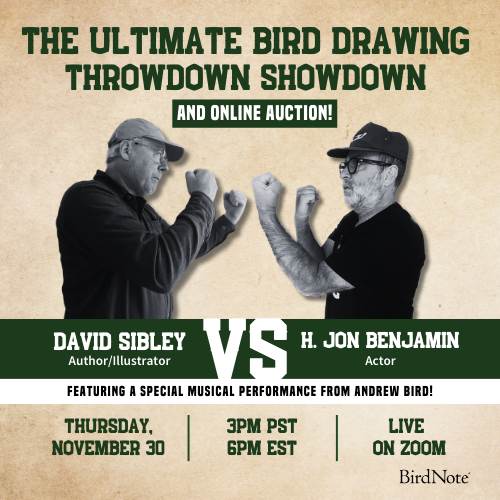
Image: The Ultimate Bird Drawing Throwdown Showdown Graphic featuring images of David Sibley and H. Jon Benjamin

Join BirdNote tomorrow, November 30th!

Illustrator David Sibley and actor H. Jon Benjamin will face off in the bird illustration battle of the century during BirdNote's Year-end Celebration and Auction!

RESERVE YOUR SPOT

Shows With Contributions by Dennis Paulson

Chestnut-backed Chickadee

Why Do Chickadees Come and Go?

A chickadee comes in to the feeder, quickly grabs a seed, and flies away. It may return immediately, but it's more likely to wait its turn. When a whole flock of chickadees moves into the yard, it looks as if they form a living conveyer belt. One chickadee after another flies to the feeder…
Domesticated rooster and hens

The Pecking Order

Birds in flocks almost invariably develop a pecking order. An alpha chicken can peck any other in the flock, and a beta chicken can peck all others but the alpha bird. Juncos and other small birds have a pecking order, too. The pecking order – or dominance hierarchy – of a flock of birds…
American Wigeon glides across water

American Wigeon

The American Wigeon is a grazer. Its bill is narrow, with a pointed tip like that of a goose. When feeding on water plants, a wigeon grabs a leaf and rips it off with its strong bill, rather than using the straining apparatus typical of dabbling ducks. Take a field trip with your local…
Rainbow Lorikeet foraging on flowers

Birds as Pollinators

Birds are part of the complex web of Nature, and each fits into this web in its own way. Some even pollinate flowers! While feeding at a flower, this Rainbow Lorikeet gets pollen on its forehead and throat. When it visits another flower of the same species, it transfers the pollen to that…
Pair of Wood Ducks

Wood Ducks Succeed

Your eye may be drawn to the gorgeous male Wood Duck, but it is the call of the modestly plumaged female you’ll hear. This call tells the male where his mate is, important as the pair stays together through much of the winter and spring. Wood Ducks are among a small number of North…
Black-necked Stilt foraging

Black-necked Stilt - The Bird with Outrageous Legs

Visit a shallow wetland in summer, and you might see this slender, black-and-white shorebird with outrageous red legs. The Black-necked Stilt uses its long legs for wading as it feeds on tiny insects and crustaceans on the surface of the water. Stilts are sensitive to drought, which has…
Indigo Bunting showing its vivid blue plumage, pale wide beak and dark legs as it stands on a wet branch.

Indigo Bunting – Bird of the Ecotone

Many birds – like this Indigo Bunting – can be found in ecotones, the borders between two habitats. Indigo Buntings breed in the ecotone between forest and meadow. They are common at Muscatatuck National Wildlife Refuge in Indiana, where grassland and forest are interspersed to produce…
Closeup of a California Thrasher perched in a shrub in bright sunlight

Un chaparral único

La densa capa de chaparral costero alberga muchas aves que no se encuentran en ningún otro lugar del mundo, incluido el cuicacoche californiano. Las especies de plantas son diferentes, pero el chaparral de California se parece mucho a la vegetación costera de arbustos del sur de Europa…
Wilson's Snipe

Two Wings and a Tail

The Wilson's Snipe lives in marshes and muddy areas, where it probes for worms and other squirmy delights. But when spring comes, it takes to the air. The male Wilson's Snipe circles high above in a series of roller-coaster arcs, each descent marked by a loud and distinctive sound. This…
A Golden-crowned Kinglet perched on a branch, its tiny round body accented with gold stripes on wing and a streak of gold feathers on its head

Kinglets in Winter

The Golden-crowned Kinglet weighs six grams, about the same as two pennies, yet winters as far north as Alaska and Nova Scotia. The birds move through the forest in small flocks and feed constantly, taking in enough tiny caterpillars to maintain their internal furnace at 110°F. And their…