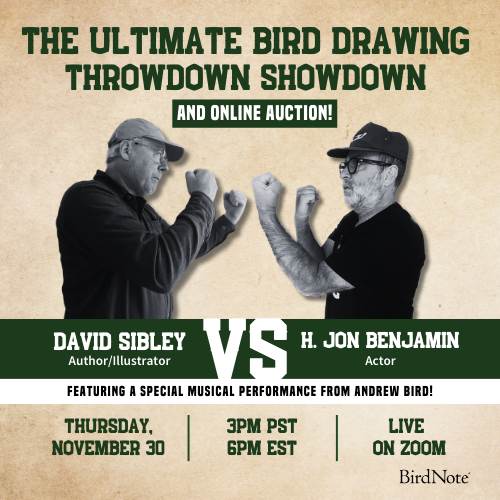
Image: The Ultimate Bird Drawing Throwdown Showdown Graphic featuring images of David Sibley and H. Jon Benjamin

Join BirdNote tomorrow, November 30th!

Illustrator David Sibley and actor H. Jon Benjamin will face off in the bird illustration battle of the century during BirdNote's Year-end Celebration and Auction!

RESERVE YOUR SPOT

Shows With Contributions by Dennis Paulson

Prothonotary Warbler

Okefenokee Swamp and Prothonotary Warbler

The Okefenokee National Wildlife Refuge was set aside to protect the fabled Okefenokee Swamp of Georgia and Florida. Tall cypress trees and Spanish moss give the swamp a prehistoric appearance. The Prothonotary Warbler is one of the most striking of the swamp’s denizens. Having wintered in…
Yellow-billed Cuckoo with caterpillar

Cuckoos – Tent Caterpillar Birds

The Yellow-billed Cuckoo, one of two species of cuckoos in North America, lives in broadleaf forests throughout the East and riparian stands in the Southwest. Cuckoos were common breeding birds in the Pacific Northwest as late as the 1920s, but then they disappeared. The Black-billed…
Song Sparrow

Mating for Life

Most bird species in North America mate for a single breeding season. Some may team up again the following year, just because both stay in - or return to - the same territory. Fewer than one-fifth of Song Sparrow pairs are reunited. Hawks, eagles, and ravens have wide territories, thus few…
Lewis's Woodpecker

Lewis's Woodpeckers and Pine Forests

A century of logging and fire control has taken its toll on the mature pine forests of the West, the preferred nest site for this Lewis's Woodpecker. But there is hope. Lewis's Woodpeckers also nest along rivers in large cottonwoods, trees of little value for timber. Also, many remaining…
Red-breasted Sapsucker clinging to side of tree, the bark with small holes pecked in it

Sapsuckers

Sapsuckers drill small holes in the bark of favored trees, then return again and again to eat the sap that flows out. And hummingbirds, kinglets, and warblers come to the sap wells to eat the insects trapped in the sap. Although a sapsucker, like the Red-breasted Sapsucker pictured above…
Long-billed Curlew coming in for a landing with wings outstretched

Long-billed Curlews Whistle from the Sky

Long-billed Curlews are the largest shorebirds in North America. In his courtship display, the male Long-billed Curlew flies a series of arcs across the sky, calling as he goes. Outside of the breeding season, they roost and forage in mixed flocks. When the flock is disturbed, the curlews’…
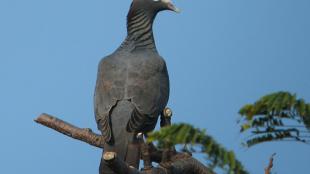
White-crowned Pigeon sits on a branch, with clear blue sky background

The White-crowned Pigeon

The Florida Keys extend from the state's peninsula like a string of pearls, and pearls they are, in their uniqueness and value. Stands of hardwood trees rise above the islands' level ground. These trees draw many birds of the Caribbean to the keys' tropical habitat. One of these is the…
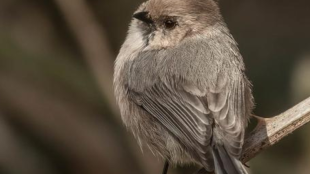
Un pajarito marrón llamado sastrecillo se sienta sobre una caña

Sastrecillos: Un cantante pequeñito

Con un peso similar al de cuatro clips, los sastrecillos ( Psaltriparus minimus) son más pequeños que muchos colibríes. Y aprovechan al máximo su diminuto tamaño. Mientras otras aves insectívoras buscan alimento sobre las hojas, los sastrecillos cuelgan por debajo, atrapando a los insectos…
Greater Yellowlegs wading in shallow water

Shorebirds Watch Their Feet

Greater Yellowlegs — not surprisingly — have bright yellow legs and feet. And why? While foraging through shallow water, a yellowlegs can keep track of its legs by the color, which contrasts with the sometimes dark and irregular bottom. A Sanderling, on the other hand, has black legs and…
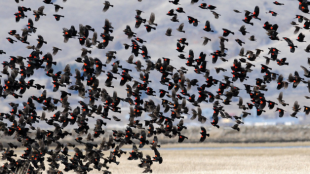
Red-winged Blackbirds flocking

Why Are Blackbirds Black?

Why are blackbirds black? One possible answer is that black is conspicuous against just about all of Nature's backgrounds. Blackbirds, like this flock of Red-winged Blackbirds and Yellow-headed Blackbirds, feed on the ground. Whenever a predator approaches, they take flight. Coming…