
Join BirdNote tomorrow, November 30th!
Illustrator David Sibley and actor H. Jon Benjamin will face off in the bird illustration battle of the century during BirdNote's Year-end Celebration and Auction!
How Jays Helped Restore an Oak Forest
Some seed-dispersing birds are inadvertent gardeners.

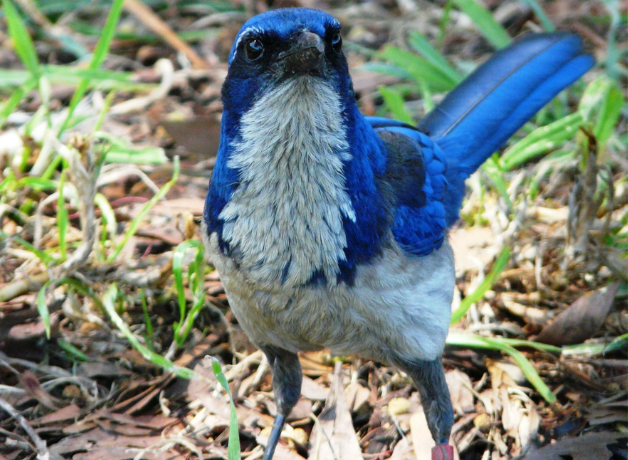

© Kirk Waln/US Fish and Wildlife Service
Corvids, like crows and jays, are known for caching seeds instead of eating them immediately. Sometimes, those seeds take root before the birds return. Mario Pesendorfer, a forest and behavioral ecologist at BOKU in Vienna, says that’s what happened on Santa Cruz Island in southern California. It’s part of Channel Islands National Park where native shrub oak habitats were largely decimated by grazing livestock. After these animals were removed in the 80s and 90s, Santa Cruz Island regained vegetation faster than its neighbors — thanks to seed-dispersing Island Scrub-Jays! It’s just one example of how birds could help restoration ecologists regrow forests around the world. Learn more about restoration ecology in the latest season of Bring Birds Back!
BirdNote®
How Jays Helped Restore an Oak Forest
Written by Ariana Remmel
This is BirdNote.
[Island Scrub-Jay calls; then sounds of jays flitting in leaf litter in the background]
Corvids, like crows and jays, are known for “scatter hoarding,” which sometimes turns into inadvertent gardening, says forest and behavioral ecologist Mario Pesendorfer.
Mario Pesendorfer: Corvids will take seeds and hide them all over the area. And often they hide more than they need over the winter, and then many stay in the ground and have a chance to turn into small plants.
That’s what happened on Santa Cruz Island in southern California. It’s part of Channel Islands National Park where native shrub oak habitats were largely decimated by grazing livestock. After these animals were removed in the 80s and 90s, Santa Cruz Island regained vegetation faster than its neighbors — thanks to corvids!
[Island Scrub-Jay rattle call]
In a 2017 study, Mario and his colleagues found that Island Scrub-Jays, a species endemic to Santa Cruz, were instrumental to the abundant new growth.
Mario Pesendorfer: We could show the jays that are flying around caching acorns — they played the main role in the recovery of oak habitat.
Since corvid species are so widespread and naturally inclined to disperse seeds, Mario says native birds could help restoration ecologists regrow forests beyond the Channel Islands too.
Mario Pesendorfer: Most people know jays for their intelligence. And I now have the joy of bringing the ecological role of jays closer to people.
Learn more about restoration ecology in the latest season of Bring Birds Back, available in your favorite podcast app. For BirdNote, I’m Jazzi Johnson.
###
Senior Producer: Mark Bramhill
Producer: Sam Johnson
Managing Producer: Jazzi Johnson
Managing Producer: Ariana Remmel
Content Director: Jonese Franklin
Bird sounds provided by The Macaulay Library of Natural Sounds at the Cornell Lab of Ornithology, Ithaca, New York. Island Scrub-Jay [ML111893 and ML111877] recorded by Tim Burr. BirdNote’s theme was composed and played by Nancy Rumbel and John Kessler.
© 2025 BirdNote September 2025
Narrator: Jazzi Johnson
ID# PodBBB-40-2025-09-24 PodBBB-40
Reference:
https://besjournals.onlinelibrary.wiley.com/doi/epdf/10.1111/1365-2664…;
Jazzi Johnson
Narrator