

Join BirdNote tomorrow, November 30th!
Illustrator David Sibley and actor H. Jon Benjamin will face off in the bird illustration battle of the century during BirdNote's Year-end Celebration and Auction!
Restoration Ecology: The Birds and the Trees
Bring Birds Back Season 7: Episode 2

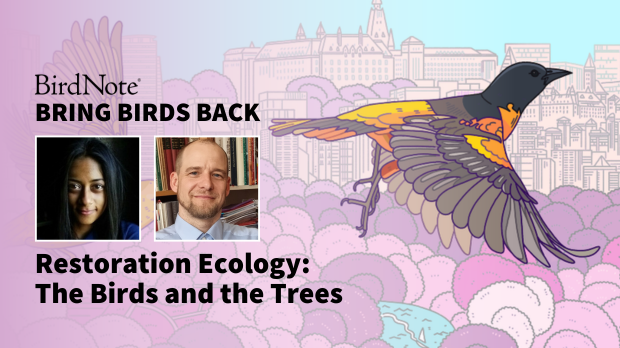
Meet your co-host, Anika Hazra! Anika is a former restoration ecologist turned science communicator, and in this episode, she’s teaching us all about her past work life. Restoration ecology is a less popular method of conservation that holds a lot of potential and Anika walks us through restoration 101. Then, she speaks with behavioral and forest ecologist, Dr. Mario Pesendorfer. Mario shares his work following the unique relationship between seed dispersal birds like corvids and successfully revitalized forests. Jays and crows step into the limelight in this episode. Grab your snacks and tune in!
Want more Bring Birds Back? Follow us on your favorite podcast app and on Instagram @BringBirdsBack!
For more about BirdNote, sign up for our weekly newsletter. And for ad-free listening and other perks, sign up for BirdNote+ here.
And for more information about how to get involved in our From Love to Action campaign, visit this page.
BirdNote is a nonprofit. Your tax-deductible gift makes these shows possible.
Bring Birds Back Season 7 is sponsored by the Cornell Lab of Ornithology and Bird Academy.
Billy Almon: BirdNote Presents.
[Bring Birds Back Stinger]
Billy: From BirdNote, this is Bring Birds Back. I’m your co-host, Billy Almon– and hopefully you know a little about me from the previous episode. This time, I want to introduce you to a lesser known conservation method called restoration ecology, which focuses less on prevention and more on revitalizing what has already been harmed.
[music starts]
One of the things I find most intriguing about restoration ecology is that the science starts with what nature innately provides.
This approach acknowledges that habitats - whether damaged, degraded or destroyed - already possess many of the basic building blocks to return to its healthy, functional state. And restoration ecologists find ways to facilitate that new growth with limited intervention, based on the needs of that ecosystem.
I think that’s fascinating because it shows how relationships and cooperation are vital to growth. And our first guest (who also happens to be my co-host) is telling us all about it: Anika Hazra! Anika is a former restoration ecologist turned science communicator. And in this episode, she’ll explain the fundamental tools of restoration ecology and what it has to offer regarding conservation solutions.
Then, Anika speaks with behavioral and forest ecologist, Dr. Mario Pesendorfer, who recruits some help in the sky from local workers you may know as birds! From California to Austria, Mario shares just how fundamental birds are in the process of revitalizing ecosystems worldwide. But to start, l’m personally excited to get to know more about Anika.
[music transitions/end]
[To Anika] Can you please introduce yourself and tell us more about your background?
Anika Hazra: Yeah, for sure! I studied ecology and evolutionary biology as an undergraduate student at the University of Toronto. And then I did a master's in ecology, again at the University of Illinois in Chicago. And, over the time I was doing graduate work, I conducted research more specifically in restoration ecology in Mexico.
Billy: So, what is a science communicator and was it connected to your previous work as a tropical restoration ecologist?
Anika: A science communicator is someone who is able to understand scientific or technical information and translate it from that very difficult to understand kind of language for most people into a different kind of language that more people can understand – with the goal of increasing scientific literacy in the general public.
So, originally I wanted to study English but my parents asked me, “What are you gonna do with an English degree?” I didn't wanna say at the time that I wanted to be a writer and then I had an idea that I wanted to try to combine these two things, ecology and writing. I had to seek out those opportunities.
Billy: You published an episode with BirdNote Daily titled To Beta or Not to Beta, about Lance-tailed Manakins and how the males pair up to perform courtship displays for females. Is it safe to assume you're a birder as well?
Anika: I wish I could say I am a birder. I have just wide ranging interests within science in general, and which is why I wanted to go into science communication, but also within the realm of ecology of the natural sciences and of wildlife animals.
So, when you work in ecology, you meet other people who work on different groups of species, different types of animals and plants. And, I kind of just immersed myself also in a lot of media. You know, I watched all the David Attenborough documentaries, any kind of documentary about any kind of animal or plant or ecosystem. I learned about bird behaviors of tropical birds, specifically the birds of paradise.
I think a lot of people who are interested in animal behavior are drawn to birds specifically because of how interesting they've become through evolution. So that was what drew me to writing that episode. And that episode was just another example of, like, the crazy things that male birds do for attention.
Billy: That's a whole other podcast episode right there. [Laughs]
Anika: My specific group of animals that I am really interested in and what I studied as a restoration ecologist was the ant. So I was looking at ant plant interactions in restored tropical forests.
Billy: Okay, let’s start there. That’s actually a perfect place to begin. First, can you explain what restoration ecology is to someone who may have never heard the term and exactly what restoration ecologists do in their scope of work?
[music addition]
Anika: Restoration ecology is the study of methods we can use to bring a degraded natural habitat back to life, basically. So these are areas where the natural ecosystem has been changed - quite drastically - to the point where, in a lot of cases, we're talking about like a forest ecosystem where the soil is not able to support the growth of any plants.
So, the process of restoration would be to figure out a way to either naturally allow that ecosystem to come back to its prior state. Or to figure out artificial ways where humans can intervene to kind of facilitate the regrowth of that ecosystem to its prior state.
Billy: Why would you say restoration ecology work is important?
Anika: It is an opportunity to make something of ecosystems that have kind of been destroyed to the point of what seems to be no return, and this is a pretty prevalent issue across the tropical regions where abandoned agricultural land is a pretty significant issue. Depleted to the point where the soil just can't grow on anything anymore. The soil will just not have the nutrients or composition to support any plant life. So as this issue becomes more prevalent globally, we're going to need to figure out how to restore these degraded areas.
My research was focused on looking at ant-plant interactions in an experimentally restored site. My research took place at a restored forest site that existed before I showed up.
Billy: Anika conducted her research in Los Tuxtlas in southern Mexico, where she studied small forest plots growing within cattle pasture. There were 24 plots in total, each covering an area of about 1000 square feet with grassy habitat in between. The experiment tested three different ways to restore these “mini forests” and Anika’s biggest question was which method works best.
Anika: So for a third of those 24 mini forests, the squares were just fenced because this restoration site was in the middle of an active cattle pasture. One of the methods to be tested was to see if they could just fence off these areas to protect them from the cattle, if the forest would grow back naturally and what that forest would look like.
And then for another third, they planted tree species that are dispersed by animals. So these species of trees depend on animals to consume their fruit, swallow their seeds and then bring their seeds somewhere else so that they can be defecated to a different area. And then the last third of those forest plots were planted with tree species that depend on wind to disperse so their seeds are a lot lighter, they don't need animals to feed on their fruit.
When I showed up, these forests were around 10 years old; it was still very young. And I wanted to look at how healthy these different mini forests were and which restoration method was working the best.
Billy: Instead of keeping count of the number of species that show up, Anika focused on the interactions between organisms living together in each restored plot. But why look at the relationships between the ants and the trees rather than just how many new trees were populated?
Anika: So I needed to look at some sort of bio indicator of forest health. So I chose a community interaction between acacia trees and acacia ants. Acacia trees, they have these hollow thorns, they have nectar, and they also have these little yellow beads on the tips of their young leaves that are called besian bodies. And those provide food, they're like a source of, uh, proteins and lipids.
So these acacias are kind of built to house ant colonies and the hollow thorns are places where the ants can stay, that's their shelter. And then the ants can feed on the nectar and feed the besian bodies. Over the course of millennia, acacia trees have evolved a mutualistic relationship with acacia ants, where the ants have shelter and food provided by the tree. And in return, the ants will defend the tree from anything that wants to eat it.
Billy: So, seeing the acacia ants successfully thrive in the environment, or as you explained in the paper, "have community level interactions," is actually an indicator that healthy restoration is taking place in the forest. Interesting.
What about this dynamic is important to understand? What exactly does this interaction indicate?
Anika: Yeah. Starting from more of, like, a basic theoretical perspective, if you're taking an interaction between an animal and plant, you can start from the baseline of what this interaction looked like in a healthy state. How do the ants interact with these trees when they aren't being threatened? And then you can compare that to, well, how do these ants then interact with trees in a disturbed area? Are they sticking around? Have they disappeared? Are there fewer of them?
So for my research, I was looking at this evolutionary relationship between a specific acacia tree called the Bullhorn acacia and two species of ants. One of these species of ants is a mutualist. It has a favorable relationship with the acacia tree, and then the second species is more exploitative. It's more of an opportunist.
Billy: Now it's important to understand why these two types of relationships are so significant. On the one hand, there’s a “give and take” dynamic at play between the mutualistic ants and the acacia trees, which benefits both partners.On the other hand, the give and take is unequal or in this instance, the exploitative ants take advantage of the acacia trees without giving much of anything back, even though the trees are expending all of their resources.
Anika: The results of my study were that these mini forests, they kind of function like islands. Where the edge of each forest is where you would see most of the bullhorn acacia trees growing, and that's where you would also see the tallest ones growing. And the tallest of these trees have the most resources to expend, producing their nectar and their besian bodies and creating large hollow thorns for shelter.
So those are the ones that attracted the mutualistic ants. And then just outside of these tree islands, you would have these individual bullhorn acacias growing, the tiniest ones in the area were just outside the fences. And those were the ones that had more of the exploitative ant species, or no ants at all, because they had nothing to offer.
They had no food, no nectar, no besian bodies. The thorns were too small. The trees just weren't big enough to attract an entire ant colony to move in. So I think, in general, my research showed that you need larger forests to kind of reconstruct those network interactions you wanna see in a healthy ecosystem.
You know, say you have an ecosystem that consists of like three species in total, maybe like two ants and one tree, and you get rid of the tree, the rest of the ecosystem is gonna collapse. Just because of how simple that ecosystem is. Whereas if you have like 10 species of ants and 10 species of trees in that ecosystem, you lose one or two ants or one or two trees, the ecosystem will still survive.
So, that's the goal: to create ecosystems that are more complex, that attract lots of wildlife. And help to kind of grow these forest islands.
Billy: So essentially, Anika’s results show that both species diversity and habitat size are key to successfully restoring forest ecosystems – not to mention time and patience.
[music starts]
The idea of leveraging naturally occurring relationships as a tool to combat habitat loss seems like a no-brainer to me but if restoration ecology is effective, why do you think we haven’t seen this work being done more frequently and celebrated?
Anika: Restoration ecology tends to be overlooked just because it's a really complicated process. It's really difficult to get it right, if we can even say that we've gotten it right in the past. A lot of people who work in that space would say we should focus on the natural areas that still exist, but are currently being threatened, because it's just easier to address threats while we're in the process of being threatened versus bringing something back to life after it's already been destroyed. Basically restarting from scratch and regrowing an entire ecosystem that originally took many, many years to grow.
But I think if we don't pursue restoration, it would be a huge missed opportunity. What it comes down to is restoration's trickier, but it's an opportunity worth exploring but needs to be approached with nuance and patience.
Billy: Thank you, Anika. This is a subject I could spend hours exploring with you, but I’m also excited to hear your interview learning about the role birds play in ecology restoration. Can you tell us more about that?
Anika: Same, Billy. It was great talking to you!
Yes, to understand the role of birds in restoring ecosystems, I spoke with behavioral and forest ecologist, Dr. Mario Pesendorfer from the University of Natural Resources and Life Sciences in Vienna.
The majority of Mario’s work has focused on the mutual relationship between birds and trees; honing in on seed production and dispersal. Birds play a critical role by both contributing to restoration and helping scientists predict the success or failure of their projects… and Mario tells us all about it.
[music transition/ends]
Anika: So earlier in the episode we shared our definition of restoration ecology, but I'd like to hear from your perspective what restoration ecology is and how it relates to your work.
Dr. Mario Pesendorfer: This sounds like a simple question but restoring habitat doesn't just involve making natural things work, but also the people around it have to work and the landscape has to be in a shape to actually be restored. The longer a habitat has been degraded and hasn't had a chance to function normally, the harder it is to get the many, many connections between organisms in a habitat to work again. The idea is to get it back to some original state, and that's where it already becomes tricky because, well, what original state do we want to restore to?
Nowadays, we often think about natural habitats in the sense that it consists mostly of native species that are able to maintain the dynamic of the habitat by themselves. But restoration implies that there was some human intervention to get this off the ground. And I think probably the best way to think of restoration is to reestablish functioning networks of plant and animal and fungal species and all the other players involved so that the habitat can sustain itself. And so when habitat is recovering and being restored, this means that more insects show up. More birds show up, more rodents and so on.
[music transition]
So birds are often used as an indicator for habitat recovery because they're easy for us to observe. People like to record the presence of different bird species, and so they provide a good way of tracking the health of an ecosystem. And therefore, uh, many, many people pay attention to the recovery of bird communities as one of the indicators of habitat recovery.
Anika: After this short break, Mario shares more about his favorite birds and the ways they enhance his work. From blue jays to crows, corvids are instrumental in re-establishing entire ecosystems– and they can do it even faster with your help.
More on that, after this.
MIDROLL + [music starts]
Anika: We’re back with Mario Pesendorfer, Behavioral and Forest Ecologist plus… bird whisperer? OK, not quite, but Mario explains how nature basically recruits birds to act as restorationists, based on their own natural desires to disperse seeds. And how he and his colleagues use that inclination to their own advantage, too.
So how would you say that birds, in general, directly help to restore habitat?
Mario: Right. So one of the main roles in which they contribute is by dispersing seeds. So, seed dispersal just means that a seed is moving away from its mother plant for a certain distance to a certain location where it might be suitable or unsuitable to establish.
So you often see plants around that have red berries on them. Most of the time, birds eat those berries, fly around and then defecate them somewhere. And those seeds then have a chance to turn into plants themselves. And in some areas, people have started taking advantage of this by providing the seeds or the fruits to birds and letting the birds do the dispersal work.
Or alternatively, by providing perches so that the birds land on them and defecate when they hang out. There's also another category of seed dispersal, which are the food hoarding birds, which have a different way of moving seeds. They don't ingest them, they actually keep them in the bill and stuff them into the ground.
And when there are seed sources around, corvids will take seeds and hide them all over the area. And often when you provide them those seeds, they hide too many or more than they need over the winter, and then many stay in the ground and have a chance to turn into small plants.
Anika: So what got you inspired to work with birds in the first place?
Mario: So my background in terms of education is actually in behavioral ecology, so [I] was very interested in why animals behave the way they do and when they do it, and also how this involves cognition – so their information processing. And one of the ways that people like to study how good the memory of an animal is, is by using food hoarding studies where animals hide food in a certain place and then you bring them back either a week later or a month later or a year later, and you see how many of the food items do they still find in this location.
And I realized at some point that this is also seed dispersal. Because often, many species hide seeds for their food, and if they forget them, they can then turn into small plants.
Anika: Would you say you have a favorite bird or a group of birds?
[music starts]
Mario: Yeah, so there's the family of Corvidae - which are the crows, the jays, the magpies, and the nutcrackers - that almost everybody knows because I think everywhere except in Southern South America and of course Antarctica, there are Corvids. And almost all of the Corvids are food hoarding species.
So some of them hoard carrion, others hoard seeds. Many species also hoard the food that we provide them. Many people have, for example, a jay that comes to their backyard feeder and takes peanuts or whatnot. And this is all scatter hoarding behavior, meaning they take this food and they hide it somewhere in the ground in many, many small locations around their territories.
Because these crows and jays are everywhere around the world, they must play a major role in the ecosystem dynamics around the world. And it's interesting because most people know jays for their intelligence. And I now have the joy of bringing the ecological role of jays closer to people.
Anika: I think we should establish what restoration is in the context of conservation. Can you explain for us what the difference is between the two?
Mario: Well, conservation often involves protecting existing habitat; whereas restoration specifically targets a functioning community, animals that inhabit this place and fungal partners and whoever else lives in the network of species. Restoration also is often used in the context of mitigation. So in a practical sense, it means changing the soil, changing the plants, and installing vegetation so succession can happen in a sense that would eventually lead to a functioning community.
Anika: And for our listeners at home, succession is the process in which different species inhabit and change an ecosystem gradually over time.
Mario: Yeah, so succession is the sequence in which the species colonize this habitat. Because some species arrive earlier, others can only arrive later when certain conditions have been met. And so this sequence of species arrivals and different community compositions is what we call succession.
Anika: Alright. So can you draw the connection between restoration, conservation and climate change? How could restoration help mitigate the impacts of climate change?
Mario: Maybe I can give an example here. So Austria is an extremely forested country. This is where I work and live now and we have 48% forest cover, but this was down to about 25% about 150 years ago. And one thing people noticed as they started cutting down forests is that the number of avalanches, floodings, and mudslides that came into their villages and crossed the roads was increasing very quickly.
This was because forests provide this protection function where they stop avalanches and other intense rain events and so on from becoming dramatic problems for us. And people then went out and planted forests very rapidly in order to protect the environment we're living in. So, as climate change is changing the world around us, this protection function of natural habitats and of forests will become more important. But in order for it to work that way, we need to restore ecosystems that, at some point, have been forests in order to capture as much carbon as possible.
Growing trees is one of the most efficient natural mechanisms that we know of to capture carbon. So the challenge for many ecosystems is that as more wildfires or flooding occur, there will be more habitat that is early in succession, meaning it has small grasses and shrubs and not the big trees. And one of the things we need to figure out, as humans, is how we can help ecosystems to quickly recover to sort of their peak state in order to have a natural world around us that can sustain on its own.
Anika: So why would a habitat essentially be stuck at that earlier stage of succession instead of progressing forward?
Mario: Imagine a piece of forest that is next to a supermarket parking lot. If that piece of forest gets disturbed and there are no other pieces of forest nearby that could provide the seeds that are necessary to establish a new population of young trees, humans might have to come in and help this forest reestablish by bringing in seeds, making sure the soil doesn't get washed away after a wildfire. So we humans can definitely help habitat recover more quickly than it might on its own, given the modified environment around it.
In nature, there is no final stage of succession, but often you see, for example, in areas that are forested, that initially you will have a community of plants that doesn't resemble the community you get there in the surrounding habitat, and that's what you maybe would call peak succession is the forest around it. But on the way to forest, there are other plants that grow in a certain location until it can become forest.
Anika: What would you say are some of the more effective strategies for getting birds involved in the restoration process?
Mario: There's a number of ways I think one of the key points is having seed sources. In order to restore any kind of habitat, you usually need seeds or seed links, you can either grow those in a nursery or you can try to bring them about by natural processes.
One important thing is in the context of seed hoarding birds, that there's certain habitat that they prefer for caching. So if you have an open, barren field, this is not the area where a jay would like to cache its acorns. But if there's a little wood pile or some shrubby vegetation along the edge of which it can hide the seeds, that is something that can attract seed dispersal.
And this has been used as a technique, where you basically provide a little kernel of restoration where you plant on 1% of the land, so that you have a functional community, and the birds then spread those out very quickly. That's called a nucleation approach.
[music starts]
There's a number of examples that show that frugivorous birds - so birds that eat fruits - they play an important role in habitat recovery. Because the large trees that we have in forests aren't usually the ones carrying fruits, but the shrubs that are below and that are sort of early in succession, they're often dispersed by frugivorous birds. So, there is actually some work from the Eastern US that shows that placing shrubs with fruits around habitat that you're trying to restore, accelerates the recovery and the succession into a more natural state.
Anika: Would you say your research is more of like an active method for involving birds and restoration? Would you say you take the more passive approach?
Mario: So, in my research we studied the role of birds and habitat recovery in passive systems where we don't interfere much and we just watch. For example, there's an island on which oaks are dominant in the vegetation and sheep and pigs used to depredate the seeds or eat the plants. Once the sheep and pigs were removed, within 25 years, we had a 50% increase in vegetation cover. And in our research we've tried to figure out, okay, what role did the birds play in the recovery of this habitat?
And then using various techniques we could show that the Corvids caching the acorns, that they played the main role in the recovery of oak habitat on these islands. Now we take this knowledge about the behavior of the animals and try to use it to recommend restoration techniques to people trying to achieve restoration outcomes.
Anika: That’s amazing. And I’m glad you brought up that study. I believe that was based out in Southern California? Santa Rosa Island and Santa Cruz Island. Can you explain that process a bit further and how you see the results of your research applied in active restoration projects?
Mario: Yeah. So one of the interesting things that we found when doing our own research on these birds is that they won't stop hiding seeds as long as they have seeds, because they never know how bad the winter's gonna get. So to them it makes sense to hide all the seeds that are around.
Anika: These seed dispersing corvids are Island Scrub-jays, which are one of the rarest birds in North America. They’re found literally nowhere else in the world but Santa Cruz Island.
Mario: So, by providing lots of seeds in a specific area, it's very unlikely that they recover all the seeds that they hid. So we'll try to push the birds by giving them more seeds than they need so that they'll plant some of them by hiding more than they need in the future. The truth is that on small scales, these types of techniques are promising. On a larger scale, you wanna induce the dynamics that are useful for the whole landscape. So by starting little forest patches in one area, you can envision that in 200 years or so, this might turn into a fully grown forest. So the idea is to impact the whole area at the landscape scale. So it's tricky. It's hard to scale up.
Anika: And you all created a pretty significant simulation model to determine how successful birds can be in the restoration process. Can you speak a little bit more about that?
Mario: Yeah, one of the ways we tried to figure out whether jays played an important role in the recovery of Santa Cruz Island, which is in a Channel Islands National Park in California, was to construct a simulation study based on all the things we had learned about the birds. So we looked at how many seeds do they hide per day, per hour, or over a whole year?
How many seeds are moved over long distances? How many over short distances? How quickly does an oak actually grow and how many seeds does it produce? And by combining all this information that we had in a simulation model, we first tested, how good is this model at retracing the actual recovery of the landscape that was observed? And by using this comparison, we could train the model to come up with the most realistic interactions. And then we used this model and applied it to a different island where the birds are currently not present and illustrated what the impact of these birds could be if they were able to do the same thing as on the other island.
So on one island, on Santa Cruz Island, we have Jays, and on Santa Rosa Island, we don't have Jays anymore, and we illustrated that on Santa Rosa Island, habitat recovery over the next 200 years would increase by more than 500% if seed dispersing birds were around.
Anika: [Wow, that is pretty amazing.] I think we briefly discussed what could be the general goal of restoration, just in a philosophical sense. But I wanted to know personally for you and the research you do, what is your goal?
Mario: So, as a scientist, I like quantitative goals. In the forest context, you would probably aim for a certain degree of shade on the ground that is caused by the trees, ‘cause one of the issues that we're starting to encounter is that land use by humans collides with the natural functions and dynamics of habitats.
But I do think that there's a sweet spot where milder land use by humans can lead to more functional ecosystems that then protect us a little better. And for example, in California, you see a little bit of oak forest, and then you see that yellow grass where the cattle graze. Now we know that if there's about a 30% ground cover in rangeland, there's actually more forage for the animals. But at the same time, the opportunity for the oak habitat to stay functional. That is my personal goal, trying to aim for a sort of intermediate point between land use and ecosystem function. That we find that spot and try to achieve it in as many locations as possible.
Anika: Do you have any suggestions for our listeners at home for things they could do to help?
Mario: Yeah, so many people have bird feeders in their backyard. And they go and buy the bird mix at some supermarket and bring it home and feed it to the birds, and it usually involves sunflower seeds, millet, and whatnot. Now, if you wanna attract native birds, it would be cool to use native seeds. One thing that is becoming clear to me is that many feeders actually interrupt these ecosystem services. So if you were interested in supporting ecosystem services or seed dispersal by birds, you could plant native shrubs in your backyard that have berries, plant trees that eventually produce seeds that will attract the birds and try to keep the number of non-native seeds that you feed to a minimum.
Anika: So, Mario, do you have anything else you'd like to add? Anything you feel like we missed?
Mario: I think it's nice to reflect on the fact in this context that ambition to restore habitat in certain areas can go a long way. There are many nonprofits and conservation agencies that are trying their hand at restoring habitat, and sometimes it fails, sometimes it goes well. But I think it's worth it to keep trying and it will be one of the essential tools in our toolkits as humans to continuously live on this planet, to learn how to restore habitat effectively. And I think we can benefit by involving birds in this planning because they play a major role in vegetation dynamics through their seed dispersal.
Anika: Mario, thank you so much for your time. I appreciate you speaking to us about birds and restoration today.
Mario: Thank you so much for having me.
[music transition]
[Outro]
Anika: As we continue seeking ways to revitalize and replenish our world in dire need of more care and much more action – restoration as a conservation tool can be done on a large scale, like with Mario’s work. But it’s also the opportunity for the average everyday person to consider, in what ways can I contribute to my own local ecosystem? From the seeds you’re giving to your local birds, down to the native plants you’re adding to your backyard garden.
Making use of the bird's natural ability to disperse seeds is another reminder that we should and could be working with nature, as much and as often as possible.
If only we recognize how intertwined our needs are – and how much we truly need each other to save the world.
And many thanks to my wonderful co-host, Billy! It was great talking to you.
Billy: Thanks, Anika. It was my pleasure getting to pick your brain, especially about the ants!
I hope this episode inspires everyone to become curious about the natural world that surrounds us and to discover new ways you can do your part, too. No matter if it’s as transformative as a forest… or simply the size of a mustard seed.
Anika: Thanks a million to Mario Pesendorfer for providing us with a truly impassioned conversation about the birds and the trees! And, of course, thank you for listening!
To learn more about Mario, restoration ecology, or how you can join BirdNote’s efforts to save the birds, look on BirdNote dot org for this episode's resources.
And keep up with our weekly updates @ Bring Birds Back on Instagram.
This episode of Bring Birds Back was created by our production team, including Fact-checker Ariana Remmel; Producers Sam Johnson and Josh Fisher; Senior Producer Mark Bramhill; Managing Producer Jazzi Johnson; and Content Director Jonese Franklin.
Our music is by Epidemic Sound.
And this episode was co-hosted by me, Anika Hazra.
Happy birding!
[Music ends]
Post-Credit Blooper
Billy: Recording now. I'll, I'll go back and, sorry, sorry. Yeah, we'll redo it, yeah, we'll do- redo that.
Anika: I'm rambling. What, what was the original question?
Billy: No, this is, this is fine.
Anika: Okay, so what I was doing…
Billy: No, no. You, you, you nailed that. Yeah, you nailed that. Stopping my recording.
Jonese Franklin
Content Director
Jazzi Johnson
Managing Producer
Mark Bramhill
Senior Producer
Josh Fisher
Producer
Sam Johnson
Producer
Ariana Remmel
Fact Checker
Billy Almon
Host
Anika Hazra
HostEpidemic Sound
Music
Anika Hazra is a former tropical restoration ecologist now working as a science communicator. She earned a BSc degree in Ecology from the University of Toronto and a MS degree in Ecology from the University of Illinois at Chicago. Her Master’s research focused on ant-plant interactions in experimentally restored forests in Los Tuxtlas, Mexico. Anika has previously guest-hosted the Science for the People podcast and contributed communications materials to the Canadian Parks and Wilderness Society and The Biomimicry Institute. She is currently a Communications Officer at the University of Toronto.
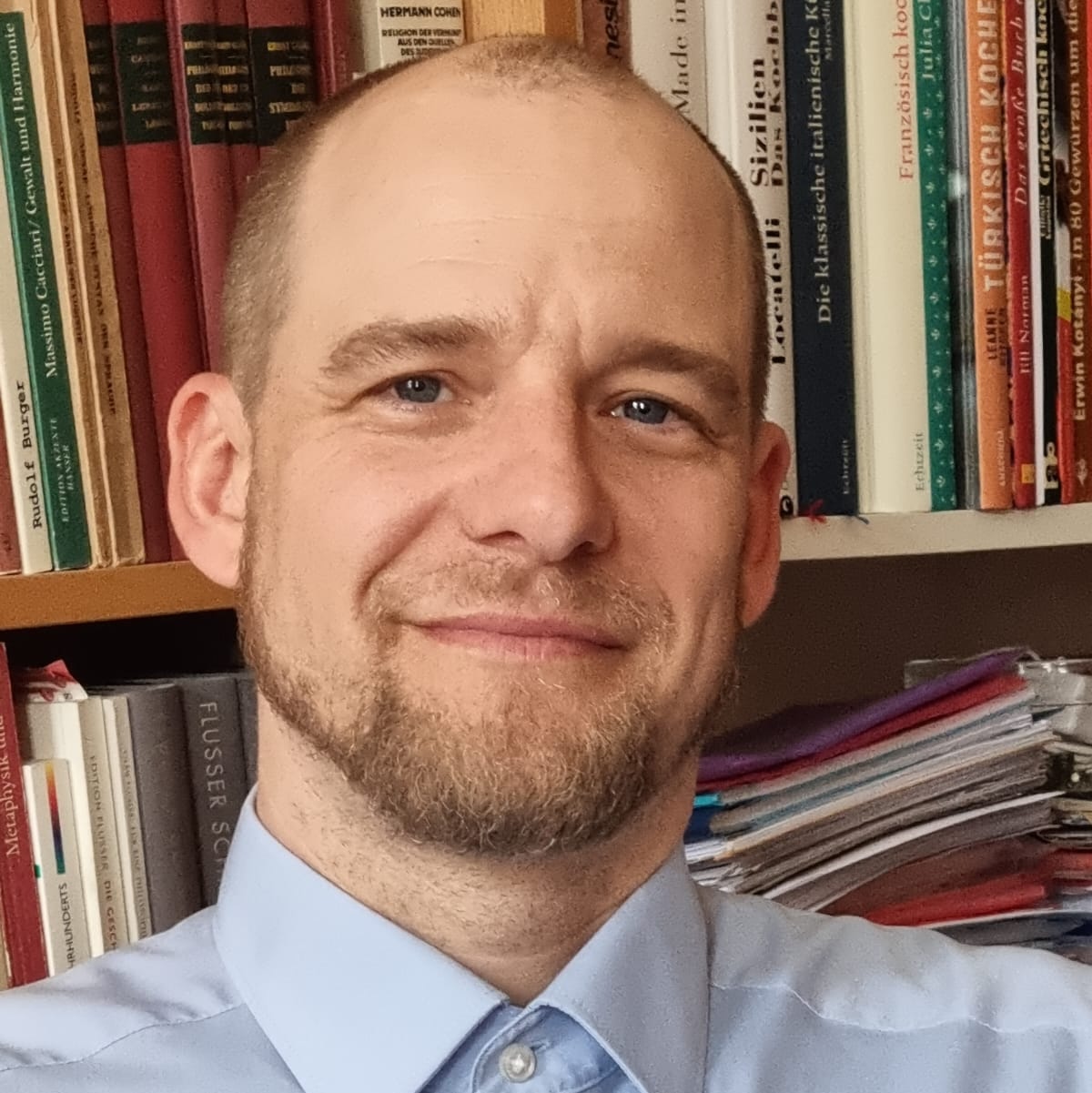
Dr. Mario Pesendorfer, originally from eastern Switzerland, studied biology, zoology, and animal behavior at the University of Vienna, Austria. After a foray into animal cognition, including work on bird and primate learning mechanisms, he pivoted to behavioral ecology for his Ph.D. in Ecology, Evolution and Behavior at the University of Nebraska-Lincoln. For his dissertation work, he partnered with the Smithsonian's National Zoo and Conservation Biology Institute to investigate the role of island scrub-jay hoarding behavior in the recovery of oak habitat in California's Channel Islands National Park. After two years as a predoctoral fellow at the Smithsonian Migratory Bird Center, he joined the Cornell Lab of Ornithology as a postdoc, Rose fellow and eventually research associate, continuing work on oak seed production, acorn dispersal and predation, and conservation ecology. Since 2019, he worked as a senior postdoc and senior scientist at the Institute of Forest Ecology of BOKU University of Natural Resources and Life Sciences, Vienna, and recently became full professor in forest ecology.
Related Field Notes

Male Marsh Wrens will build several--as many fifteen--dome shaped shells in the reeds to woo fema
The Osprey is the only North American raptor to eat fish almost exclusively, and it's well adapte

