

Join BirdNote tomorrow, November 30th!
Illustrator David Sibley and actor H. Jon Benjamin will face off in the bird illustration battle of the century during BirdNote's Year-end Celebration and Auction!
Hummingbirds Help Mites Hitch a Ride
Many mites rely on larger animals to survive.

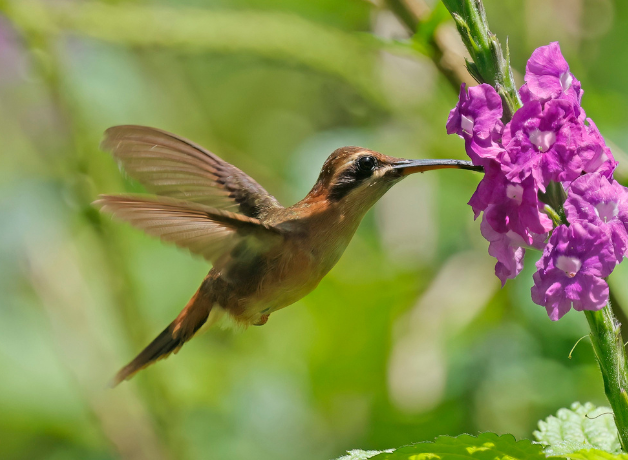

© Robin Gwen Agarwal
Mites are tiny critters related to spiders and ticks. Because they are typically no larger than a grain of salt, many mite species rely on larger animals to survive. In the neotropics, hummingbird flower mites freeload off an existing partnership. This group of mites feeds on nectar and pollen, but only from specific types of flowers. These picky eaters need reliable transport between blooms that may be yards apart. Without wheels — or wings — of their own, these mites catch a ride in the nostrils of a passing hummingbird! In fact, scientists have discovered that hummingbird flower mites can detect the electric fields generated by the whirring birds, a sense called electroreception.
BirdNote®
Hummingbirds Help Mites Hitch a Ride
Written by Ariana Remmel
This is BirdNote.
[Rufous-tailed Hummingbird wings whirring]
Hummingbirds are alluring birds. People are often enamored by their iridescent feathers and charismatic personalities. But for some species of mites, the attraction is electric.
[Rufous-tailed Hummingbird chirps]
Mites are tiny critters related to spiders and ticks. There are thousands — if not millions — of species worldwide that are typically no larger than a grain of salt. Being so small, many mites rely on larger animals to survive.
In the neotropics, hummingbird flower mites freeload off an existing partnership. This group of mites feeds on nectar and pollen, but only from specific types of flowers. These picky eaters need reliable transport between blooms that may be yards apart — basically a squillion miles to an itty bitty mite! Without wheels — or wings — of their own, these mites hitch a ride on a passing hummingbird!
[Stripe-throated Hermit chirps and whirring]
As the hummingbird takes a sip from a favored flower, the mites make a mad dash for its bill. With help from static electricity, the mites zap onto the bird like lint to fresh laundry. Once safely on board, they tuck themselves into the hummingbird’s nostrils until the hitchhikers can safely disembark at the bird’s next stop.
In fact, scientists have discovered that these teeny mites have evolved the ability to detect the electric fields generated by the whirring birds, a sense called electroreception. Sharks use this to hunt prey — these mites are just looking for their next nostril.
For BirdNote, I’m Ariana Remmel.
###
Senior Producer: Mark Bramhill
Producer: Sam Johnson
Managing Editor: Jazzi Johnson
Managing Producer: Ariana Remmel
Content Director: Jonese Franklin
Bird sounds provided by The Macaulay Library of Natural Sounds at the Cornell Lab of Ornithology, Ithaca, New York. Rufous-tailed Hummingbird ML609061939 recorded by Pam Rasmussen. Stripe-throated Hermit ML84289 recorded by Gregory Budney.
BirdNote’s theme was composed and played by Nancy Rumbel and John Kessler.
© 2025 BirdNote July 2025
Narrator: Ariana Remmel
ID# symbiosis-01-2025-7-25 symbiosis-01
Reference:
https://biodiversity.uconn.edu/rob-colwells-mites/
https://www.si.edu/stories/mites-are-everywhere
https://www.pnas.org/doi/10.1073/pnas.2419214122

Ariana Remmel
Writer NarratorRelated Field Notes

Male Marsh Wrens will build several--as many fifteen--dome shaped shells in the reeds to woo fema
The Osprey is the only North American raptor to eat fish almost exclusively, and it's well adapte