
Image: The Ultimate Bird Drawing Throwdown Showdown Graphic featuring images of David Sibley and H. Jon Benjamin

Join BirdNote tomorrow, November 30th!

Illustrator David Sibley and actor H. Jon Benjamin will face off in the bird illustration battle of the century during BirdNote's Year-end Celebration and Auction!
RESERVE YOUR SPOT

Shows With Contributions by Frances Wood

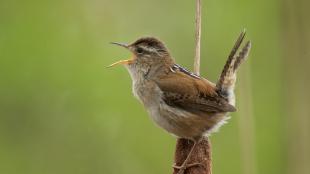
A Marsh Wren singing while perched on a cattail reed.

The Marsh Wren

Some bird-lovers have tagged the Marsh Wren the "Heinz 57 variety" bird, because scientists have recorded 57 different variations of its song. And nightfall doesn't faze these birds. A male may sing straight through the night. Marsh Wrens usually forage out of view, hopping up only for…
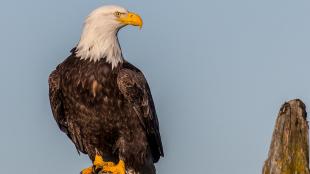
Bald Eagle perched on driftwood at the beach, in sunshine, it's head turned to the left in profile against a blue sky

The Bald Eagle, a National Symbol

Immature Bald Eagles look so different from mature Bald Eagles that early ornithologists thought they were a different species entirely! Sitting about three feet tall, these majestic birds have wingspans of more than six feet. Stretch your arms as far as you can, and imagine a bird whose…
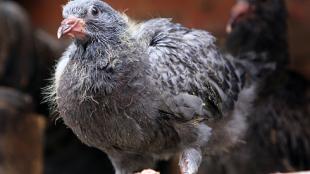
Juvenile Rock Pigeon

Pigeon Babies Do Exist

Rock Pigeons are one of the most common urban birds. But why do we never see baby pigeons? Some baby birds — like down-covered ducks, geese, and chickens — leave their nest shortly after hatching and do a lot of growing up while following their parents around. Others, like pigeons, depend…
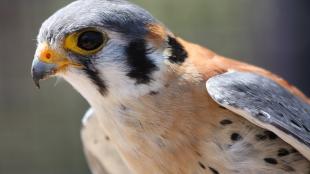
American Kestrel

American Kestrel

The American Kestrel is the smallest, most numerous, and most widespread North American falcon. This bird is built for speed, its long pointed wings often bent back at the tip. While hunting, kestrels hover above an open field. These days, the lack of suitable nesting cavities, which…
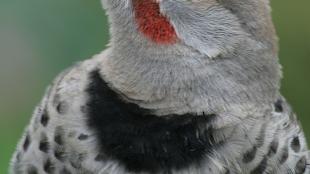
Northern Flicker

Northern Flicker, Drummer

Springtime brings the sound of a woodpecker, like the Northern Flicker, drumming on a hollow surface. Members of the woodpecker percussion band announce their territory and attract mates, as they pound away on metal roofs or gutters. Drilling holes in tree trunks calls for some specialized…
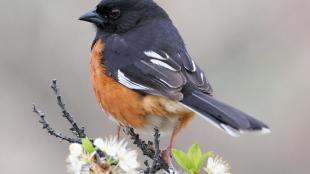
Eastern Towhee

Towhees' Distractive Plumage

Both this Eastern Towhee and the Spotted Towhee of the West sport a black or dark brown hood and back. And when they fly, their tails flash white. When a hawk gives chase, the towhee's flashing tail-feathers draw the predator's attention. Momentarily distracted, the hawk may come up with…
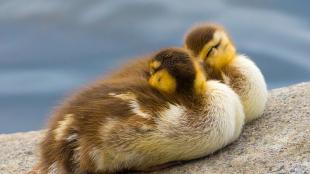
Two Mallard ducklings snoozing on a cement bank by the water, their beaks tucked beneath their wings

Where Birds Sleep

All birds need to sleep — or at least snooze — sometime during each 24-hour period. And most sleep at night. A bird, like a Mallard duckling, may turn its head around and warm its beak under its shoulder-feathers. Songbirds find a protected perch, sheltered from rain and nighttime…
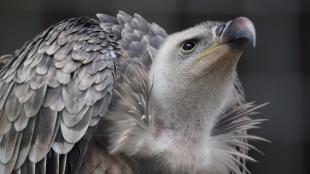
Ruppell's Griffon Vulture

How High Do Birds Fly?

For the majority of the year, most birds stay under 500 feet. During migration, many species fly at 2,000 to 5,000 feet or above, using prevailing winds to assist them. And some birds go even higher! In 1973, a Rüppell’s Griffon set the world record by soaring to 37,000 feet.
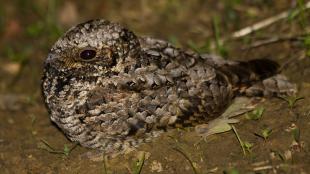
Common Poorwill, male

Birds That Say Their Own Names

Some birds, such as the Northern Bobwhite, get their name from their songs or vocalizations: "Bobwhite! Bobwhite!" The Killdeer is another bird named for its song: "Kill-dee, kill-dee, kill-dee." There are others. "Poorwill, poorwill, poorwill," says this Common Poorwill. This bird is the…
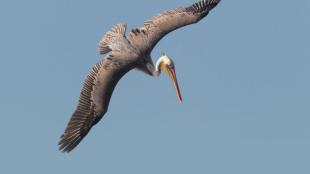
Brown Pelican soaring against a blue sky

How Brown Pelicans Dive

Brown Pelicans fly just above the surface of the water. They circle high, then diving headfirst, plunge under water to catch fish. But doesn't that hurt? Several adaptations protect pelicans as they dive. First, they have air sacs beneath the skin on their breasts, which act as cushions…