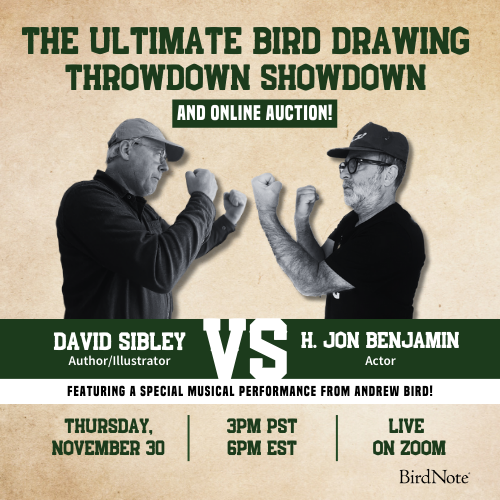
Join BirdNote tomorrow, November 30th!
Illustrator David Sibley and actor H. Jon Benjamin will face off in the bird illustration battle of the century during BirdNote's Year-end Celebration and Auction!
Radical Joy with Dr. J. Drew Lanham
Bring Birds Back Season 7 Finale!

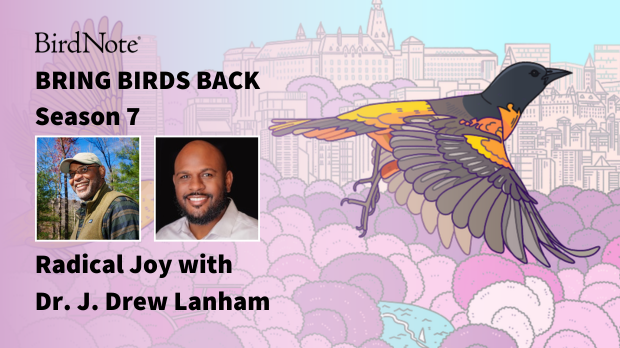
Ornithologist, poet and MacArthur Fellow, Dr. J. Drew Lanham, speaks with host Billy Almon in our season 7 finale! The two begin by talking about Drew’s humble beginnings and southern influence from his grandmother’s teachings, and how he became a self-taught birder. Later, they discuss his latest book, “Joy is the Justice We Give Ourselves,” and talk about the connection between his poetic roots and his identity as a Black man with a deep love for birds and the wilderness. You won’t want to miss this special episode. Listen now.
Want more Bring Birds Back? Follow us on your favorite podcast app and on Instagram @BringBirdsBack!
And for more information about how to get involved in our From Love to Action campaign, visit this page.
BirdNote is a nonprofit. Your tax-deductible gift makes these shows possible.
Bring Birds Back Season 7 is sponsored by the Cornell Lab of Ornithology and Bird Academy.
Billy Almon: BirdNote Presents. [Bring Birds Back Stinger]
J. Drew Lanham: Joy is the Justice We Give Ourselves [poem title]
Joy is the sunrise
breaking through night’s remains,
bright shone new
on a shell-wracked shore;
a fresh tide-scrubbed world
redeems what was,
to is.
Joy is on whimbrel’s wings;
the wedge in fast flight,
wandering curlews,
curved-beaks’ cries
stitching top of the world
to bottom.
Joy is the soul stirred
underneath the journey,
gaze snagged on wonder,
not knowing final destination,
blessed as a witness,
moored to ground,
worshipful tears
dripped into grateful smile.
Joy is the silent spring,
unquiet.
Rachel’s world not come to pass.
The season
dripping ripe full
of wood thrush song.
Joy is all the Black birds,
flocked together,
too many to count,
too many to name,
every one different
from the next,
swirling in singularity
across amber-purpled sky.
Joy is being loved
up close
for who we are.
Joy is the last song,
drifting in
as dark curtains fall;
the sparrow’s vesper offering,
whistle lain down
in pine-templed woods,
Joy is the justice we give ourselves.
Billy: From BirdNote, this is Bring Birds Back. I’m Billy Almon.
This season, we’ve focused on difficult topics and shared uneasy conversations centered around the survival, preservation and restoration of the sciences.
Like the impacts of devastating budget cuts, the dismantling of long-standing environmental protections and the uncertainty of available resources that can literally mean life or death for many, including birds and other wildlife.
But, we also want to share - and remind you - of hope. The hope that exists in all of us to continue showing up for ourselves. The hope that inspires us to explore new methods of conservation, like restoration ecology. The hope that’s needed to discover new ways we’re all similar and different, like through speech and song… in humans and birds. The stories we’ve shared of activists, scientists, and policymakers is a reminder of our power as a collective and as individuals.
And for this season’s closer, there’s one man who often speaks to that hope in a new and refreshing way: Dr. J. Drew Lanham.
Drew opened this episode with an excerpt from the title poem of his book, Joy is the Justice We Give Ourselves. A renowned author, poet, wildlife biologist, conservation and cultural ornithologist plus a MacArthur “genius grant” recipient, Drew’s words are not only important to share but timely. And today, we have the pleasure of sharing more about him, his work, and how it’s all tied to his philosophy around justice and the joy we must find, for ourselves…
[to Drew]: The Dr. Drew Lanham. How are you, sir?
J. Drew Lanham: I am doing well, Billy. How are you?
Billy: Good, good. I'd love for us to dive a little bit into your latest book of poetry but before we get into that, let's get to know, you know, a little bit more about you.
In preparing for this conversation and reading up on you, I saw that, as a black boy living in the south, you wanted to be able to fly and birdwatching is something you've done since you were seven years old. So, I absolutely need to know more. Where did you grow up and what is it about birds that made you want to become an ornithologist?
Drew: Billy, I grew up in Edgefield County, South Carolina. It's a county hugging the Savannah River and right across the river and to the west is Augusta, Georgia. I like to think of it as one of the places that James Brown became famous. So, that's where I grew up. It was a farm that had been in ownership probably since the early 1900s. But the indications are that my family had also worked there, as enslaved persons. So, that tie to the land first not by choice, and then by choice sort of defines me. So I'm proudly rural. Progressively southern. Birds were my, were, were my first friends because I spent so much time outdoors. You know, they weren't judging me like my grandmother's God, they didn't tell me every day that the world was ending.
Billy: Mm-hmm. Mm-hmm.
Drew: And, uh, and they weren't watching me like my parents would to tell me to do this thing or that thing or else. So, you know, that was special. Um, I didn't realize it at the time, that I was fostering, you know, these wild kinships but that's what was happening. I only had, sort of, socialization from eight to three every day. I didn't go to birthday parties, I didn't learn to skate, I didn't learn to do any of that. But I, I learned how to imitate birds. I learned how to identify birds and at the same time, I think I learned how to identify with birds. That's why I call myself a bird brain because, um, apparently I developed a kind of a unique kinship with non-human beings that I just thought was natural.
I was a boy who wanted to become a bird. Um, but sometimes I'm a man who wishes he was a bird, so I envy them in that way. Birds have amazing superpowers of perception and communication. And so there are lots of stories that tie us together. And, as a Black southern man, I, you know, I, I'd like to think about certain birds, um, as, as representing sort of our story.
Billy: Drew earned undergraduate and graduate degrees in Zoology at Clemson University. As a graduate student he focused primarily on ornithology. In 1997, he received his PhD in wildlife and conservation. It’s pretty clear that his love for birds largely fueled his love for the outdoors as a whole. So, what bird can we credit for starting it all? [an aside]
Billy: Do you have a spark bird?
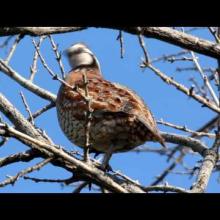
Drew: Wow. Yeah. I have several, and for me it's, it's almost more a conflagration bird, right? But probably bobwhite quail, ‘cause I would see them every day. Uh, it's the first bird, maybe, that I came to know by voice because I could hear it. It was calling its name across the pasture in the, in the woods. [Northern bobwhite male song begins.] And maybe in the less-than-quarter of a mile between my grandmother's house and my parents' house, I might flush three coveys. And today that's unheard of because bobwhite quail, especially in the southeast are, are rare as hen's teeth, so to speak. Um, but yeah, bobwhite quail, just that: [Drew whistles the Northern bobwhite quail song]. I mean, that was everything. So that's the bird that I came to know first. Um, a brown, nondescript, shy bird that I think in some ways represented who I would become as a boy and into adulthood.
Billy: For folks listening who may not know, can you explain what it means to “flush a covey”?
Drew: Yeah, yeah. Uh, I fall into this jargon, but my grandmother used to call 'em partridges. So they're these small, chicken-like birds, quail that hide, they feed, they nest on the edges of an unkempt fence row or a weedy overgrown ditch. And everything wants to eat quail. They're on everybody's menu: um, foxes and hawks and bobcats and everything out there. So, when you surprise them, they will explode in flight. And a covey is just a group of quail. And each bird, maybe a dozen birds in a covey will go in a different direction to confuse the predator. So that is a flush. And so it's like a feather explosion.
And even though you knew they might be there, just this surprise of all these birds exploding would always surprise you and you'd feel for a moment like your heart had stopped. But it was really exciting 'cause you then watched those birds fly, um, in all these different directions and then a few minutes later you would hear them, um, make this what I would call a covey recovery call or a gathering call. Um, that was like a: [Drew whistles their recovery song.]
Billy: Hmm.
Drew: And so you knew that these birds, even though the covey had been separated, everybody was being called back together in some other place, to be safe together. So that was my spark bird.
Billy: You know, you doing those bird calls, that is a sign to me of an aficionado in their craft. Someone who has developed an ear and has obviously practiced those vocalizations. So I'm curious, do you have a favorite bird and you know which one and why?
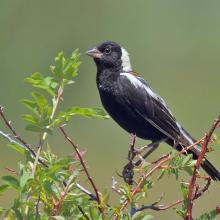
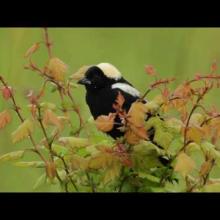
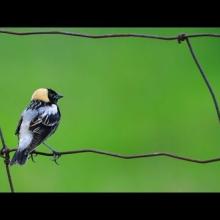
Drew: Yeah. You know, it's almost a daily thing. It's seasonal. Usually the easiest answer is to say “my favorite bird is the one with feathers”. But this week, um, it is really Bobolinks [Bobolink male song begins] and, um, they're these really cool, gregarious social birds that are neotropical migrants, which are birds that spend portions of their lives, at the equator or below the equator, um, in the tropical regions.
And then they return here in the spring and summer to breed, and then they go back south in the fall. And Bobolinks males are probably most recognizable to people because they sort of have this reverse color. They have, kind of, like a little bit of a blonde wig and a white back and then, black breasts. And their songs, the best way to describe 'em is like a broken music box and R2-D2, if somehow those mechanisms were able to have offspring, that's what it would sound like. But when you hear it, it's just this unmistakable call. And so these birds now are coming back through in flock and finding fields of, of grain, ripening.
But the old name for the bird is rice bird. And part of the reason that Bobolinks are a favorite bird of mine is because these are birds that also would've been flushing through the antebellum landscape and through the landscape when the ancestors would've been bound to chattel slavery and they would've been working the rice fields. And these birds might descend and threaten the crop. And because they were threatening the crop, they were threatening the immense wealth of this planter class who was growing rice, Carolina gold rice. But then they were also threatening the livelihood of the enslaved who were given the unfair responsibility of producing even in the face of what nature has to offer in terms of storm or anything else.
So, you know, I imagine the ancestors, knowing the calls of these birds, and knowing the time of year that they would return, and knowing that it meant that they were gonna have to make extraordinary effort to keep the birds as best they could out of the rice crops. And so, um, when I think of Bobolinks, when I hear them, I seek them out because they're beautiful birds. The females are kind of a buffy, yellowish brown this time of year. So they're, they're really beautiful as well, but in a different way. I'm not just thinking about the journey that they've made from as far south as Argentina to here, but that these birds were creasing across the landscape to come here - 200, 300 and more years ago - to take advantage of the crops that were being grown to grow this country. So, I connect those birds to the ancestors. I connect those birds, Billy, to the joy of hearing that sound. Um, I connect them to, uh, the misery of people who were bound to the land in ways and, so, it's sort of a bird of reconciliation.
So my favorite bird this week, it's Bobolinks it could very well change in the next day or week when the next bird takes me away from all the insanity that surrounds us. Birds aren't paying attention to executive orders and tariffs and senseless words and threats. I mean, thinking about birds gives me the privilege of not thinking about much less pleasant things.
[music ends]
Billy: Well, this is a primary example of why I was so excited for us to connect and talk, because I think you have such a profound way of contextualizing the significance of birds beyond what their biology says about them.
And from a social structure perspective, the way that you talk about birds reminds me in some ways of the role that, um, African griots form and have a certain role within a community as keepers of the stories of time passed. And also, these living libraries of wisdom. I'm just curious, what do you think about that idea? The way that you can associate what birds do and what they contribute with cultural significance is really interesting.
Drew: Well, I appreciate that, man. I love that idea of bird griots, of the keepers of legacy. And what our ancestors certainly knew is that the world exists beyond human arrogance. You know, us thinking, we are the pinnacle, the absolute, everything – and we aren't. These birds are carrying stories, across landscapes, across generations. And people might not have known where birds were going, but they knew that they came and then maybe they disappeared for a time and then they showed up again.
So, some people would say that the birds disappeared into the sky. Some people would say that birds disappeared into the sea. Some people would say that birds disappeared into the ground. Well, we were able to discern some by science, where birds go, what birds do, but we still don't know what birds think. So I love that idea of birds being messengers but in order to share stories, we have to listen, man. We have to be open to this interspecific kind of conversation. And, certainly, we know there are conversations going on between birds. But if we listen, the birds, I think, are trying to tell us something, and those are stories that have to be told.
Billy: There's something you said about birds and their songs carrying stories, and I know some of your research is around bird vocalizations and bird mimicry and, you know, just thinking about the connection between those two of, the birds that are mimicking the sounds of other birds and you know, some birds that are no longer with us that may have went extinct, and the carrying on of stories. I wonder if you see any connection there?
Drew: Yeah, you know, growing up, the first mimic that I knew was a mockingbird. You would hear a bird that you thought was a certain bird, but then it became another bird, and then another bird, and then it became some other bird. And my grandmother taught me, ‘Baby, that's a mockingbird’ [Northern mockingbird male song begins] music selection]. And I came to know that bird in this way. And so, you know, I learned mockingbirds say things in threes and fours, brown thrashers say things in couplets, and twos and catbirds [Gray Catbird calls] will give themselves away with a [makes sound of a cat meowing] but they also, they mimic, they just sort of run through stuff. They really, sort of, remix and scratch at a much faster rate.
But, I wrote this piece a long time ago. I think I called it ‘Memory of the Mimic’ or something like that. But I was wondering, okay, so these birds are passing stories down. You learn the science, the scientists that have studied birdsong and they say birds are teaching their eggs. The embryonic birds, they're teaching them songs before they are out of that shell. And we know that humans are learning in utero, right? And so if you can learn in utero, they were mimicking Carolina Parakeets or maybe the coos of Passenger Pigeons, or kent calls of Ivory-billed Woodpeckers. [Ivory-billed Woodpecker calls.] Or in the northeast, maybe you had birds that were mimicking the booming of heath hens. And so, when do you stop mimicking? When does that fade from your memory? Because at some point, birds were mimicking their world and what was around them. I mean, we know starlings now will mimic car alarms, they'll mimic cell phone rings.
So just that amazing ability to pick that up in your brain and then produce it through your syrinx– that voice box that birds have. You know, when does a mimic forget what was? And that just haunts me because in my own fantasies, I've had this idea that at some point, some mimic, some mockingbird sort of dusts off some code and just a little bit of a bird that no longer exists, comes through in a song.
Billy: Hmm.
Drew: You know, just a little bit. But we wouldn't know what it is. But there it is. It's just this little glitch, this little piece that's still there that's etched into what that bird is. And so I fantasize about that. I want to write more about it. I mean, it's sort of like all the music in America that has the thumbprints of Black folk on it.
Billy: Mmhmm. Yes.
Drew: You know? And it just does. And people might not want to admit that, but if you look at the roots of it, the influence of the past can't be forgotten. It isn't erased, no matter who tries to do it, it's still there. You know, I think about on campus, here at Clemson, there are buildings that were built by enslaved and by convict labor– sort of one and the same, right? Black people held against their will unjustly, frequently. And there's a researcher there, Dr. Rhondda [Robinson] Thomas who does a lot of this work, but, you know, they'll find bricks with fingerprints in them.
Billy: Mm. Mmm.
Drew: Now, you know, current trends would have people say, ‘Oh, well. Maybe I ignore the fingerprints or I don't know, maybe I tear down the building and build it with bricks that have no fingerprints.’ But people aren't gonna do that, are they?
[music selection ends]
So, you know, I think about these birds. They've got prints, they've got imprints of the past in their brains. This is the way that these birds remember these migratory routes. So we are all the way back to them stitching the world together. [Laughs]
[midroll music starts]
Billy: After these messages, we’ll dive deeper into Drew’s work as a poet. From events and people that motivated his pivot into writing, down to how his personal relationship with birds and birding continues to help him thrive in a world of uncertainty. Stay tuned.
MIDROLL
Billy: We’re back with Dr. J. Drew Lanham: birder, ornithologist, conservationist, esteemed and award-winning poet. We’ve just finished talking about his time growing up in rural South Carolina and how his love for birds and the outdoors impacted his life’s trajectory into ornithology. But what prompted his interest in poetry?
[to Drew] It's so obvious in how you think about all of these different implications around birds, how much you love birds. And you mentioned some of the things that you're looking to write about. I'm curious how your love for birds eventually transitioned into your work as a writer. Which came first for you? Which was the chicken and which was the egg? What, what motivated you to begin writing about birds?
Drew: Um, reading about birds probably motivated me to write about birds and one of the first books that I read as a child was by an author named Fred Bodsworth called the Last of the Curlews. And it was this beautiful story about the last of a bird that's now extinct, the Eskimo Curlew. And I remember reading that book and then I saw an ABC afterschool special that like, set me on fire, right? I was like, ‘oh, wow, this bird is gone’. And in my mind though, I was like, maybe it's not gone, maybe it's there.
But you know, as the writer had written this story from the point of view of a bird, it's like he had become this bird in a way. And so I went on to read other writers that were writing about nature, sometimes writing specifically about birds. So that was, sort of, the Genesis for me, that maybe while I was stealing the eggs somewhat, that was singing to me in a way that said, ‘okay, when you hatch, you get to write about birds yourself’. And so, for a good portion of my life, Billy, I wasn't doing what I loved to do.
[music selection]
I was doing what others thought I should do. And part of the way that I stayed alive during that period of time that I was living by expectation was to write little bits and pieces about birds, but really more thinking about the writing and reading it. And so then when I finally hatched into my own and enough confidence to say, ‘no, I'm not doing what you want me to do, I'm gonna do what I love to do’, I started writing about birds. And it's gone through transition. I mean, it went from poems and a line or two here, and then years and years and decades of scientific writing, which is very different, obviously.
But then something happened that, you know, I'm teaching these students in a conservation biology class, really most of what you're giving people is bad news. You know, it's just all about the world burning up, all about the world being fragmented apart, all about the species going into extinction. And I got the good news, um, one day from a grad student, Brand Cromer came to me and he said, ‘have you heard?’ And I said, no. And he said, ‘they've rediscovered the ivory-bill’.
Billy: Wow.
Drew: And, uh, I went to my computer and I tell people I cranked up Netscape 2.0 and looked it up, and, uh, and there it was. So I went to my class and that day I had good news for them. And I was very emotional. I, you know, I cried a little bit and uh, and I quoted Emily Dickinson, or a portion of her poem of Hope is the Thing with Feathers. And from that point on, I said, you know, this is the hope.
And so I want to write about it in ways that evoke feelings and, this is the honest truth here, a lot of that inspiration came through BirdNote and it came through BirdNote because I was searching. I'm searching on Netscape 2.0 for bird stories. The science had to be there, but then how do we get digestible, lyrical, evocative stories about birds to people, so then they care about or hear something and say, ‘how can I learn more’? So that's when I started writing and um, that's when I sort of, I think, hatched into it. It just sort of, it was like a covey flush. It just sort of exploded out of me. I've been fortunate in being able to do that.
[music ends]
Billy: So, how do you approach writing about birds in such a way that it still feels fresh? I mean, there’s no shortage of poetry about birds but when I read your writing, there’s a unique aspect to it. What do you think about when you're setting out to write a poem?
Drew: Well, I wish I could say that I thought about it. Um, I just let it go. I would hope that my words, maybe they're transcendent in some ways but they're also convergent. So, I want there to be some confusion as the reader reads that eventually, maybe the bird's being becomes human being, and maybe the human's being becomes bird being. And maybe there's a question of who I'm talking about and what I'm talking about. So that bird lives and human lives, that Black lives and bird lives, black bird lives, and we are like, wait a minute, is he talking about black birds lives mattering? What does that have to do with my Black life mattering?
And in that way, to come at people, obliquely so that you strike the glancing blow and they have a chance to say, ‘wait a minute, that sort of knocked me off my feet, let me read that again. Let me try to understand it’. Or maybe just enjoy it. So, I see poetry as the rawest form of literary expression and try to stay true to that.
I don't set out necessarily to write a poem about it. I may take a line down about something and then come back to it later. But, poetry is the way that I collect ornithological data, really. The other day I was out and there was a Kentucky Warbler singing in the bottomland forest. [Kentucky Warbler male song and calls begin.] But I became aware of all these Jack-in-the-pulpits around me and all of a sudden it just seemed to me that I can make the connection between Jack-in-the-pulpits and Kentucky Warblers and light coming into the forest where a tree has fallen.
And it was a very, kind of a holy trinity, for me in that moment: hearing that bird chant as Kentucky Warblers do, seeing the jack-in-the-pulpits. And that's not an oblique thing, right? You know, pulpit and preaching. And then this light coming into the place is illumination. So that gives me an idea about the bird of a picture that I want to paint but I don't know what that picture's gonna be. Is it gonna be a pen and ink sketch? Is it gonna be an impressionist watercolor? Is it gonna be hyper realistic? So that's the way I think about it.
But mostly those plans fall to the side and I just end up writing what I feel. It's hard for me to go back later and say, ‘oh, what was I feeling at that moment? Let me look at my notes’. To me, I've lost so much by that time that it's not necessarily worth me going back and fabricating feelings because I feel like then, you know, I'm not giving that raw essence to the work. That probably sounds silly, but I, you know, that's how I work.
Billy: No, no, I get that. Because there's a purity of being present that you don't get when you're being reflective. So, let's talk a little bit more about your writing. In your book, Joy is the Justice We Give Ourselves, the title poem, and perhaps the most profound and important theme that's echoed throughout is about this idea of radical joy. How would you describe radical joy? What is it? What does it feel like and how can people recognize it when they experience it?
Drew: Hmm, radical joy feels like power, man.
Billy: Hmm.
Drew: It feels like unquenchable thirst, but being sated by the best, ever. So, when you feel it, you almost feel like you're levitating or soaring. Everything is possible. In that moment of joy, the troubles of the world don't disappear, but you don't see 'em, you don't hear 'em, you don't feel 'em. And so that's radical joy. And it's a power, it's immutable and you would die for it. Uh, because you know it's greater than you. That song my grandmother used to sing in church, and you know, ‘this joy I have, the world didn't give it, uh, the world can't take it away’. Yeah. And so again, that takes me to the ancestors, right? Where you were property of somebody else. You were given a name. I was on this property a while back, and they had written, wonderfully written the names of the enslaved, who had worked that land. And one of those souls, one of those people was named Hard Times. That was their name.
Billy: Mmm. Oh my goodness.
Drew: That's the name: Hard Times. So, I don't know who that person was. He, she or they. I have no idea. But I, I do know they were living a life under extraordinary duress. But that doesn't mean they didn't have joy, because joy is what allows you to survive to a point that nobody can imagine you surviving because, you know, I try to imagine people living through those times and it hurts.
But then, we're only here because they found some joy, some kind of way. So, that's radical joy to me. It sounds simple, but you have to grab it, you have to grasp it, you have to steal it, you have to keep it, you have to covet it, you have to play keep away with it. But however you get it, you turn to it as your superpower. And in those moments, you're all powerful in it and it's what keeps you alive from moment to moment. So that's how I think about it, man.
Billy: Uh, that's so good. It's what keeps you alive from moment to moment. It also makes me think that it's also a kind of audacity to demand peace in a world that is calling for your extinction.
Drew: Yes.
Billy: And, you know, I think that's kind of similar to what we're seeing happen with birds as well. And so I was just curious, you know, was there a particular moment or event that motivated you to write this book?
[music selection]
Drew: You know, this book was born in the Pandemic and, um, I would wake up every day, I would go to bed at night and I would be sure to take these deep belly breaths, right? And that was my way of just sort of thanking the universe for being able to breathe that day. And then I wake up in the morning and I would check my breath. You know, was there any rattle? Was my chest clear? Okay, so I can go forward in this day. But then it, you know, when we got the news of George Floyd's murder, right? And Breonna Taylor and all the other names, even before, right? And you realize for all that there is physiologically that can go wrong with you, that somebody else's psychology, well rather, their psychosis, can take your breath away from you.
Billy: Mm. Ugh.
Drew: And so that was the tipping point. And I'm like, I gotta have joy today now because it's not guaranteed. So you better have joy now. Because that's gonna allow you to cope in a way that allows you to survive.
Billy: I think that's so well encapsulated in the title poem, right? It echoes all of these themes from finding and seeking the truth to even wars and violence against children. And, you know, as the poem nears the end, you speak directly to the reader and you simply just remind us again that joy is this justice that we give ourselves and that it's necessary. What does that look like for you? And how does a person find that joy?
Drew: For me it is, um, you know, joy in part is exercise in choice that my ancestors didn't have. You know, liberties that they didn't have.
Billy: Whew. That part.
Drew: You know? And we take simple things for granted, going from here to there without having to ask somebody permission. Not having to show a pass, not worrying that me going from point A to point B is gonna have somebody string me up in a tree. Now, on the real, those things, they still happen, right? But it's sort of back to boyhood. The place I feel safest is in wildness because there aren't [any] non-human beings that are looking at me and saying, ‘oh, uh, look at the color of your skin’. They're not performing that kinda calculus. So when I'm in wildness, I can breathe differently. I'm not looking over my shoulder unless there is some birdsong that says, look over your shoulder. I'm in the moment. I'm not projecting, I'm not protecting other than what it takes to be safe out there in the wild. So I find my joy that way.
[end music]
Man, this past spring, early in the spring, I was just enthralled watching robins. [American Robin calls begin.] It was like they were so happy that spring was here. They would just sit in little shafts of sunlight and just sit there. And I've watched these birds just sit in the warmth of the rays of sun and do nothing but just sort of be.
Billy: Mmmm.
Drew: And it was the epitome of peace to me. And I was thinking, now that's joy, right? To be able. So I, I grab it by being feral, tending wild.
Billy: What an aspiration. Just the connection between birds in the sun, and just being able to be. You know, these are the kinds of connections that I think make your work so poignant and powerful. What do you think we can learn from birds today? During a time where socially it seems like we are only fragmenting more and more apart, what lessons are you finding even within that sense of fragmentation?
Drew: I think the hardest thing now, as we parcel ourselves into avatars and likes and swipes or whatever, the hardest thing I think is just being. Just being without expectation of how many likes you get or updating status or whatever. That in those moments, in that lesson that the robin teaches in just sitting there. It was beautiful because it's just sitting there in the middle of dooryard violets. And I could see its eye blink and then it opened that yellow beak and, like, yawned. And it didn't move.
Billy: The imagery of that.
Drew: It was just being. That's the lesson that a robin teaches. Or yesterday, watching Mississippi Kites. [Mississippi Kite calls begin.] The aerial ballet of watching those birds soar, right? They're soaring, they're soaring, but then all of a sudden they fold their wings and they just, they're falling, willfully towards the ground. And then they check that fall with their wings open, and then they grab a dragonfly off the top of the marsh grass. And then they eat it in midair, and then they climb again, and they soar, and they dive. That's just joy. I, you know, I don't care what anybody tells me. They could say, ‘well, you don't have proof’. Well, I could say, you don't have proof that it's not joy. So watching that bird just do what a Mississippi Kite does brought me these moments of extreme joy.
And I know my friends that were there with me, they felt it too. We were all just wrapped in this bird and you could look at each person and you could see eyes closed, you could see miles agate. You could just see, just the wonder in watching what it was. And seeing other people find that joy in that simple, wild thing gives me joy as well.
Billy: Those moments can often feel so fleeting, especially in the world that we find ourselves in. And you've been very vocal about the impact of things like racism in your everyday world and especially when out in nature. And how those things make those moments of joy feel so fleeting and that that much more significant to grasp. What has helped you the most in overcoming the frustration of that particular type of experience that's contrasted to those moments of joy?
[music selection]
Drew: [lightly chuckles] There was a moment yesterday where we had just watched Anhingas soaring, they were kettling up in a thermal. And I had never seen that many Anhingas sort of climb like that and then kettle, I think there were six or seven of them. And we were just standing there sort of in this glow of it.
And these two people in the car, they happened to be white, they rolled up between us and they immediately looked at the one white man on the side of the road, and they said, ‘have you seen anything good? What you seeing’?
And not only did they turn their heads towards him, they turned their backs towards us. Okay. Now, that body language says you're invisible. It's a show of disdain. And in that moment, there was this souring of what I had just seen with the Anhingas. But then, all of a sudden, here comes these Wood Storks and then the next thing you know, there's a Painted Bunting singing, and then the next thing you know, there's something else happening. So they gave me joy that I can talk to you about, that I can relate in this story. But the joy that the birds gave weighed like metric tons, right? It was like tons of gold.
And so I'll let them remain small. And I'll let that Painted Bunting and those Wood Storks, you know, get bigger. That's how I hold onto it in the midst of these things. And you have to be willing to let them take it. The birds took it away. They saved me, Billy. They saved me yesterday. Um, as long as birds exist, they will save me.
[music ends]
Billy: The birds took it away. That is incredible. As we conclude our time, I wonder if you can give our listening audience advice on how that can work for them and how the birds or some other element of nature can also take it away for them.
Drew: So, for everybody out there, uh, you know, open your eyes, allow yourself to get lost. And, you know, just watch that bird. See what you can see, watch it move, watch it just be, and that becomes a meditation. And hopefully, with some time, it will allow that bird to take what you have that's weighing you down. And as tiny as that bird might be, it might be a chickadee um, but that bird can take away tons of weight.
And you don't have to watch it with your binoculars. Don't worry about what the name of the bird is, what anyone else calls it. You know, don't dismiss pigeons. Watch a flock of starlings. Don't dismiss any bird as unworthy of being watched because when you dismiss a life like that, then you begin to dismiss the opportunity for your joy to get lifted.
Billy: Dr. Drew Lanham, thank you so much for your time. This was incredible.
Drew: You're very welcome, Billy. Thank you, again, for the conversation. So many thanks to, to Jazzi and to the folks at BirdNote for doing the work, for not shrinking in the moment but getting larger in the moment. This is important stuff and I'm grateful to be a part and to have the opportunity to talk to you.
[music shift]
Billy [to audience]: I have to say, today’s conversation with Drew really hit home. From hearing about his childhood explorations in the outdoors to his insights on what birds are still teaching us intellectually and intrinsically, today’s talk left me feeling deeply rooted in my own human experience. Both as a Black man in the U.S. and as a human being that is part of the natural world.
Have you ever talked with someone you had a deep respect for and after they shared their worldview, it altered your own in a beautiful way? That’s been happening to me this entire season. It was especially a pleasure sharing these episodes with my co-host, the amazing, incomparable, Anika Hazra.
Anika: Thank you, Billy. I can’t emphasize enough the impact of everyone’s words and works, from your own knowledge about biomimicry to the history and future of indigenous science, it’s been quite the ride.
Billy: We went from emergent strategy to climate activism, I mean, we’ve covered so much range. And yet, it all still trickles down to our feathered friends— or, I mean feathered cousins…
Anika: These are conversations that will stick with me for quite some time. And we hope they’ll do the same for you. We encourage you to share them with your family and friends.
Billy: And use them as conversation starters to help us continue to do the work.
Many thanks to our guest Dr. J. Drew Lanham for sharing his art, his passion and his joy with us! Drew is also an emeritus member of BirdNote’s Board of Directors, a cherished friend of the show and a vital voice in the world today. And, of course, thank you for listening this season! We hope you’ll join us again.
To read this episode’s transcript, learn more about Drew, or listen to more of Drew’s work with BirdNote, just go to BirdNote dot org. And please follow us @ Bring Birds Back on Instagram for the latest updates about our show.
This episode of Bring Birds Back was created by our production team, including Fact-checker Are-eana Remmel; Producer Josh Fisher; Senior Producer Mark Bramhill; Managing Producer Jazzi Johnson; and Content Director Jonese Franklin.
Our music is by Blue Dot Sessions and Cosmo Sheldrake. Season 7 of Bring Birds Back was sponsored by the Cornell Lab of Ornithology and Bird Academy.
And this episode was hosted and co-produced by me, Billy Almon. Remember: to change the world– dream boldly, and start where you are. Until next time…
[Music ends]
Post-Credit Blooper:
Billy: No, that’s my fault. That’s me Ron Burgundy-ing. That’s my Ron Burgundy coming out, that’s all.
Jonese Franklin
Content Director
Jazzi Johnson
Managing Producer
Mark Bramhill
Senior Producer
Josh Fisher
Producer
Ariana Remmel
Fact Checker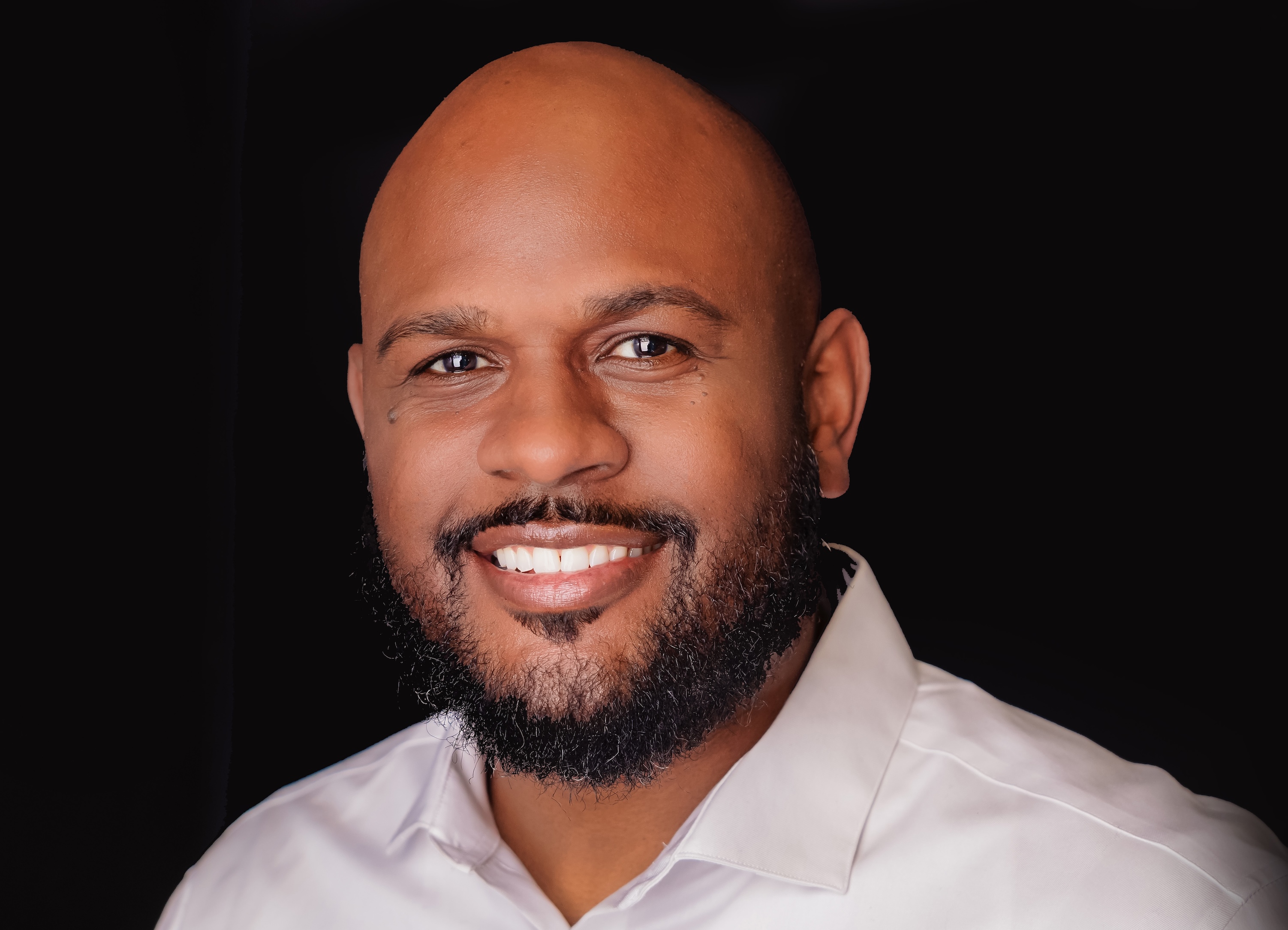
Billy Almon
Host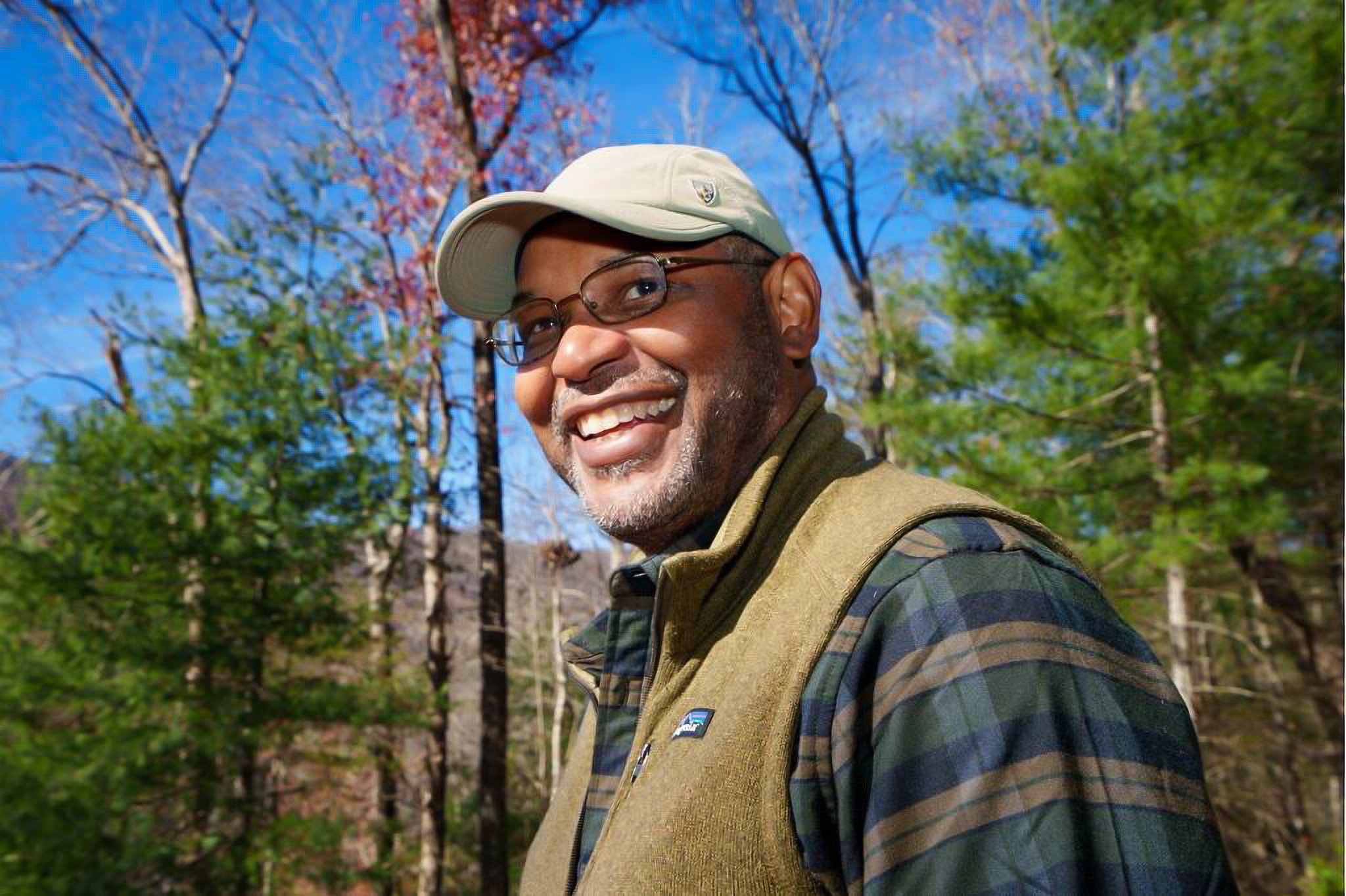
J. Drew Lanham
GuestBlue Dot Sessions
Music
Dr. J. Drew Lanham received a BA (1988), an MS (1990), and a PhD (1997) from Clemson University, where he is currently Alumni Distinguished Professor of Wildlife Ecology and Master Teacher in the Forestry and Environmental Conservation Department.
Lanham is also a 2022 MacArthur Fellow, an inaugural fellow of the Audubon-Toyota Together Green Initiative and is an Advisory Council member of the North American Association for Environmental Education. He is also an emeritus member of BirdNote’s Board of Directors.
He's most recently authored the book of poetry, Joy is the Justice We Give Ourselves. Lanham is the poet laureate of Edgefield, South Carolina, and the author ofother books such asThe Home Place: Memoirs of a Colored Man’s Love Affair with Nature and Sparrow Envy, which received the Reed Award from the Southern Environmental Law Center and the Southern Book Prize, and was a finalist for the John Burroughs Medal.
He's also written Sparrow Envy: Field Guide to Birds and Lesser Beasts (2021) and has published in a variety of leading journals and media platforms, including Audubon, Orion, Vanity Fair, Forest Ecology and Management, Oxford American, Flycatcher, and Wilderness. And he's featured in several anthologies, including The Colors of Nature, State of the Heart, Bartram’s Living Legacy, and Carolina Writers at Home.
Sights & Sounds