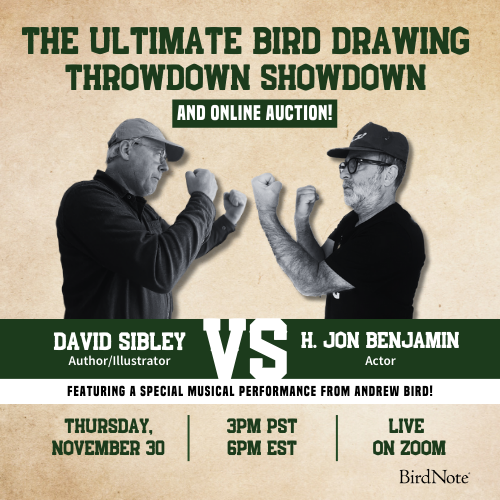
Join BirdNote tomorrow, November 30th!
Illustrator David Sibley and actor H. Jon Benjamin will face off in the bird illustration battle of the century during BirdNote's Year-end Celebration and Auction!
Wonder and Awe with Aimee Nezhukumatathil
Featuring poetry from her new book, Night Owl.

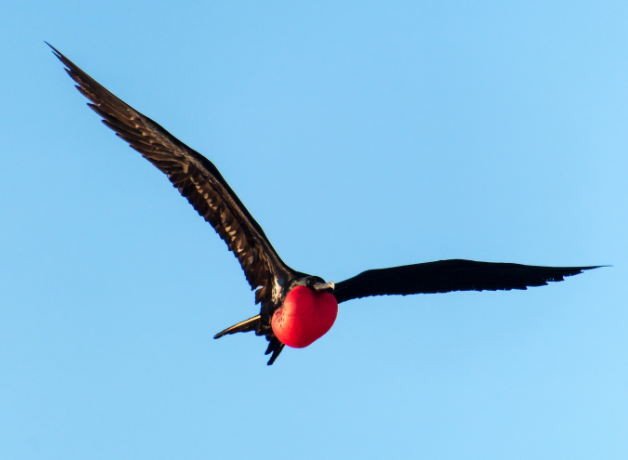

© Peter Swain
It’s National Poetry Month in the U.S., and each year we like to celebrate by sharing our favorite contemporary writers’ work about birds. Aimee Nezhukumatathil is known for writing about nature, but more than that, wonder at the natural world. In this episode, Aimee describes precious moments she’s shared with birds, plants, and her teenage son.
BirdNote®
Wonder and Awe with Aimee Nezhukumatathil
Written by Mark Bramhill
Mark Bramhill: This is BirdNote.
It’s National Poetry Month in the US, and each year we like to celebrate by sharing our favorite contemporary writers’ work about birds. Aimee Nezhukumatathil is known for writing about nature, but more than that, wonder at the natural world.
Aimee Nezhukumatathil: One of the roots of the word ‘wonder’ is the same root of the word ‘to smile’. And so for me, wonder is curiosity, but with a smile.
Mark Bramhill: And Aimee is full of both curiosity and smiles. Her poetry is often driven by encountering a new species, learning a new animal behavior, seeing connections between nature and ourselves.
Aimee Nezhukumatathil: When you’re like, gosh, why does the Barred Owl sound like, ‘who cooks for you? Who cooks for you all’? You know, that kind of thing. Like, who came up with that? And how do you even say that phrase without smiling?!
[Barred Owl Call]
Aimee Nezhukumatathil: I have no tolerance for people who say, ‘I have nothing to write about’. like, you are not looking, you are not hearing, you are not feeling, you are not tasting. Like what is wrong with you that you are not just opening yourself up to ask why or how or what, you know, like just to be curious about the world around you.
I don't understand how anyone can run out of things to write about when you've got this planet to work with.
Mark Bramhill: For example, take the Baja Fairy Duster. When Aimee first saw this woody shrub, she was enamored. It's native to the Baja peninsula, hence the name. But the 'fairy duster' comes from its flowers: they're bright red pom-poms that seem impossibly delicate. That plant inspired this poem:
Aimee Nezhukumatathil: This is called When You Are Near, I Turn Into a Baja Fairy Duster at Night:
When You Are Near, I Turn Into a Baja Fairy Duster at Night
By which I mean I look like that flower that fireworks in midsentence
in the sky, over the end of a sweaty ball game. The crowd makes its way
to their cars while popcorn-spill & multicolored chocolate candies melt
into concrete steps. Maybe I mean you make me want to live
beachfront—so I can taste the salt & cliff-twist on each red stamen.
When you’re near, you call hummingbirds to my throat & we throw
our heads back and stomp our feet from laughing too loud in a café.
I make good tears in my eyes, which means joy & maybe emerald
feathers fall to the floor. All the other patrons turn to glare: how
dare we delight in the swoop of blossom & neck. I know
it sounds like turning into a plant would not be fun, but have you seen
a Baja fairy duster? The way it shocks the mountain trail, how
it asterisks all year round? Perhaps you think I’d be sad to rely
on sunlight & sea spray, that I would wither in the dark, but trust me—
some people wait whole pink & proper lives to feel this even once.
Mark Bramhill: Noticing and investigating the flora and fauna around her isn’t just something that brings Aimee joy — she thinks we should all get to know our natural neighbors.
Aimee Nezhukumatathil: I just think it's so important to know who else is sharing the planet with us?
As kids, everybody wants to know the names. Like, “what's this? What's this? What that? What that?” They want to know! Like, somewhere in middle school, I think that curiosity leaves half of us, you know, or we get shut down and then it's like, ‘oh, well forget it. I get made fun of when I ask a question, so I'm not gonna ask anymore.’ But remember what it was like when we were kids and we wanted to know the name of all the dinosaurs, all the fish, like all the birds? You know, things like that. Like we should still be doing that as grownups!
Mark Bramhill: And it's not like you need to know the names of every plant or animal.
Aimee Nezhukumatathil: That's like a, you know, a whole lifetime would never be enough. But if you just start small, like, can you learn three birds that you didn't know were in your neighborhood yesterday? Study them, get to know their habits, when they appear, what they sound like — that's three more birds than you knew last year!
[Waves on the beach on Yucatan Peninsula fade in]
Mark Bramhill: As much as Aimee loves nature and wonder, even she needs the occasional reminder to stay curious and open to the unexpected. On winter holiday with her son in Cancún, Aimee was in a bit of a funk. She was coming to terms with her first kid imminently leaving the nest to go off to college.
Aimee Nezhukumatathil: Like, wait a minute, we didn't… take you to this national park, or… I don't know if you know how to make a frittata! Or, you know, like nothing that he needs necessarily his first year in college in a dorm. But you just run through the list and there's never enough time.
Mark Bramhill: This trip was where he wanted to go, a kind of high school graduation gift. And while Aimee adores her son, the most tourist-y part of Cancún? Not so much.
Aimee Nezhukumatathil: I was not thrilled to be there in the first place. You know, I wanted to be like in a remote, like the Everglades say or something. I think I was kind of just disgusted seeing all this light pollution.
Mark Bramhill: Not a great starting place for awe and wonder. But that first night there inspired this short poem:
My Son Reminds Me He Was Listening All Along
Just when I think
there is so much
I have yet to teach him
before he flies off to college.
Look up! he points
from the balcony,
our first night in Cancún —
a whole flock
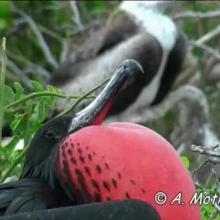
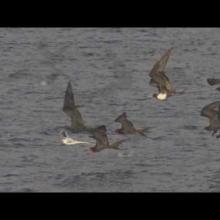
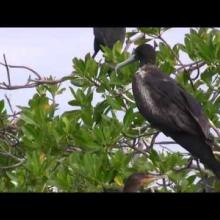
of Magnificent Frigatebirds
night feeding, their white necks
lit from the glow on hotel row.
[Clicks of Magnificent Frigatebirds above the waves]
Mark Bramhill: Aimee had always tried to instill a love of nature in her kids, taking them hiking or birding, teaching them the names of plants. As teenagers, they seemed less receptive. But on that balcony, Aimee was moved by her son’s open wonderment.
Aimee Nezhukumatathil: It was so magical. I get teary-eyed just thinking about it. Like, all the times he was rolling his eyes at me, he learned something: to look up. You know, like even when I was just disgusted, frustrated, like I wasn't where I wanted to be for the holidays. He kind of taught me a lesson too.
Mark Bramhill: The poem is a 'carmina figurata', or 'concrete' poem, where the words are arranged in the shape of the poem’s subject. So, in this case, try and picture all those lines arranged in the silhouette of a Magnificent Frigatebird.
If you're having trouble imagining that, that's ok! You can find both of these poems in Aimee's new book Night Owl. It's all about the night and the creatures in it — salamanders, fireflies, and of course more birds.
And for even more wonderful poetry about birds, check out our new hourlong special Words in Flight. Find these at our website, BirdNote.org. I'm Mark Bramhill — happy poetry month.
###
Senior Producer: Mark Bramhill
Producer: Sam Johnson
Managing Editor: Jazzi Johnson
Managing Producer: Ariana Remmel
Content Director: Jonese Franklin
Bird sounds provided by The Macaulay Library of Natural Sounds at the Cornell Lab of Ornithology, Ithaca, New York. Barred Owl ML105433 recorded by Geoffrey A. Keller. Anna's Hummingbird ML171963 recorded by Gregory Budney. Magnificent Frigatebird ML136230 recorded by Martha Fischer.
BirdNote’s theme was composed and played by Nancy Rumbel and John Kessler.
© 2026 BirdNote April 2026 Narrator: Mark Bramhill
ID# NezhukumatathilA-01-2026-04-03 NezhukumatathilA-01
Mark Bramhill
Writer NarratorSights & Sounds