
Join BirdNote tomorrow, November 30th!
Illustrator David Sibley and actor H. Jon Benjamin will face off in the bird illustration battle of the century during BirdNote's Year-end Celebration and Auction!

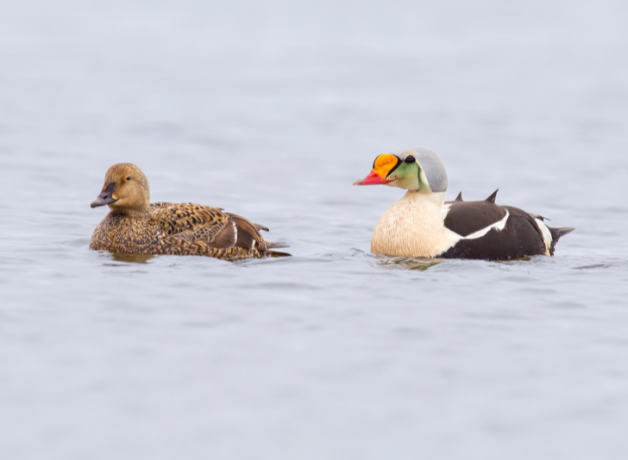

© Mick Thompson
The King Eider is one of the most striking sea ducks in the Northern hemisphere. This male King Eider is trying to woo a mate with soft coos and brilliant colors — his beak and feathers are decked out in black, white, green, grey, tangerine, yellow, and ivory. Unlike her showy suitor, the female King Eider is mottled brown — the perfect camouflage for blending into the Arctic tundra. After incubating her nest for nearly three weeks by herself, the female eider leads her fluffy chicks to the sea where the ducks spend the winter diving amidst the pack ice in search of tasty shellfish.
This episode is dedicated to Gary and Liz Kennedy Ketcheson, who are grateful to BirdNote for sharing the wonder of birds with listeners around the world.
BirdNote®
The Stunning King Eider
Written by Ariana Remmel
This is BirdNote.
[King Eider]
This bird may not quack like a duck or look like a duck, but the King Eider is one of the most striking sea ducks in the Northern hemisphere.
[King Eider]
This male King Eider is trying to woo a mate with soft coos and brilliant colors — his beak and feathers are decked out in black, white, green, grey, tangerine, yellow, and ivory.
[King Eider; King Eider female, in the background]
Unlike her showy suitor, the female King Eider is mottled brown — the perfect camouflage for blending into the Arctic tundra where she’ll hunker down on her nest for 3 weeks by herself!
[King Eider chicks]
When the eggs hatch, she’ll guide her fluffy ducklings toward the sea, stopping at freshwater “nursery” ponds along the way — always on alert for hungry foxes and gulls.
[Waves crashing]
Young eiders quickly learn to fend for themselves at sea. Some venture south toward coastal Washington and New England, but most spend winter amidst the pack ice, diving for shellfish and crustaceans from nearly 180 ft below the surface.
At least until spring, when King Eiders flock by the tens of thousands to croon and swoon on the Arctic tundra once again.
[King Eider]
For BirdNote, I’m Mark Bramhill.
This episode is dedicated to Gary and Liz Kennedy Ketcheson, who are grateful to BirdNote for sharing the wonder of birds with listeners around the world.
###
Senior Producer: Mark Bramhill
Producer: Sam Johnson
Managing Producer: Jazzi Johnson
Managing Producer: Ariana Remmel
Content Director: Jonese Franklin
Bird sounds provided by The Macaulay Library of Natural Sounds at the Cornell Lab of Ornithology, Ithaca, New York. King Eider ML31729201 recorded by Andrew Spencer, ML121655821 recorded by Stein Nilsen, and ML137308 and ML137307 recorded by Stewart D. MacDonald.
BirdNote’s theme was composed and played by Nancy Rumbel and John Kessler.
© 2026 BirdNote March 2026
Narrator: Mark Bramhill
ID# KIEI-01-2025-03-25 KIEI-01
Reference:
https://www.allaboutbirds.org/guide/king_eider
https://birdsoftheworld.org/bow/species/kineid/cur/introduction

Mark Bramhill
Narrator