

Join BirdNote tomorrow, November 30th!
Illustrator David Sibley and actor H. Jon Benjamin will face off in the bird illustration battle of the century during BirdNote's Year-end Celebration and Auction!


© Matthew Studebaker
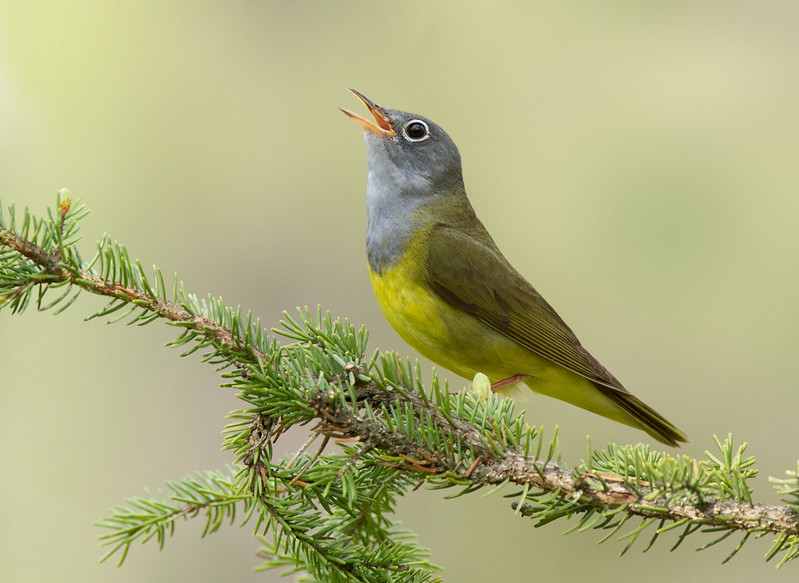
Connecticut Warblers nest in the northern boreal forests, migrate through the Midwest, and winter in the rainforests of South America. Even with all that traveling, you rarely see one of these birds. Though their loud, ringing song might be easy to identify, it often seems to emanate from low in a tree when the warbler is perched high in the crown, frustrating birders from Canada to Brazil.
This episode is brought to you by Wild Delight Bird Food, which aims to support wild bird populations with clean, nutritious ingredients in every blend. Available at Chewy.com.
BirdNote®
Connecticut Warbler
Written by Rick Wright
This is BirdNote.
[Connecticut Warbler]
It’s incredibly challenging to spot a Connecticut Warbler. It’s not that the bird is especially rare or its range is especially narrow. It isn’t restricted to rugged, remote wildernesses. This relatively big, slow-moving warbler just keeps a low profile — whether it’s nesting in the boreal forests, wintering in the forests of South America, or migrating between the two.
The best way to track down a Connecticut Warbler is by listening for its loud and distinctive song.
[Connecticut Warbler]
But even singing birds on the breeding grounds can be tricky to spot. Observers in the north woods of Minnesota regularly find themselves swatting black flies for an hour or more before seeing so much as a brief glimpse of this bird as it struts across the forest floor.
When it does perch deep in a small spruce or tamarack to sing, the Connecticut Warbler carefully conceals itself before making a peep.
And even the call itself makes it hard to pinpoint the bird -- it often sounds like the bird is calling from low in a tree when it’s actually perched high in the crown.
[Connecticut Warbler]
It takes more than a little luck for intrepid birders to train their binoculars on this songbird.
For BirdNote, I'm Michael Stein.
This episode is brought to you by Wild Delight Bird Food, which aims to support wild bird populations with clean, nutritious ingredients in every blend. Available at Chewy.com
###
Senior Producer: Mark Bramhill
Producer: Sam Johnson
Managing Producer: Jazzi Johnson
Managing Producer: Ariana Remmel
Content Director: Jonese Franklin
Bird sounds provided by The Macaulay Library of Natural Sounds at the Cornell Lab of Ornithology, Ithaca, New York. Connecticut Warbler, ML 10074, recorded by Robert C. Stein.
BirdNote’s theme was composed and played by Nancy Rumbel and John Kessler.
© 2020 BirdNote October 2020 / September 2022 / March 2026
Narrator: Michael Stein
ID# CONW-01-2020-10-02 CONW-01

Rick Wright
Writer
Michael Stein
NarratorRelated Field Notes

Male Marsh Wrens will build several--as many fifteen--dome shaped shells in the reeds to woo fema
The Osprey is the only North American raptor to eat fish almost exclusively, and it's well adapte