

Join BirdNote tomorrow, November 30th!
Illustrator David Sibley and actor H. Jon Benjamin will face off in the bird illustration battle of the century during BirdNote's Year-end Celebration and Auction!
Ancient Birds Nested in the Arctic, Too
The oldest known breeding colony dates back to the age of the dinosaurs.

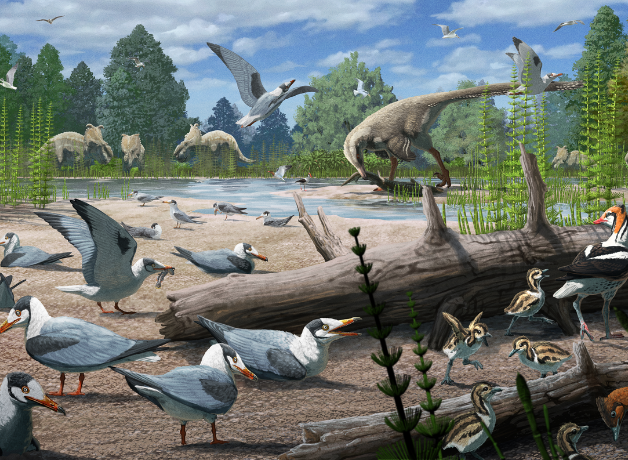

© Illustration by Gabriel Ugueto/Science
Every summer, millions of birds flock to the Arctic Circle to find mates and raise their young. In a study published in 2025, paleontologists found evidence of the earliest known Arctic breeding colony from fossils uncovered in northern Alaska. The site dates back nearly 73 million years when many prehistoric predecessors to modern birds still had teeth; including the gull-like ichthyornitheans and the flightless, loon-like hesperornitheans. These were among several types of ancient avians preserved as both adults and hatchlings, which suggests the site was used for nesting. Just like today, these birds were likely taking advantage of the abundant food provided by the 24-hours of summer daylight.
BirdNote®
Ancient Birds Nested in the Arctic Too
Written by Adé Ben-Salahuddin
This is BirdNote.
[Arctic breeding colony soundscape]
Every summer, millions of birds flock to the Arctic Circle to find mates and raise their young. Now, a new study [Alt: And a study published in 2025] suggests that this tradition has been going strong since the age of the dinosaurs.
Paleontologists found evidence of the earliest known Arctic breeding colony from fossils uncovered in northern Alaska. The site dates back nearly 73 million years when many prehistoric predecessors to modern birds still had teeth; including the gull-like ichthyornitheans and the flightless, loon-like hesperornitheans.
These were among several types of ancient avians preserved as both adults and hatchlings, which suggests the site was used for nesting. There were even fossils from early members of bird lineages that gave rise to the ducks and chickens still around today.
But why the Arctic? Just like today, these birds were likely taking advantage of the abundant food provided by the 24-hours of summer daylight. The traits that allowed early modern birds to thrive in the Arctic climate might have even helped them survive the mass extinction that wiped out the rest of the dinosaurs.
[asteroid strike, brief silence, resume Arctic breeding colony soundscape]
You’ll find more about Arctic birds, both past and present, when you visit our website, BirdNote.org. I’m Adé Ben-Salahuddin.
###
Senior Producer: Mark Bramhill
Producer: Sam Johnson
Managing Producer: Jazzi Johnson
Managing Producer: Ariana Remmel
Content Director: Jonese Franklin
Bird sounds provided by The Macaulay Library of Natural Sounds at the Cornell Lab of Ornithology, Ithaca, New York. Glaucous Gull ML130972 recorded by Gerrit Vyn.
BirdNote’s theme was composed and played by Nancy Rumbel and John Kessler.
© 2026 BirdNote January 2026
Narrator: Adé Ben-Salahuddin
ID# breeding-03-2026-01-27 breeding-03
Reference:
https://www.science.org/doi/10.1126/science.adt5189

Adé Ben-Salahuddin
Writer NarratorRelated Field Notes

Male Marsh Wrens will build several--as many fifteen--dome shaped shells in the reeds to woo fema
The Osprey is the only North American raptor to eat fish almost exclusively, and it's well adapte