

Join BirdNote tomorrow, November 30th!
Illustrator David Sibley and actor H. Jon Benjamin will face off in the bird illustration battle of the century during BirdNote's Year-end Celebration and Auction!
White-winged Doves and Saguaro Cactuses
In the Sonoran Desert, doves and cactuses share a symbiotic relationship.

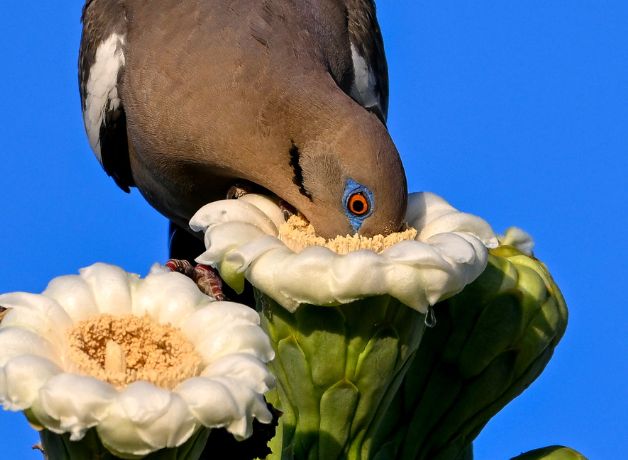

© Mike Henry
White-winged Doves are common throughout Central America, the Caribbean, and North America’s Desert Southwest. Like the closely related Mourning Doves, they primarily eat seeds and grains. But in the Sonoran Desert, White-winged Doves time their migration to sync up with the Saguaros’ reproductive cycle – to the benefit of both species. The cacti provide doves with a crucial source of water in the driest part of the Sonoran summer. The doves sustain the saguaros as pollinators and seed dispersers. It’s a classic case of mutualistic symbiosis.
BirdNote®
White-winged Doves And Saguaro Cactuses
Written by Ariana Remmel
This is BirdNote.
[White-winged Dove wingbeats]
It’s morning in southern Arizona and a White-winged Dove coos from atop a Saguaro Cactus.
[White-winged Dove song]
He looks a lot like a Mourning Dove, a close relative. But this bird’s voice — and signature white wing patch — set him apart.
[White-winged Dove song]
[In background for rest of episode, White-winged Dove calls]
White-winged Doves primarily eat seeds and grains. But in the Sonoran Desert, a large part of their diet depends on Saguaro Cactuses. These massive plants grow in columns more than 40 feet tall. In late spring, they bloom a crown of large white flowers, packed with sweet nectar. The blossoms attract bees, bats, and doves that transfer pollen between plants as they forage.
[White-winged Dove wingbeats]
The Saguaros then bear fruit that bursts open to reveal a dark red pulp and thousands of delicious seeds.
[White-winged Dove song]
In the Desert Southwest, White-winged Doves time their migration to sync up with the Saguaros’ reproductive cycle – to the benefit of both species. The cacti provide doves with a crucial source of water in the driest part of the Sonoran summer. The doves sustain the saguaros as pollinators and seed dispersers. It’s a classic case of mutualistic symbiosis.
[White-winged Dove song]
Learn more about the relationships between plants and birds on our website, BirdNote.org. I’m Mark Bramhill.
###
Senior Producer: Mark Bramhill
Producer: Sam Johnson
Managing Producer: Jazzi Johnson
Managing Producer: Ariana Remmel
Content Director: Jonese Franklin
Bird sounds provided by The Macaulay Library of Natural Sounds at the Cornell Lab of Ornithology and by Xeno-Canto. White-winged Dove XC940721 recorded by Richard E. Webster, ML175874441 recorded by Rick Sharloch, and ML4037 recorded by Robert C. Stein.
BirdNote’s theme was composed and played by Nancy Rumbel and John Kessler.
© 2026 BirdNote August 2026
Narrator: Mark Bramhill
ID# WWDO-01-2026-08-03 WWDO-01
Reference:
https://www.desertmuseum.org/pollination/doves.php
https://www.allaboutbirds.org/guide/White-winged_Dove/overview
https://birdsoftheworld.org/bow/species/whwdov/cur/introduction
https://www.nps.gov/orpi/learn/nature/saguaro-cactus.htm

Mark Bramhill
Narrator
Ariana Remmel
WriterRelated Field Notes

Male Marsh Wrens will build several--as many fifteen--dome shaped shells in the reeds to woo fema
The Osprey is the only North American raptor to eat fish almost exclusively, and it's well adapte