
Join BirdNote tomorrow, November 30th!
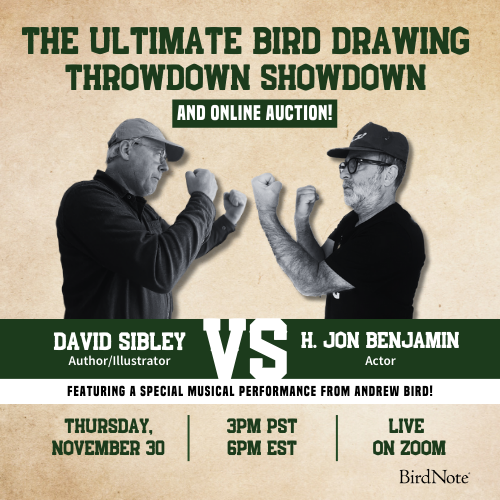
Illustrator David Sibley and actor H. Jon Benjamin will face off in the bird illustration battle of the century during BirdNote's Year-end Celebration and Auction!
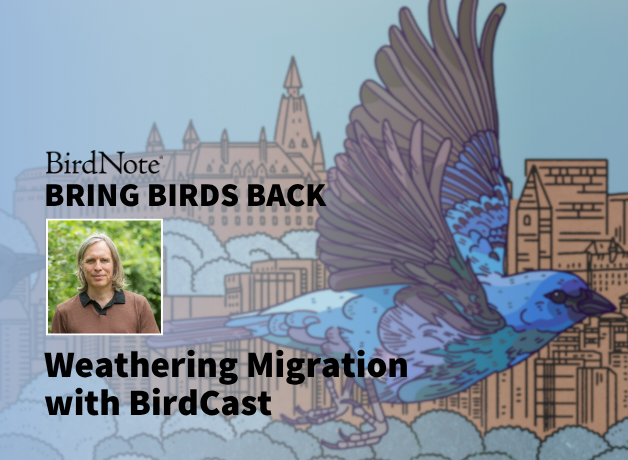
Weathering Migration with BirdCast
Bring Birds Back Season 8, Episode 4: Learn how researchers use weather radar to track migrating birds.

In this episode, Dr. Deja Perkins speaks with aeroecologist, Dr. Adriaan Dokter about the study of bird migration with weather radar. Using the vast supply of radars, primarily in the United States, Adriaan and his colleagues at the Cornell Lab of Ornithology research the failure and successes of journeying birds from all over the world. Adriaan also talks about the power of BirdCast, a weather radar website that tracks the progress of traveling birds in the air each migration season. Learn what they’ve uncovered and how they’re using it to benefit conservation when you press play!
BirdNote is a nonprofit. Your tax-deductible gift makes these shows possible.
Want more Bring Birds Back? Follow us on your favorite podcast app and on Instagram @BringBirdsBack!
For more about BirdNote, sign up for our weekly newsletter. And for ad-free listening and other perks, sign up for BirdNote+ here. Learn how you can get involved in our From Love to Action campaign when you visit this page!
Bring Birds Back Season 8 is sponsored by Teton Science Schools and the Cornell Lab of Ornithology’s Bird Academy.
Deja Perkins: BirdNote Presents...
[Bring Birds Back Stinger]
This is Bring Birds Back and I’m Dr. Deja Perkins...
The world is constantly and rapidly changing, yet one thing stays the same, and that’s the need for migration. Migration is one of those historical journeys that many species complete, even humans. In search of optimal resources and opportunities for survival, one of the most fascinating, grueling, and anticipated multi-country crossings is the biannual bird migration. If you’re a birder, you probably look forward to the colors and ID challenges that spring and fall migration bring, but have you ever thought about the difficulties of a migratory journey?
As researchers, we use a variety of methods to study birds. Sometimes we use techniques that require capturing and studying birds in the hand; things like netting, banding, and tracking, to name a few. Other times, we use observation, like nest monitoring with binoculars, counting species by sight or song, and reporting bird bands. And then, there are those of us who study birds on the computer, using geolocated science data or even radar technology to study bird movement, migration, and land-use patterns.
The foundation of radar technology began to emerge around the late 1800s. And over the past 80 years or so, some scientists have been using it to study bird migration. On this episode of Bring Birds Back, we’ll learn more about how we use radar technology to study bird migration, with my guest radar ornithologist, Adriaan Dokter from the Cornell Lab of Ornithology.
—--------------------
Deja: Hi, Adriaan. Thank you for coming on the show today. Can you introduce yourself and what you do to our audience?
Adriaan Dokter: Yeah hi, I am Adriaan Dokter. I'm a researcher here at the Cornell Lab of Ornithology and I'm working on bird migration. I'm studying mostly the migratory flights of birds when they are in the air and moving from their breeding grounds to their wintering grounds and back. Been here for the last 10 years.
Deja: Wow. Can you talk to us a little bit about migration ecology? What exactly is that?
Adriaan: Yeah. Migration Ecology really focuses on that interesting and challenging cycle in a bird's life– or not just birds, there's many migratory animals ranging from whales to insects. But birds are really, of course, our most well known migratory animals, I would say. 'Cause they're so beautiful and they're noticeable.
And migration biology sort of studies this very challenging phase of these birds. They might travel for thousands of kilometers in any given spring or fall. So often also a dangerous and challenging phase in a bird's life. Especially if you think of ways like a lot of these birds they're going on their first migration, they've never done this, and uh, they head out and there they go.
Deja: Yeah, I can only imagine if we had to do something similar and go out on this long journey without actually knowing where we're supposed to go. That's actually a very intimidating thing to think about; traveling for so many miles just to a new place without ever having gone there.
Adriaan: Yeah, exactly.
Deja: Can you tell us why you chose to study birds in this way? What sparked your interest?
Adriaan: It's like something that grew mainly from my early childhood. I grew up in the Netherlands, close to the sea in the city of Haarlem. And, you know, there were a lot of migratory birds around and I was maybe also a little shy kid. So I dove as an early kid already deep into ornithology and I was just going out and I always was very fascinated with migration.
It's maybe not very noticeable at first, but once you know where to look, it's really impressive. And just a sheer number of birds that you see fly over. So I would climb on a dune top and sit there early in the morning and just see all these birds go by. That sparked an early interest and I'm fortunate that I am able to continue working on that.
Deja: So as a kid, was there a specific species that really hooked you into wanting to study birds?
Adriaan: Maybe I was very fascinated with Swifts, you also have them in the US, like the Chimney Swifts. In Europe it's more the Common Swift.
[Common Swift calls]
You just hear them everywhere in the summer. They're really the sound of the summer and you hear them screeching over your house, even if you live in a city like I did.
They fly almost for 10 months nonstop through the air.
But the cool thing about these birds is they're really ultimate flyers. They sort of only come down to breed under your roof maybe for one or two months, and after that they're just off and they fly almost for 10 months nonstop through the air. So, I mean, that really fascinated me that birds can be so adaptive to flight and just be such an ultimate flyer. There's many, many cool examples of extreme migrants, but this is really one of them that was just close to my home, you know?
Deja: Yeah, that is really cool to have a bird that is able to be constantly flying for 10 months out of the year. That sounds exhausting, um, but Swifts are some pretty cool species. I think back to seeing Chimney Swifts doing their, like, swirling flight going into the chimney for the first time this past year. And that was just fascinating to see them move all in sync. And they’re definitely some pretty cool birds.
Adriaan: Yeah, you were saying that must be exhausting for them. I think that's a big question, actually, that we still have, like how challenging is it for them to migrate? And it's often humbling if you also have birds that are not migrants, but that just fly around a lot like gulls that are just doing their daily migrations from here and there.
If you add up how much distance they actually go, just on these forging flights, it really adds up to a lot. So what we think is maybe very challenging on birds, they might just be so used to it and so adapted to it that they can do these long distances without that much effort.
Nonetheless, it's a challenging and dangerous period, this long distance migration for most birds. We do think that a considerable amount of mortality does happen during migration.
Deja: I think when we think about mortality, in recent episodes that we've had, we've thought a lot about how they come across different challenges in urban areas like running into glass and being victims of window strikes. But are there any other challenges that birds may come across during migration?
A lot of birds just migrate in total darkness.
Adriaan: Yeah, like a lot of birds just migrate in total darkness. That's why in my research I use a little radar, for example, to study birds because you can detect them when they're flying at night. But the landscape at night has really changed a lot. Because, like, humans altered the landscape, the whole scenery is different.
You see the sky glow from big cities. Birds can see this from very very far away. While they were sort of evolved to migrate under these pitch dark skies where they had good access to light from the stars and for orientation. So we don't really know exactly how that has impacted the migratory birds movement. But it does seem to be that, especially light at night, does attract birds and draws them maybe into cities and areas where their survival might not be great. Any urban environment has a lot of challenges with- you mentioned glass, but also cars and cats.
It's a challenging environment for a bird that might have grown up in, sort of, the boreal forest of Canada and has never actually seen any of that and is not used to it. But I think we also think that migration is probably challenging because, uh, you know, birds do that for the first time. They're in a new environment and they don't know the dangers. Predation risks are probably also higher. And then some birds make these long migratory flights over, for example, the Gulf of Mexico all the way to Central America. That's just dangerous to do and they can run into bad weather. And I guess that's when we maybe see some of these more dangerous mortalities.
Deja: Yeah, there's so much that they have to overcome on these long journeys that I don't think the average person thinks about a lot. Traveling in a plane at night, I think that puts into perspective how large of an issue the lights at night can be; to be up 10,000 feet in the air and seeing cities, like you can tell the difference between a city and a rural area just by all of the lights. You can tell the different types of lights that different places have on the streets. And, it is really disorienting. So I could only imagine trying to navigate by the stars as a bird, and seeing all these dazzling things on the ground, just kind of deter you on your journey.
Adriaan: Yeah, exactly.
Deja: You are a part of the BirdCast team as a research associate. Can you explain what BirdCast is and what you do there?
Adriaan: Yeah, so BirdCast is a public platform managed by the Cornell of Ornithology, but it's very much a research collaboration between various institutions.
Deja: [to audience]
[Driving guitar music starts]
The Cornell Lab of Ornithology helped establish BirdCast in 1999. BirdCast is jointly managed by its leading researchers, analysts, and developers from Colorado State University and the University of Massachusetts Amherst. It’s supported by a slew of leading funders and supporters, including the National Science Foundation and NASA.
BirdCast is a forecast mapping system for migratory birds and can be found on the web at BirdCast dot Info. The site refreshes with a live feed every migration season, with spring migration updates beginning March 1st through June 15, and August 1st through November 15th for fall migration.
Adriaan: And what we try to do is bring to people the sort of information about the migrations of birds that mostly happen at night. What we've tried to develop is sort of a system based on weather radars that are located through the US. Uh, there's 143 of these radars all through the lower 48, mostly used for weather observations. And what we've done in BirdCast is kind of turned that into a wildlife surveillance system, where we bring to you, like every 10 minutes, updates on how many birds are flying in the night sky.
And in addition to that, we also use those data to generate forecasts on when bird migration might happen in the future. So you can think of us as the weather reports, but for birds.
You can think of us as the weather reports-- but for birds.
Deja: There are a few different types of radar that can be used for science. These radars emit a radio frequency and measure the returning wavelength from an object. In this episode, we are referring to doppler weather radars which can detect different types of particles - like rain, hail and snow. Compared to other techniques, weather surveillance radar is great for monitoring lots of birds moving over a large area, which is what Adriaan's team uses for his nocturnal migration research.
Adriaan: Like most birders, I usually do look at BirdCast and I see, ‘Oh, there's gonna be a major flight tomorrow or this night, I'm gonna go out, definitely, the next morning to see what new birds I might find’. I mean, migration is always very exciting and often during migration you see species that you only see during the migratory periods.
[Driving guitar music ends]
Deja: Yeah. You never know what you might see, so just make sure you go out. Um, so let's talk a little bit about the technology behind BirdCast. You've mentioned a couple times that it uses radar. Can you explain how this radar technology works and how it may be different from other forms of bird data collection?
Adriaan: Yeah, radars are really interesting technology. And it's been around for a while. It was basically in the Second World War that these radars were really used for the first time and that people sort of noticed that there's actually birds being detected on our radar screens. And they were, in the early days, mostly used for military applications or looking whether there were some airplanes coming towards you or not. These radars are very expensive to operate. The fact that there are existing networks of radars in the US really allows us to use them to survey birds and also insects and bats and potentially other things. Something we couldn't do if we had to build that from scratch.
So the radar network that we mostly use is called NEXRAD. It's short for Next Generation Radar. It's a big network that's maintained by NOAA and also other organizations. So if you open up your weather app on your phone and you see the precipitation going over a map, that's most likely detected by a NEXRAD radar. By default you don't see any birds on those because meteorologists try to filter those out and just present you the clear weather signal. Uh, what we do, sort of look into, sort of, the garbage bin of the meteorologists and try to make sense of the biological echoes.
So even bird density of a few birds per cubic kilometer- very sparse, very low migrations- these radars are so extremely sensitive that we can easily detect the migratory birds. And, maybe, say the last 10 years or so, the use of these radar networks has really transformed or sort of given a bird's eye view on bird migration. Like we really start to see these continental scale flyways of songbirds over the continents and just also the massive scale that's involved in the huge numbers of birds that we can detect. So we have ways to really quantify how many birds are flying over our heads.
And similarly to, like how, if you look at the weather radar and you see a precipitation or a rain cloud, you might not see the individual droplets. It doesn't have that detail. It's the same for us with the birds. So we don't see the individuals, but we do see sort of the density and the biomass that's moving over our heads. And being able to put a number on that has been a success of BirdCast, I think. Just because people never realized just the enormous numbers of birds involved.
We are gearing up for spring now, but last fall we broke our record again, and in a given moment in October, we had over a billion birds in active flights above the US, which is just a mind-boggling number.
Last fall we broke our record again, and in a given moment in October, we had over a billion birds in active flights above the US, which is just a mind-boggling number.
Deja: Wow.
Adriaan: Yeah.
Deja: It is, I mean, that puts a lot into perspective thinking about how many birds would be needed in order for it to be mixed up with the cloud. Now, I know you mentioned that there are a lot of things flying in the sky, thinking about not just birds, but bats or even insects. Like, I know you said that you all are kind of going through, essentially, the trash of the meteorologists but how do you all distinguish between birds, clouds, or other insects once you have that next bit? Um, how do you all actually filter out everything else?
Adriaan: Right. Yeah. Which is not easy. Like, these weather radars have been around for like, over 30 years. But still we’ve had BirdCast less than 10 years– like, maybe 2018 we went live with these things. And both the radar technologies have improved but also the way in which we can analyze it. So it used to be that you just look at the radar image and you had to sort of manually brush out the rain, which is often much more intense than the birds. But if you have like 143 radars that give you an image every five to 10 minutes in a whole year, that becomes totally undoable. So a lot of the innovation has been around automating things and having computers learn to identify precipitation. And then that combined also with the enormous revolution that we've had in data centers and the whole internet also means that we can easily process radar data at a very massive scale and sort of filter out the birds.
So I think that that infrastructure of computing, that's really what makes this possible. And on the other end, I think there was also an upgrade to the radar system not terribly long ago. One really interesting upgrade that we've seen in recent years is the change to dual polarization radar. And these radars, they send out pulses of radiation that are polarized, uh, both horizontally and vertically.
And then you have sort of two channels that you can compare and it gets a little technical, to be honest, especially scattering on birds, it's very complicated. If I talk to meteorologists, they say, ‘Oh, you have a more difficult time than us dealing just with nice spherical droplets of rain’. So it's quite complicated to understand these signals, but luckily there's a really big difference in these dual polarization metrics between precipitation on the one hand and birds and bats and insects on the other hand.
And then we were able to train computers to do that automatically; that problem of getting rid of the rain, which was really a big one, so that was a really big change. After that, we're sort of still left with this sort of like, how do we distinguish birds from insects and bats? And I think it's a not fully solved problem, but I think we're lucky that just during migration in spring and fall, birds are just so enormously abundant compared to insects and bats that we can sort of safely assume that it's almost all birds that we are seeing.
But like in early fall, you know, then there's a lot of insects still in the air because insects like warmer climates. We're trying to work on filters for those too, by looking at how fast are the birds moving, and if there's like a little bit of insect contamination then you'll see that the biomass as a whole seems to be moving a little bit slow because insects mostly float with the winds. So we- we have some tricks there to sort of filter out the insects as well. But, um, yeah, that, that's, that's sort of what's behind it.
Deja: That's, that's really cool. I think one of the things that stood out is that there's a lot of machine learning and coding. So if anybody likes computing or coding and likes data and they like birds, then they could help with migration.
[overlapping]
Adriaan: Oh yeah. Yeah. They should contact me. Yeah, we have a funny niche where we're, we are ecologists but work very closely with computer scientists. And I had my training also in physics. Like, there's a lot of people in our field, which is called aeroecology, that have like a bit of a funny background between working with data and analysis, but also have that passion for birds at the same time.
[music transition]
Deja: After this break, we’ll dive deeper into what exactly scientists like Adriaan can learn about birds by using weather radar technology. And what their findings can teach us about their habitats, bird migration and bird conservation. We’ll be right back.
MIDROLL
[Music starts]
Deja: We’re back. I’m Dr. Deja Perkins and we’re speaking with radar ornithologist and researcher, Adriaan Doktor, from the Cornell Lab of Ornithology. We just discussed the importance of weather radar for tracking birds, how it’s used for BirdCast and for understanding migration.
Now, we’re going to talk a bit more specifics about what is being learned and how scientists are using that data to better conservation.
[Music ends]
Deja: What would you say is the most exciting thing that you've learned about birds during migration using weather radar technology?
Adriaan: Oh, that's a big one. One thing that I studied that I liked that we didn't do too long ago is using the weather radar to sort of look into the mortality and the birth of young birds. Um, so what one thing that we can do is like, see how many birds are leaving, for example, the Texas and the southern border of the US.
So in the fall when they're migrating south. And then we measure again in the spring how many young birds are coming back. And then usually you'll see that fewer birds are coming back, right? Because there's mortality happening during migration and when they're over wintering in the south. And that allows us to sort of estimate, survival of all birds combined on a very massive scale. And it turns out to be that actually those long distance migrants that we mostly measure in the south of the country right before they hit away on the Gulf of Mexico. That's why we- we can filter or zoom into those types of migrants by just looking at birds migrating in the south.
They have actually quite a high survival. And if you compare that, for example, to if you would do the same study, see how many birds are coming in through the northern border of the US to overwinter from Canada and then come back in the spring- survival is quite a bit lower. And I was first surprised and then I thought, ‘Oh, this actually makes some sense’.
I mean, there's a reason, right, that these birds are migrating to the tropics and to warmer areas. That really allows them to have a good overwintering time where there's a lot of foods and and good survival in the winter while other species of birds, they might have just chosen to follow a different evolutionary path. They have more strategy of staying with us in the winter and therefore being exposed also to these harsh conditions and have a higher risk to die and to not make it through the winter.Think of robins or like White-throated Sparrows or Song Sparrows that stay mostly in the US and they have to, sort of, manage the winter but their life strategies have just evolved to deal with that. They also make a lot more young.
And so in the end, you know, there's these different strategies that different species of birds have taken and some of them rely more on producing a lot of young and accepting therefore that more birds will die in the winter, while other birds maybe produce less young, but they gamble more higher survival.
So it was nice that that's a sort of high level thing, but we were still able to contribute to those questions using the weather radar network by looking at mortality at this massive, massive scale.
And that has been a bit of a theme, maybe more of these demographics in my recent research where we've also been able to look at sort of trends and how birds are changing. So that was another important study that we did, that we do see a bit of a decline. If you look with radars in the night sky, there's a few percent fewer birds every year, which suggests we do lose some of our common migratory birds. Which concerns me for obvious reasons.
If you look with radars in the night sky, there's a few percent fewer birds every year, which suggests we do lose some of our common migratory birds. Which concerns me for obvious reasons.
Also, think that [the] radar really looks at a lot of common birds, right? The radar doesn't see, like, a very rare species. It really looks at the mass and the millions and millions of birds. So the fact that we see declines with radar sort of suggests common birds are probably in decline. That's really one of the major trends that we see.
Deja: I feel like that is a really big sign for concern if the birds that we see every day and think are going to just always be around, are in decline. And I'm curious, are you all seeing any different changes when it comes to climate change and how far birds are either traveling up or down. Are you all seeing anything with this kind of long term data that you have?
Adriaan: Yeah, I mean, this is really a hot topic of research and it's a difficult one because you mentioned climate change and habitat change.
[music addition here]
It's happening in North America. It's happening in Central America. It's happening everywhere, right? Like, it's one thing to measure and notice that certain species are declining, but then to really pinpoint why that is and sort of the real causes of the declines, that's much more difficult. And that's really something, I think in our field is really up there as something we need to get better at. Because, like, if you wanna do something about it, you wanna know, ‘Do we need to do something on the breeding grounds? Is that the challenge? Or is it during migration? And is migration becoming more dangerous? Or is it maybe in the non-breeding grounds? Is there something changing?’ And we kind of want to know, you know, ‘where's the bottleneck?’ And then only for a few species, we have some understanding of that, but for the majority, really not.
And, and maybe the answer is that there are challenges everywhere, but, for efficient conservation actions, you do wanna pinpoint that more and more. That's why I think getting better understanding of these underlying things of mortality and recruitment will be really central to better understanding that.
And we do a little contribution of that with the BirdCast project, with radar. But ultimately I think a lot of these questions will also be species specific and we need to look more and more into different species. So also in the context of BirdCast, that's really something we're thinking about. Like, ‘Oh, how can we maybe make our radar data and our analysis about migration and movement, make that transition maybe towards more species specific information?’ Because yeah, species matter.
Deja: Is there any species that you've found to be of greatest concern through your research thus far
Adriaan: I think that that not only my research, but I think more generally, if you think about grassland birds, they're often really in decline. And maybe not surprising, like there's a lot of change in agricultural practices with mowing that has become earlier and more intensive. It's a really common problem that we see everywhere that grassland birds are really in decline.
Same for maybe a lot of shorebird species are also really in decline. Which is often very puzzling exactly why that is because they spend such an enormous range and breed often in the High Arctic. And then visit so many spaces, very long distance migrants also. So yeah, there's definitely some of these groups that, um, that are of concern.
But I think in the contents of my work and the radar and songbirds, there's not really one species again, but it's really like a lot of the common birds that are just getting less abundant. And yeah, that's sort of a big warning sign or sort of a message that we should take seriously. Because to me it signals a little bit like there's a sort of a general degradation maybe in the habitats that these common birds are experiencing and some hope is maybe that they're, they're still around, right?
And bird populations have also been shown to rebound spectacularly if we just make the conditions right. So I try to be hopeful therefore that some of these declining trends can definitely be reversed if we are willing to do what's necessary.
[end music addition here…]
Deja: Is there anything in relation to, maybe, weather and birds that this technology is teaching you?
Adriaan: Yeah, that's a good one. Birds are enormously skilled weather forecasters. And if you go to BirdCast, you'll notice what you see when migration is good, there's a very strong link with weather. Birds, they're very clever, and if they're migrating, they wanna do it as efficiently as they can.So they often wait for when the winds turn in the right direction. So in spring, a nice sudden wind, that will really get 'em going. If it suddenly turns to headwinds, then there might be no migration at all. So birds are extremely skilled in sensing the weather and making use of weather patterns. And yeah, that's the fact that BirdCast’s forecasts work so well. They're really built on top of a weather model, ultimately.
These models, you give them the weather and they tell you how many birds are gonna fly. The fact that that works so well is just because birds respond so strongly to weather patterns. Sometimes you see that the winds near the ground is very bad and they have headwinds. But then there's this very specific layer at two kilometer height or like, it's 5,000 feet high, there's this layer where the wind is maybe supportive and then in the pitch dark, they managed to sort of climb up and find these supportive winds very high in the sky and then get sort of this free ride on the winds. Um, you wouldn't notice that if you didn't have the radars to detect that.
And it still amazes me also how they are able to navigate that very complex environment that our atmosphere is. It's like winds are changing with altitude and where they are, and it's just a second nature to them. They really know how to navigate that and make the best of it.
Deja: Yeah, that really is an amazing thing that they're just born knowing how to do. Which kind of makes me wonder if the birds that show up after large storms that are rarities, if those may be like young birds that weren't as experienced. Who are these individuals that kind of show up after the large storms?
'Cause I remember, um, after a hurricane a couple years ago, when all of the flamingos came up the coast they were in North Carolina, people were seeing reports of them, I think even in New York. Um, so that was one thing it makes me think about.
Yeah, I think real hurricane events gives rise to really strange things.
Adriaan: Yeah, I think real hurricane events gives rise to really strange things.
[music addition]
So like one of my colleagues did a study on that. You can see the birds sometimes being captured in the eyes of hurricanes. Sort of being trapped in the center of the storm. And of course they stay in there. And then if the hurricane makes landfall, you might see very strange sea birds and petrols and also songbirds that might be entrained might show up in very strange places.
That shows you, again, it can be a dangerous environment, especially with storms and hurricanes and birds might be displaced by that. It doesn't have to be a hurricane, but there can be just a front that they didn't expect, and then all of a sudden they crash into that and then they have to come to the ground.
That's one of the situations that we wanna try to capture better with BirdCast. Like that interaction between weather on the one hand and these big movements of birds in the sky on the other hand. When these two collide, that's when birds have to come to the ground. Sometimes we call it a fallout where there's a huge number of birds piling up in front of a weather system.
That again, might bring them into situations where they don't wanna be, or in huge concentrations that makes them vulnerable to predators or in, in a bad situation there in the middle of a city and they're confused by light.
So, knowing when big migration happens, I think we have a good handle at that. Improving our tools so that we also know when big migration is gonna collide with bad weather, that will really help us, I think, to pinpoint even more the really dangerous situations for birds. That's my ambition, being able to warn for those dangerous situations in advance through BirdCast so that maybe that doesn't happen.
Deja: Yeah, that makes a lot of sense.
[music end]
Like you guys are on the front lines of a lot of really important research and things that have a lot of really important applications, too. Is there anything in particular that you all are studying like right now? What projects do you currently have on your desk?
Adriaan: Uh, one project I'm excited about is called BirdFlow. It’s in collaboration with the University of Massachusetts Amherst, and also University of Illinois. That's really about this sort of holy grail of estimating movement for individual species across their whole range, the huge areas where they occur. And this is a product where we use eBird data. Many people in the US at least use eBird. You can just report your observations. So the Lab of Ornithology is already producing these very interesting maps that you can look up on the internet of distributions of birds changing throughout the year. So you see them first in Central America, and then you see their distributions spread out all the way to North America. If you have a little Wilson's Warbler, for example, uh, it's really fun to look at these.
And the BirdFlow project kind of takes these maps and what we try to do is sort of estimate what are all the individual routes of birds that cause these distributions of birds to change throughout the year and really get individual connections so that we are able to predict like, 'Oh, this bird starts in New York. Where is it most likely to be, like one month from now?' And then we are able to guess that. So I learned that that really gives us a way to maybe partition the radio data and sort of say, 'okay, these are probably the most likely species that were flying.' So it is a nice connection to BirdCast, but it also opens up new possibilities for all kinds of applications.
I mean, I think disease spread is something we get contacted for a lot where, you know, if there's some avian influenza outbreak here, how likely is it that wild birds could maybe transport that to a different region? Um, so these models can really help us with that. So, yeah, I'm excited about that. And results are looking promising.
Deja: Yes. That sounds really exciting. I'm looking forward to seeing whatever you all put out, especially when it comes to any type of visualizations for that. So are there any updates that our audience can be looking forward to when it comes to BirdCast?
Adriaan: So we've been working hard on an update and we hope to have a nice fresh look this spring. People will be able to sign up for more cities to get BirdCast alerts for when there's a peak migration night forecasted for your region. That's something to look forward to. And more general, I think we'll also make more of the connections between the risks of collisions and BirdCast. It's a new sort of collaboration to a different website called StopBirdCollisions.org, where we are one of the contributors that really tries to address these issues around collision and give people also simple solutions on how you can do something about that. Um, so check out our new BirdCast website and also new tools in the future; always new updates coming.
Deja: Oh, well that's always exciting. Um, I do wanna say thank you for coming on the show. I think that this conversation is getting me really excited for migration, as a geospatial ecologist, to maybe look into some data and start looking at some things. And I'm sure a lot of our audience will start getting excited for migration happening soon. Is there anything else that you'd like to speak on or share with our audience regarding weather radar and ornithology?
I just hope people use BirdCast to go explore and be a little researcher yourself.
Adriaan: I just hope people use BirdCast to go explore and be a little researcher yourself. There's a huge archive of data that we have and you can really start to learn a lot about migration in your area; when it happens and, sort of the behaviors and the timings and all the detail that you can see. And what I really hope in the end is that people really start to care about this phenomenon of mass migration. Um, something that's very hidden at night, that we can bring that something that's actually a little bit closer to home and that you can sort of follow when you're sitting behind your computer.
And then I hope you go out and then start to see these birds for real and care about them, ultimately.
[outro music starts]
I really believe that caring for birds, that's really the start of everything. And changing maybe some of the trajectories that these birds are on in their conservation. It all starts with that we have to care about it. So I hope BirdCast can be a little contributor there as well.
[music transition]
Deja: Perkins: I hope this episode gave you some insight into the challenges birds face during migration and one of the most unique ways that researchers study it: using weather radars. As bird lovers, we can help researchers uncover the mysteries of bird migration by becoming participatory scientists and submitting our observations to eBird, Merlin BirdID and others. Not only are we helping them understand the birds in our neighborhood, but also how birds might use our neighborhoods as stopover habitats during migration as they build out the BirdFlow project. I don’t know about you, but after this episode, I’m really excited to get outside and go birding this migration season.
Many thanks to Adriaan Dokter for sharing with us how weather radar is uncovering the mysteries of bird migration. And, of course, thank you for listening!
To learn more about Adriaan’s research, how to access BirdCast for your local neighborhood migrations and other resources mentioned during the show, look for this episode on BirdNote dot org.
And follow us @ Bring Birds Back on Instagram for the latest updates about the show! Let us know how you’re using BirdCast to keep birds on your radar this season.
This episode of Bring Birds Back was created by our BirdNote production team, including Fact-checker Ariana Remmel; Producer Sam Johnson, Senior Producer Mark Bramhill; Managing Producer Jazzi Johnson; and Content Director Jonese Franklin.
Our music is by Blue Dot Sessions and Cosmo Sheldrake. And this episode was hosted and co-produced by me, Dr. Deja Perkins.
Thanks for listening!
[Music ends]

Deja Perkins
Host
Jazzi Johnson
Managing Producer
Mark Bramhill
Senior Producer
Sam Johnson
Producer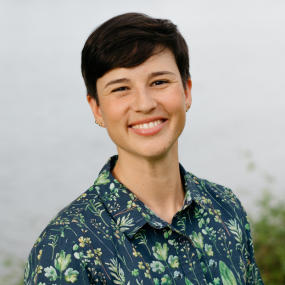
Ariana Remmel
Fact Checker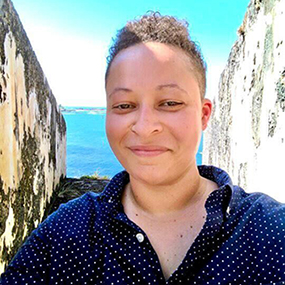
Jonese Franklin
Content DirectorCosmo Sheldrake
MusicBlue Dot Sessions
Music
Adriaan Dokter studies the seasonal migrations of birds, from the continental-scale movements of species to the fine-scale behavior of individuals flying through the atmosphere. He uses weather radar networks, citizen science data and tracking data to address questions in migration ecology, including when and where birds migrate, when and where birds die within the annual cycle, and how shifting patterns in mortality and recruitment of young birds cause bird abundances to change. At the Cornell Lab of Ornithology Adriaan leads the BirdCast project, an online platform for observing and forecasting bird migration in real-time. He also develops software tools for biologists using weather radar as a tool in their research.

