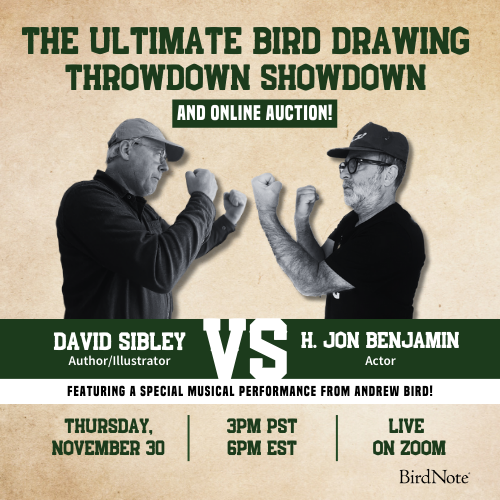
Join BirdNote tomorrow, November 30th!
Illustrator David Sibley and actor H. Jon Benjamin will face off in the bird illustration battle of the century during BirdNote's Year-end Celebration and Auction!
BONUS EPISODE: Words in Flight
An hour-long celebration of poetry about birds.

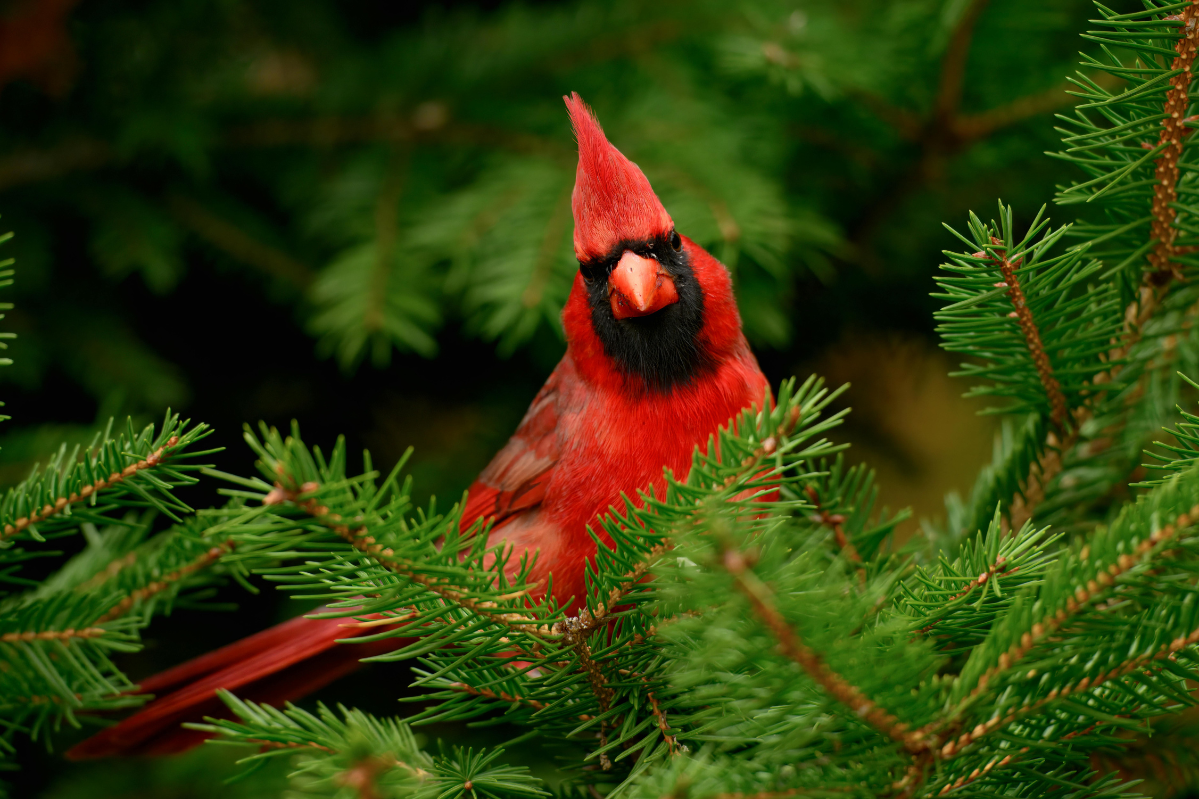
© Dmitri Sotnikov
Birds have always been a source of inspiration for writers, like Edgar Allen Poe, Maya Angelou, and William Shakespeare, to name a few. But what is it about them that so captures our literary imagination? Words in Flight is a celebration of contemporary poetry about birds and what they teach us about ourselves and our world. In our first hour-long special program, you'll hear from some extraordinary writers, including Dr. J. Drew Lanham, Ada Limón and Traci Brimhall.
Mark Bramhill: Birdnote presents.
Drew Lanham: One of the first books that I read as a child was by an author named Fred Bodsworth called the Last of the Curlews.
[music]
And it was this beautiful story about the last of a bird that's now extinct, the Eskimo Curlew. And I remember reading that book and then I saw an ABC afterschool special that like, set me on fire, right? I was like, ‘oh, wow, this bird is gone’.
[music out]
And in my mind though, I was like, maybe it's not gone, maybe it's there.
[music sting]
But you know, as the writer had written this story from the point of view of a bird, it's like he had become this bird in a way. And so I went on to read other writers that were writing about nature, sometimes writing specifically about birds. So that was, sort of, the genesis for me, that maybe while I was still in the egg somewhat, that was singing to me in a way that said, ‘okay, when you hatch, [music in] you get to write about birds yourself’.
Mark Bramhill: From BirdNote, this is Words in Flight, a celebration of contemporary poetry about birds. I’m Mark Bramhill. There’s something about writers and birds. Take Emily Dickinson’s ‘Hope’ is the Thing with Feathers, or Edgar Allen Poe’s The Raven, or John Keats’ Ode to a Nightingale. Shakespeare’s works mention birds more than 600 times.
[Hamlet clip: “There’s a special providence in the fall of a sparrow. If it be now, ‘tis not to come!”]
This hour, we’ll hear selections from episodes of BirdNote Daily and Bring Birds Back. They feature poets sharing what birds mean to them, and what they teach us about ourselves and our world. Poetry has a reputation for being inaccessible or hard to understand, but just like with birds, you don’t need to be an expert to find joy and delight.
We started with Dr. J. Drew Lanham — an ornithologist, naturalist, and writer.
Drew Lanham: “When you hatch, you get to write about birds yourself’
Mark Bramhill: Who did eventually get to write about birds himself. Although it took him a while to get there.
Drew Lanham: I wasn't doing what I loved to do. I was doing what others thought I should do. And part of the way that I stayed alive during that period of time that I was living by expectation was to write little bits and pieces about birds, but really more thinking about the writing and reading it. And so then when I finally hatched into my own, and enough confidence to say, ‘no, I'm not doing what you want me to do, I'm gonna do what I love to do’, [SongSparrow in] I started writing about birds.
Mark Bramhill: Sometimes Drew was writing ornithology research papers, other times verses about connecting with the birds around him. Like in his poem “Sparrow Envy”:
[music]
Drew Lanham:
Were I the sparrow
brown-backed skittish and small—
I would find haven
in thorniest thickets—
search far and wide for fields lain fallow
treasure the unkempt
worship the unmown
covet the weed-strewn row
I would slink
between sedges
chip unseen from brambles
skulk deep within hedges
and desire the ditches grown wild
I would find great joy
in the mist-sodden morning
sing humble pleas
from the highest weeds
and plead
for the gray days to stay
Mark Bramhill: Sparrows are often written off as just ‘little brown birds’ because of how common they are, but Drew is hardly the only poet to be inspired by them. In her poem “Sparrow, What Did You Say?”, former US Poet Laureate Ada Limón works through a major life decision while listening to a White-crowned Sparrow from her porch.
Ada Limón: I wrote this poem when my husband and I were trying to have a child and maybe contemplating stopping fertility treatments. Um, and so I was sort of in this moment in my life, where I was like, well, maybe it's time to release this idea. And what would that feel like? And so this poem kind of deals with that duality of different possible futures.
Sparrow, What Did You Say?
A whole day without speaking,
rain, then the sun, then rain again,
a few plants in the ground, newbie
leaves tucked in black soil, and I think
I'm good at this, this being alone
in the world, the watching of things
growing, this older me, the she in
comfortable shoes and no time
for dishes, the she who spent
an hour trying to figure out that the bird
with the three-note descending call
is just a sparrow. What would I
do with the kid here? Teach her
to plant, watch her like I do
the lettuce leaves, tenderly, place
her palms in the earth, part her
black hair like planting a seed? Or
would I selfishly demand this day
back, a full untethered day trying
to figure out what bird was calling
to me and why.
Figuring out it was a sparrow was just hilarious to me because I kept being like, "what is that beautiful sound?" and it was just a sparrow. Not that a sparrow should be just a sparrow, but, you know. And it was that kind of, wow, I just probably spent an hour doing that and that's not something you could do if you had a toddler — perhaps, if you had a child at all. I don't know. I'm happily child-free and it was the right decision for us. But I do think that poem, you know, was, was me letting go in some ways, of that idea of maybe having a kid in my life and also the idea of holding on to what it is to be a child-free person and to have a sort of freedom as an artist to play in the world. And I think it was an afternoon when, of course, I thought the work I was doing was trying to identify a bird, but the work I was doing was deeply deciding on whether or not I wanted to be a mother.
Mark Bramhill: Ada has loved birds all her life, and this was not the first time she’d turned to them for comfort. When she moved to Kentucky for her husband's work, she struggled to adjust to her new home.
Ada Limón: One of the ways that I get to know any place and get connected and to feel grounded and, you know, feel like I'm not just swimming out into the universe, not knowing where I am, um, is to name birds and plants and trees. And I was sort of doing that work and just sort of, you know, just naming what kind of tree is that, what— you know, that's this and this.
Mark Bramhill: And in her research on the local plants and animals, Ada looked up the state bird of Kentucky — it's the Northern Cardinal — and the idea of a state bird resonated with her, and inspired this poem:
Ada Limón: State Bird
Confession: I did not want to live here,
not among the goldenrod, wild onions,
or the dropseed, not waist high and the barrel-
aged brown corn water, not what the million-
dollar racehorses, nor the tightly wound
round hay bales. Not even in the old tobacco
weigh station we live in, with its heavy metal
safe doors that frame our brick bedroom
like the mouth of a strange beast yawning
to suck us in, each night, Like. air. I denied it,
this new land. But, love I'll concede this:
whatever state you are, I'll be that state’s bird,
the loud, obvious blur of song people point to
when they wonder where it is you've gone.
[Northern Cardinal song, ML 325699101, 0:26-0:29]
Ada Limón: I kept thinking of me being the poet of the state bird, being the one who makes the song, right. So I thought while he's working and he's working on his business, my business will be to make music and to sing and so that's where that poem came from.
Mark Bramhill: Ada would go on to be named the first Latina U.S. Poet Laureate.
Even if you don’t know much about birds, you might be aware of how for some species, when males are trying to attract a mate, they do these elaborate dances and songs. Their rituals can be beautiful and complex… and sometimes birds seem to understand courtship better than humans .
Years ago, poet Donika Kelly was trying to figure out how to date, when she saw a nature documentary about a bowerbird.
[Clip of David Attenborough from BBC documentary]: “When it comes to jewels, blue is undoubtedly his favorite…”
Mark Bramhill: Male Satin Bowerbirds will gather all the blue items they can find, build a beautiful structure called a bower, and do a dance to try to woo the females. And this caught her attention.
Donika Kelly: And so I turned to the birds ‘cause they're much smarter than I am about these things. They have, they have systems in place. Uh, and I thought there might be some comfort, uh, in having, having a system of my own. I just wish that there was like a dance I could do. And then like a woman can just be like, yes, no. And I'm be like, “okay, great!” Let's just be clear. Um, but that was, uh, that's, that's not really how that works.
Mark Bramhill: And this inspired a series of poems reflecting on the bowerbird, and this idea of courtship:
Donika Kelly: Bower
Consider the bowerbird and his obsession
of blue, and then the island light, the acacia,
the grounded beasts. Here, the iron smell of blood,
the sweet marrow, fields of grass and bone.
And there, the bowerbird.
Watch as he manicures his lawn, puts in all places
a bit of blue, a turning leaf. And then,
how the female finds him,
lacking. All that blue for nothing.
Donika Kelly: The second one shares the same title, it sort of creates a link where I don't have to refer. It— the sequencing sort of allows the poem to build in different kind of way or resonate in a different kind of way. And it's driven a little bit more by sound, like the repetition of the O sounds: “groomed ground, his wooing place.” And I think that that movement into sound helps me, sort of, then figure out, oh, is this what I'm interested in? It provides that sort of bridge between the originary experience of watching the documentary and then why I feel compelled to spend time with this bird and with this image.
Bower
The bowerbird finds
a bluer eye to line his nest,
his groomed ground,
his wooing place.
The bluer eye does break
and weep when the bowerbird
leaves or brings
leaves or branches or bits
of simple blue string.
The bluer eye does look and look
and flinch at the open beak,
the narrow maw,
the trauma of being dug
deeper into the arched
and closing bower.
The bowerbird has lost
his sense of blue, his sense
of eye, but the string tangles,
beautifully, on his dark, clean grounds.
Mark Bramhill: And with the third and final part of this sequence, the speaker of the poem talks to us directly to address the idea of wooing a partner, and how it can feel foreign, as though she is a different species.
Donika Kelly: I think one of the things that the speaker knows is that she is not a bowerbird, right? And there's this sense of resignation. Like who will listen to the song of a nutbrown hen, right? Like that's not who does the singing. That's not who does the wooing.
Bower
A small hat, the fedora,
gray-blue banded tweed,
sits atop an unkempt nest,
my unpicked hair, a bromeliad
in the canopy. This
is a failure,
this ill-fitted hat. These boy things.
These men things. This hurried
disrobing. My ashen body
and untrimmed nails. But who will listen
to the song of a nutbrown hen?
Mark Bramhill: In case you’re worried, Donika did eventually untangle the mysteries of courtship. She married writer Melissa Febos in 2021.
In most of the poems we’ve shared so far, the birds are relatively literal. But often, birds are used more abstractly, as an image or metaphor. Like in this poem by Traci Brimhall, about a nightjar, a kind of small bird that’s most active at dusk and dawn. The bird is more allegorical about the end of a relationship:
Traci Brimhall: Aubude with a Broken Neck
The first night you don't come home
summer rains shake the clematis.
I buried the dead moth I found in our bed,
scratch up a rutabaga and eat it rough
with dirt. The dog finds me and presents
between his gentle teeth a twitching
nightjar. In her panic, she sings
in his mouth. He gives me her pain
like a gift, and I take it. I hear
the cries of her young, greedy with need,
expecting her return, but I don't let her go
until I get into the house. I read
the auspices—the way she flutters against
the wallpaper’s moldy roses means
all can be lost. How she skims the ceiling
means a storm approaches. You should see
her in the beginnings of her fear, rushing
at the starless window, her body a dart,
her body the arrow of longing, aimed,
as all desperate things are, to crash
not into the object of desire,
but into the darkness behind it.
Mark Bramhill: The poem is an aubade is a lyric form of poetry that one lover would sing to another before they had to part in the morning. Traditionally, this type of poem was simple and romantic…
Traci Brimhall: So Romeo and Juliet fighting over whether it's a lark or a nightingale is really a debate over whether or not he's gotta roll out of bed and climb out the window or if he can stay and snuggle for a few more minutes.
Mark Bramhill: But in this poem, the parting is very different:
Traci Brimhall: There's something else going wrong in the relationship, and that's why the relationship's going to be over. So instead of a sweet love poem where the parting is just the fault of the sun, there's something else darker happening with it.
Mark Bramhill: Many poets write about birds in a romantic style, exalting nature as this pristine thing, separate from people. But Traci’s work has a level of intimacy, a more everyday and immediate view of nature.
Traci Brimhall: Fledgling
I scare away rabbits stripping the strawberries
in the garden, ripened ovaries reddening
their mouths. You take down the hanging basket
and show it to our son—a nest, secret as a heart,
throbbing between flowers. Look, but don't touch,
you instruct our son who was already begun
to reach for the black globes of a new bird’s eyes
wanting to touch the world. To know it.
Disappointed you say: Common house finch,
as if even banal miracles aren't still pink
and blind and heaving with life. When the cat
your ex-wife gave you died, I was grateful.
I 'd never seen a man grieve like that
for an animal. I held you like a victory,
embarrassed and relieved that this was how
you loved. To the bone of you. To the meat.
And we want the stricken pleasure of intimacy,
so we risk it. We do. Every day we take down
the basket and prove it to our son. Just look
at its rawness, its tenderness, It's almost flying.
Mark Bramhill: Traci sees this poem as a celebration of everyday miracles.
Traci Brimhall: The problem with miracles is most of them are so common that we forget to notice. So something like childbirth, everybody's like, oh, it's such a miracle and I are you kidding that was bloody and painful and gross but it is miraculous. And I think we forget that a miracle can be all of these things at once. It can be so extraordinary and sublime and also common in and also maybe messy, but I think we forget the miraculous has many qualities.
Mark Bramhill: After the break, we’ll hear poets inspired by the incredible abilities and behaviors of birds, on Words in Flight, from BirdNote.
Welcome back to Words in Flight, from BirdNote. I’m Mark Bramhill. Birds can so easily inspire wonder in us; maybe it’s learning about a surprising ability or behavior, a meaningful encounter with a bird, or just the sheer beauty of a species. And few people notice and hold onto this feeling of wonder better than poets.
Ojibwe poet Heid E. Erdrich has loved birds since she was a little girl — her family loves to tell her first bird story:
Heid E. Erdrich: I was just a little toddler and my mom let me go wander in the yard. And I came running back in. She said, my eyes were just big and I looked terrified. She said, “go outside and play.” And I said, “no, there are chickadees fighting with English Sparrows out there!” So I always knew, you know, the particular birds in their names because my family were people who loved birds and paid a lot of attention. I think probably my dad was the one who began keeping track of the birds, making lists, talking about birds that he'd hoped he’d encounter, coming home from supposedly deer hunting with a bird report instead.
Mark Bramhill: Heid grew especially fond of the little birds — the Redpolls, the kinglets, the Indigo Buntings. But not just the small ones:
Heid E. Erdrich: We all were really obsessed with the big woodpeckers because they're just so dramatic and we were lucky enough to live where they've always been Pileated Woodpeckers. Like, just now when I sat down and I heard a pileated out there, you know, normally I would have jumped up to go to a window to try and get a look at it.
Mark Bramhill: One of her poems is about another kind of dramatic woodpecker: the Northern Flicker. The birds have tan bodies with black dots emblazoned on their chests. And they have either red or yellow feathers on the underside of their wings and tail feathers. The yellow-shafted flicker lives in the eastern US, the red-shafted in the west. But in parts of the Great Plains, the ranges overlap and both colors can be found. And that is where Erdrich grew up.
Heid E. Erdrich: I have friends from a tribe in California. And, when I went to go visit them, I saw that they use the feathers for various art works and so forth.
Mark Bramhill: And Heid remarked on how they only had red flicker feathers, and offered to send some yellow feathers back from the Midwest.
Heid E. Erdrich: So I went to go try to find some feathers for my friend and I just had to go a little south of where I grew up and my memory was correct, there were both colors there.
Flickers
Abandoned town on the border, I wait
in tedious drilling noise. Flickers,
my sister birds, try a hole. Grub-full
and greedy, they ignore me. Fine, I say,
just fine. When have those birds ever
waited for me? What's in that hole for me?
It is hot while I stalk Flickers for feathers—
red and yellow shafts I mean to collect
for prayer fans. Hen-bodied, they would plummet
so easily. It's a pity they act so disappointed in love.
They make their mates sob sad wet notes that move
them to nest in dead wood. I watch, my gaze still, hot.
Ah! Their wings burn right past me.
One eyes me: the sun in a crushing black rock.
She blots me bone dry, sends me dreaming
through a red and yellow thirst—
this prayer they will teach me.
Heid E. Erdrich: I don't think people notice them that much. They just think it's a woodpecker. They don't notice, but I think they're fancy. They're just a really beautiful bird and they have a sort of ferocity to them. And they're not as quiet as the little black and white woodpeckers. I think they have a little bit more pride, maybe. They always looked like they were wearing medals to me, like they'd been given an award.
Mark Bramhill: Many people don’t notice birds — they’ re just something in the background until you purposefully tune in. For a lot of people, the lockdowns early in the COVID-19 pandemic became a moment of tuning in, sparking lots more interest in birds. And poet Susan Nguyen was one of those people:
Susan Nguyen: I was home all the time, as many of us were. And my neighbor gave me their extra hummingbird feeder. And we kind of had a competition, just to see like, oh, which one are they going to go to?
Mark Bramhill: Susan took to naming some of her regulars, like Clementine and Jelly-Belly. And watching these birds brought a kind of peace.
Susan Nguyen: It was a little bit of magic happening every day outside my window during a time I think that was pretty difficult.
Mark Bramhill: As Susan began researching her new feathered friends, she learned how much these birds defy our expectations. Like, for almost two centuries, scientists believed that hummingbirds tongues worked through capillary action. But in 2015…
Susan Nguyen: They found out like they've been wrong this entire time — their tongues do not work like a straw, it works differently. And I just thought that was incredible that we went that long just assuming, like, yeah, of course, that's how their tongues work, you know? And then someone actually observed them, like, just set up a camera and were like, “this is not what I'm seeing,” right, and it was so much more recent.
Mark Bramhill: Learning about these tiny, glittering marvels wound up inspiring a poem:
Susan Nguyen: In Praise of a Hummingbird’s Tongue
So long it coils around their small skulls. A forked miracle that traps nectar — collects it in the beak and forces it to the back of the throat. That’s where the hum begins. Flicks in and out and again. Something about surface tension: how a dead hummingbird’s tongue in nectar will drink repeatedly. A flock of live hummingbirds is a bouquet of white bellies, humming. Something about how hard it is to stay still, be an absence of sound. I name each bird as they float at my feeder. A glittering of green, the way they fan their tail feathers. The way they divebomb each other through the notes of their body’s hum. So small a marvel. But back to the tongue, back of the throat. Anything but the absence of miracle.
Mark Bramhill: In her book Trophic Cascade, Camille T. Dungy writes about themes of nature and becoming a mother. The title is an ecological term about how ecosystems go through far-reaching changes with the removal or introduction of a top "trophy" predator. In the titular poem of the book, Camille writes about this phenomenon with the reintroduction of gray wolves into Yellowstone National Park — how their presence had an incredible cascade of positive effects on the ecosystem. And she draws a parallel to her introduction to motherhood:
Camille T. Dungy: In this book there are many ways in which I'm thinking of that trophy creature, that top predator who's been introduced into my life is my daughter. There are other poems in this book that talk about the loss of elders as well. And I think that we experience this very frequently when key people are introduced into our lives or removed from it, everything in our landscape shifts and changes.
Trophic Cascade
After the reintroduction of gray wolves
to Yellowstone and, as anticipated, their culling
of deer, trees grew beyond the deer stunt
of the mid century. In their up reach
songbirds nested, who scattered
seed for underbrush, and in that cover
warrened snowshoe hare. Weasel and water shrew
returned, also vole, and came soon hawk
and falcon, bald eagle, kestrel, and with them
hawk shadow, falcon shadow. Eagle shade
and kestrel shade haunted newly-berried
runnels where deer no longer rummaged, cautious
as they were, now, of being surprised by wolves. Berries
brought bear, while undergrowth and willows, growing
now right down to the river, brought beavers,
who dam. Muskrats came to the dams, and tadpoles.
Came, too, the night song of the fathers
of tadpoles. With water striders, the dark
gray American dipper bobbed in fresh pools
of the river, and fish stayed, and the bear, who
fished, also culled deer fawns and to their kill scraps
came vulture and coyote, long gone in the region
until now, and their scat scattered seed, and more
trees, brush, and berries grew up along the river
that had run straight and so flooded but thus dammed,
compelled to meander, is less prone to overrun. Don’t
you tell me this is not the same as my story. All this
life born from one hungry animal, this whole,
new landscape, the course of the river changed,
I know this. I reintroduced myself to myself, this time
a mother. After which, nothing was ever the same.
Mark Bramhill: Sometimes, just looking at birds can be inspiring — their shapes, colors, movement. Like for poet Joyce Clement. She writes haiku, a traditional Japanese form of poetry. Often thought of as having three lines with 5-7-5 syllables, English haikus don't always follow this pattern. Joyce thinks of the form like this:
Joyce Clement: It is a one breath poem that usually consists of two parts: a fragment and a phrase. And those two parts are juxtaposed next to each other and form a type of relationship.
Mark Bramhill: Haiku have many common traits — they're often about nature, about a moment in time, or reference a season. In this sequence of haiku, Joyce juxtaposes punctuation marks with images of birds, drawing on their similar appearances, as well as meaning and function. Listen for how these work together:
Joyce Clement:
Birds Punctuate the Days
apostrophe
the nuthatch inserts itself
between feeder and pole
semicolon
two mallards drifting
one dunks for a snail
ellipses
a mourning dove
lifts off
asterisk
a red-eyed vireo catches
the crane fly midair
comma
a down feather
bobs between waves
exclamation point
wren on the railing
takes notice
colon
mergansers paddle toward
morning trout swirl
em dash
at dusk a wild goose
heading east
question mark
the length of silence
after a loon’s call
period
one blue egg all summer long
now gone
Mark Bramhill: In each haiku in the sequence, you can see the different kinds of relationships between bird and punctuation. Joyce was initially inspired by the down feather bobbing in the water — its shape like a comma, moving in arcs, with a repetitive, list-like quality to its motion. Or in the haiku about the loon…
Joyce Clement: It's all about asking questions. You've got a question mark and then that silence that it talks about creates a question, will there be a response? It fosters a sense of loneliness. Which, you know, the loon’s call often evokes, right?
Mark Bramhill: When we come back, we’ll hear poets inspired by the incredible behaviors of how poets write about traveling and migration, and birds. On Words in Flight, from BirdNote.
Welcome back to Words in Flight, from BirdNote. I’m Mark Bramhill. Maybe it’s obvious by now that many of the metaphors we use in writing about birds involve moving from place to place. Migration is something all birders pay attention to. At certain times of the year, some birds will leave, others will arrive. But human migration isn’t always as easy to understand.
Poet Sean Hill has moved around many times in his life — between Georgia, California, Texas, Alaska, Minnesota, and now to Montana. While getting to know his new home in the Treasure State, Sean went up to Mount Helena for a hike…
Sean Hill: …when I saw the Western Tanager. It flew by. It was this beautiful flash. I was like, okay, that's a good omen, good auspice. I think I'm gonna be okay in this place.
Mark Bramhill: Around the same time, Sean went to a reading for a book about Rose Gordon, a Black woman born in Montana in the late 19th Century.
Sean Hill: There's a lot of Black folk who moved here, more than you might think, in the 19th Century. And raised families and stayed for generations. And this person in the audience was like, “Why Montana? Why did these people come here?” So part of it's like, ‘why do people move places?’
[Lonesome, peaceful zither music]
The Western Tanager or Why Montana
Piranga ludoviciana
Are wanderings the same as migrations?
I came to Montana for love, which sometimes is
how we know our destinations.
The Western Tanager flies here for procreation
when the snow goes wet, puddles, runs, and takes to
far wandering. Is this the same as migration?
A life is the sum of grand and modest peregrinations.
Communities bloom at the meeting of opportunity
and ambition and can be a way to know our destinations.
A fire-engine red head cooling to orange to
a sunny yellow body with those charcoal wings,
the male western tanager flashes conflagration
or an eastern autumn, in flight. One, familiar, greeted
me shortly after we both arrived letting me know
our wanderings weren’t the same—his, a migration.
In a stand of ponderosas where a blanket of snow lay for decades
or longer, the dendrologist says these trees moved up from what’s
Mexico as that quiet water pulled back, a different migration
—moving seed by seed north generationally migrating
to where they had been and where they could live
never asking how do we know our destination?
Why Montana? One among my interrogations,
both public and private like How big is a home?
Are wanderings the same as migrations?
and How do I know my destinations?
Mark Bramhill: If you noticed a lot of repetition in this poem, that's because it's what's known as a villanelle. It's a poetic form, like a sonnet or a limerick — but rather than simply having a rhyme scheme, a villanelle also has two lines alternately repeated throughout the poem. In Why Montana, you have…
Sean Hill: Are our wanderings the same as migrations?
Mark Bramhill: …and…
Sean Hill: How we know our destinations.
Mark Bramhill: But journeys don’t always go as planned. Sometimes we find ourselves where we didn’t mean to be… like the lost soul that poet Timothy Steele saw in an airport.
Timothy Steele: I saw this little warbler that had found its way into the airport and didn't seem able to find its way out. You know, I thought things were a little upside down in the situation that you know, I was able to fly off without the benefit of wings and it was trying to migrate north.
[Kentucky Warbler Calls]
In the Memphis Airport
Above the concourse, from a beam,
A little warbler pours forth song.
Beneath him, hurried humans stream:
Some draw wheeled suitcases along
Or from a beeping belt or purse
Apply a cell phone to an ear;
Some pause at banks of monitors
Where times and gates for flights appear.
Although by nature flight-endowed,
He seems too gentle to reproach
These souls who soon will climb through cloud
In first class, business class, and coach.
He may feel that it's his mistake
He’s here, but someone ought to bring
A net to catch and help him make
His own connections north to spring.
He cheeps and trills on, swift and sweet,
Though no one outside hears his strains.
There, telescopic tunnels greet
The cheeks of their arriving planes;
A ground crew welcomes and assists
Luggage that skycaps, treating bags
Like careful ornithologists,
Banded with destination tags.
Mark Bramhill: Planes aren’t the only way people get around — in the U.S., we’re mostly traveling by road.
Poet Claire Wahmanholm's work focuses on nature and the environment. So, when she was at the Ragdale writers' residency north of Chicago, it's no surprise she spent a lot of time exploring the outdoors.
Claire Wahmanholm: It's just a beautiful residency. The buildings back up onto, like, 50 acres or so of prairie and wetlands. I think it adjoins two nature preserves. The Skokie River runs through it, and walking is like a big part of my poetic practice, and so every day I was taking these long kind of rambles through this like beautiful nature area.
Mark Bramhill: And as she walked around, Claire was listening for birds. But there was something else she was hearing:
Claire Wahmanholm: I was like, what is that noise? Is it like, really windy? What is that sound? And I was like, oh, it's the highway.
[Tires singing on the highway]
There's like this, beautiful, beautiful nature area, and there's a highway right behind it. Highways are something I generally tune out, because I live in an urban area and the noise of industry is kind of my ambient soundtrack. But when you're trying deliberately to hear something else you really notice it. And I was like, oh my gosh, it's always there.
Mark Bramhill: Claire’s experience inspired this poem:
[Solemn string music fades in]
Claire Wahmanholm:
YOU CAN ALWAYS HEAR THE HIGHWAY
beneath the Eastern Phoebe. It hums alongside the Hermit Thrush
and Indigo Bunting. It is almost like a river but it is not a river.
It is not out-runnable. There are moments when the Marsh Wrens die
down, and the highway fills them like the blood in your ears.
There are no real lulls. You could call the highway a zipper
because of the way it buzzes above the Ruby-crowned Kinglet
and the Willow Flycatcher. You could call it a drone or a moan.
I have never heard a Vesper Sparrow or a Dark-eyed Junco.
A chickadee is hatching crisply from its egg, a Gray Catbird is ripping
a millipede from the meadow, but how would you know.
The highway’s sound is like a strong wind, or like a heavy curtain
being dragged along the ground. It is louder than the alarm call
of any bird, louder than the noise a Barn Swallow makes when it is
being eaten. I may never hear a Brown Thrasher, a Pine Warbler,
a Rose-breasted Grosbeak, a Common Yellowthroat.
There are 160,955 miles of highway in America.
[Sounds heard:
Hermit Thrush song;
Ruby-crowned Kinglet song;
Common Yellowthroat song]
Mark Bramhill: Birds are facing so many threats and challenges. And yet, poets still continue to find hope in these creatures. As Emily Dickenson famously wrote, “hope is the thing with feathers.” Poets have always found joy and inspiration from birds, and that’s still true today.
Like in Camille T. Dungy’s poem, Clearing, where a Blue Jay gives her a new perspective:
all night the wind blows & my mind
my mind is like the hawthorn that loses
limbs they litter the ground crush
the black-eyed susan scatter buds
over rows of lettuce bean sprouts
whose greens are clusters of worry
in raised beds blown leaves & cracked limbs
threaten our foundation water backs up
in gutters seeps into the house’s walls
but my mind my mind is not in the house
in the yard’s far corner the eye of my mind rests
on a hawthorn branch shaken snapping
hectic then still the day dawns
without anger the blue jay I’ve looked for
pushes sky off his crest how splendid
his wings & tail it’s not so much
that before this he’d hidden himself
it’s only he favored a roost
I could not see until the storm thinned the tree
[Blue Jay call]
Mark Bramhill: For some poets, like Craig Santos Perez, writing about birds is a source of hope. Growing up, his relationship with birds was somewhat abstract. Perez is Chamorro and grew up on the island of Guam; by the time of his childhood in the ’80s and ’90s...
Craig Santos Perez: Most of our native birds had either gone extinct or were taken into captivity by zookeepers to keep them safe from the invasive brown tree snake, which had come to Guam a few decades earlier and colonized the entire island and taken over the ecology.
And so sadly, growing up, when I would go into the jungle, into the forest, it was a very silent place. I didn't hear any of the native birds. So early memories of the birds, you know, it's basically learning about them in school. Learn their Latin, English, and Chamorro names for them, which is our native language. We would learn about their characteristics, their feather colors, their patterns. And we would even do some projects in school where we would build a fake nest or color in pictures of the birds. And it was kind of, in a memorial kind of way because they were either no longer wild or no longer even in existence.
Mark Bramhill: Later in his life, Craig moved to Hawai‘i. And he saw so many parallels between Hawai‘i and Guam:
Craig Santos Perez: You know, not only in terms of kind of colonial and military history, but also, of course, the environmental history. Hawai‘i struggles with invasive species as well. Just like Guam, many of its native birds are either endangered or extinct.
Mark Bramhill: Hawai‘i has the unfortunate distinction of being the “extinction capital of the world,” where two-thirds of their native bird species have gone extinct. And, beyond that being a heart-wrenching fact, it also was complicated for Craig as a dad.
Craig Santos Perez: My eldest daughter really loves birds. And, you know, she was born and raised in Hawai‘i. So I wanted to write a poem kind of bringing together my concerns as a father, as an environmentalist.
For me, poetry has always been a space of catharsis and healing, and a kind of site where I can reckon with a lot of the devastations of the world around us, whether it's related to colonialism and my home island, or related to climate change and bird extinction.
And so I tried to come to the page with an openness and vulnerability, and a willingness to just feel all the feelings, and to find the words that will kind of help me to just articulate those emotions, and express them in a way that gives me, you know, a feeling of hope, but also, of course, of memorial and kind of a way to honor and to eulogize what we've lost.
Mark Bramhill: Here is the poem that came from that:
Craig Santos Perez: The Last Safe Habitat
I don’t want our daughter to know
that Hawaiʻi is the bird extinction capital
of the world. I don’t want her to walk
around the island feeling haunted
by tree roots buried under concrete.
I don’t want her to fear the invasive
predators who slither, pounce,
bite, swallow, disease, and multiply.
I don’t want her to see the paintings
and photographs of birds she’ll never
witness in the wild. I don’t want her to
imagine their bones in dark museum
drawers. I don’t want her to hear
birdsong recordings on the internet.
I don’t want her to memorize and recite
the names of 77 lost species and subspecies.
I don’t want her to draw a timeline
with the years each was ‘first collected’
and ‘last sighted’. I don’t want her to learn
about the ʻŌʻō, who was observed atop
a flowering ‘Ōhiʻa tree, calling for a mate,
day after day, season after season.
He didn’t know he was the last of his kind,
or maybe he did, and that’s why, one day,
he disappeared, forever, into a nest
of avian silence. I don’t want our daughter
to calculate how many miles of fencing
is needed to protect the endangered birds
that remain. I don’t want her to realize
the most serious causes of extinction
can’t be fenced out. I want to convince
her that extinction is not the end. I want
to convince her that extinction is just
a migration to the last safe habitat
on earth. I want to convince her
that our winged relatives have arrived
safely to their destination: a wondrous
island with a climate we can never
change, and a rainforest fertile
with seeds and song.
Craig Santos Perez: I remember writing this poem and — you can probably hear in my voice — I became very emotional while writing it. Just thinking about the island and the future that my daughter will inherit. And of course most children, you know, they have a very beautiful and kind of wondrous sense of awe to the natural world, and especially towards animals. And I wanted her to hold on to that before she has to kind of reckon with the facts of the world we live in today.
And so for me, this is kind of a poem about a father who doesn't want his daughter to learn the truth about the world just yet.
Mark Bramhill: Craig’s daughter is still young, and hasn’t heard the poem. But he hopes that, for her and for others, it might also bring a sense of hope and possibility.
Craig Santos Perez: Having this kind of fantasy idea of this last safe habitat, using that wondrous magical space to inspire activism and conservation in the present, knowing that we can never create that magical space, but we can at least kind of return to the beauty of the ecology that once was.
Maybe if she can imagine such a place, maybe her generation or future generations can actually create a planet that is safe for all species.
Mark Bramhill: Many species, like the Kauai ‘O‘o, we can never bring back. But for others, there is a small chance. The breeding program for Craig's elementary school mascot, the ko‘ko‘ or Guam Rail, has been much more successful.
Craig Santos Perez: The ko‘ko‘ is now the second bird in history to recover from being declared extinct in the wild. Many of them have been released onto neighboring islands that are free of the brown tree snakes. There are several hundred of those now released back into the wild. And so that's, you know, very hopeful news. Still an endangered bird. Obviously the population is still very vulnerable. But most zookeepers consider them to be self-sustaining at this point, so that's really exciting.
Mark Brahmill: We’ve spent the hour exploring why poets are so inspired by birds… but there’s still so much more out there to read, to witness, to experience. We’ll end this program the way we started, with Dr. J. Drew Lanham, reading an excerpt from the title poem from his book, Joy is the Justice We Give Ourselves:
J. Drew Lanham:
Joy is the sunrise
breaking through night’s remains,
bright shone new
on a shell-wracked shore;
a fresh tide-scrubbed world
redeems what was,
to is.
Joy is on whimbrel’s wings;
the wedge in fast flight,
wandering curlews,
curved-beaks’ cries
stitching top of the world
to bottom.
Joy is the soul stirred
underneath the journey,
gaze snagged on wonder,
not knowing final destination,
blessed as a witness,
moored to ground,
worshipful tears
dripped into grateful smile.
Joy is the silent spring,
unquiet.
Rachel’s world not come to pass.
The season
dripping ripe full
of wood thrush song.
Joy is all the Black birds,
flocked together,
too many to count,
too many to name,
every one different
from the next,
swirling in singularity
across amber-purpled sky.
Joy is being loved
up close
for who we are.
Joy is the last song,
drifting in
as dark curtains fall;
the sparrow’s vesper offering,
whistle lain down
in pine-templed woods,
Joy is the justice we give ourselves.
Mark Bramhill: Words In Flight is a production of BirdNote. This program was written and produced by me, Mark Bramhill, along with Jonese Franklin and Laura Ellis. Fact checking by Ariana Remmel. Special thanks to Jazzi Johnson, Conor Gearin, Sam Johnson, Billy Almon, and Josh Fisher, and Kentucky Shakespeare.
BirdNote is an independent nonprofit that relies on the generosity of listeners like you. Learn more about our work and listen to our other programs about birds at birdnote dot org.
© 2026 BirdNote February 2026
Narrator: Mark Bramhill
Music by Blue Dot Sessions
ID# wordsinflight-2026-02-23 wordsinflight