
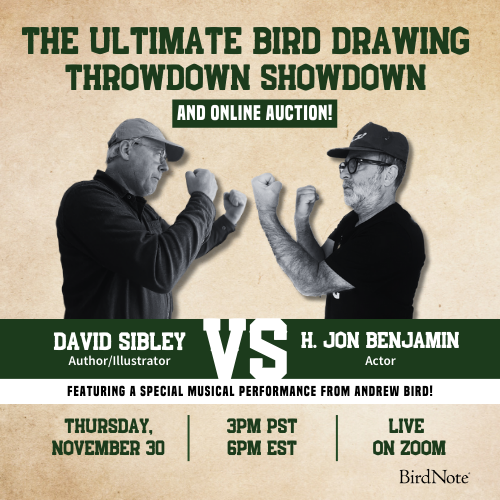
Join BirdNote tomorrow, November 30th!
Illustrator David Sibley and actor H. Jon Benjamin will face off in the bird illustration battle of the century during BirdNote's Year-end Celebration and Auction!
Hunting Is for the Birds (Too)
Bring Birds Back Season 8, Episode 3: Duck hunters are among our leading conservationists today.

Duck hunting may sound like a forbidden sport for most bird lovers but did you know that some of the most dedicated bird conservationists - in the world - are also devout hunters? In this episode of Bring Birds Back, our host Dr. Deja Perkins speaks with Jerad Henson from Ducks Unlimited – one of the largest and longest running waterfowl and wetlands conservation organizations in the world. Jerad talks us through the complex history of the organization and the incredible impact of hunters as conservationists from past to present. The oft-times controversial sport is much more than just a pastime, it’s also been a lifeline for species and habitats for decades. You don’t want to miss this one!
Want more? Stay up to date by following us on your favorite podcast app and on Instagram @BringBirdsBack!
For more about BirdNote, sign up for our weekly newsletter. And for ad-free listening and other perks, sign up for BirdNote+ here.
Learn how you can get involved in our From Love to Action campaign when you visit this page!
BirdNote is a nonprofit. Your tax-deductible gift makes these shows possible.
Bring Birds Back Season 8 is sponsored by the Cornell Lab of Ornithology’s Bird Academy.
Deja Perkins: BirdNote Presents…
[Bring Birds Back Stinger]
This is Bring Birds Back and I’m Dr. Deja Perkins.
As of 2025, the poultry industry is a 70.2 billion dollar industry in the US, and it’s projected to generate more than 400 billion dollars worldwide by 2030. Chicken, eggs, and turkey are common sources of food for many individuals around the world. So why do people have such negative reactions to other wild birds for consumption like ducks, quail, grouse, or even sandhill cranes? For some individuals, especially in cultures outside the US, their relationship to birds is through the perspective of food as a resource.
The term “resource” - which you will hear throughout this episode - defines a common good that belongs to no one but is regulated by the government for all, deemed as a sort of public trust agreement… think national or state parks. That can also include hunted wildlife or “game” like duck or deer, as well as feathers, leather, and other cultural objects created from its materials.
But even before the age of the grocery store, hunting, foraging, and eventually farming were how everyone obtained their food. Hunting has a complex history, but for much of human history, hunting was the primary way to obtain a large part of our diet. And for many cultures around the world, hunting was and still is a practice that keeps them intertwined with nature, managing and protecting the land that sustains the flora and fauna they harvest.
On the other hand, hunting has also been used for sport and even political control. For example, during the colonization of the US, the hunting of the buffalo was used as a tool for genocide to deprive Indigenous populations of their traditional food source, forcing them onto reservations. Despite its tumultuous and complex history, today, hunters and hunting play a vital role in wildlife conservation.
To explore this relationship between hunting, hunters, birds and land conservation, we’re speaking with Jared Henson of Ducks Unlimited.
Deja: Hi Jared. I'm so happy to have you all on the show today. Can you introduce yourself to our audience?
Jerad Henson: Yeah! First off, I'm really excited to be here. I’m Jerad Henson. I'm a project manager, actually at Ducks Unlimited, and I work with our sustainability and our ecosystem services team talking about all of our different conservation projects and, uh, all the benefits that those have beyond just duck benefits.
Uh, I've been with Ducks Unlimited for a couple years. I came out of academia in the Memphis area where I taught for six years. Taught ornithology, physiology classes, organismal biology, a whole suite of stuff. And then did my graduate work at the University of Memphis. So that's kind of my super brief bio.
Deja: Awesome. So today we are here to talk about hunting. But first, how did you get interested in birds and what prompted you to study them?
Jerad: Yeah. I grew up in Arkansas, there's a lot of waterfowl history, waterfowl hunting history in Arkansas. My grandfather hunted, my dad hunted, my great-grandfather hunted, and it's been part of our family for a long time and that put me outside a lot. And because I'm a hunter and there are restrictions on what you can and can't take, I started getting pretty good at IDing birds, but then I started seeing these small passerine species and things like that while I'm in the field and I was like, what is that?
So that got me interested in birds, in general. That turned into a much stronger influence on my life in grad school. I took ornithology and I knew after that class I was like, ‘oh no, this is, this is different.’ I thought I was just seeing four or five different little species while I was out there in the woods, and all of a sudden I've got a 40 species bird list in an hour.
Deja: Nice.
Jerad: Like really quick, right? But it's because I've picked up the skills to actually know what I'm looking at.
And so, the hunting brought my passion for the outdoors, for birds. But it also brought the interest for me to actually ask more and figure out what more was going on, what the effects of hunting are, right? I'm still a hunter but I take a little different lens than I probably did when I was a teenager, about hunting and the appreciation for everything around me. So that's how I got into it.
Deja: I think that's great and it really emphasizes how we're all existing in our own little bubbles. So, from your story, I gather that you do consider yourself a birder?
Jerad: I do to a certain degree. I'm also an ornithologist, and so I have a little more of a science approach. But yes.
Deja: I have to ask, what is your favorite bird and why?
Jerad: I knew that was coming. Um, I can narrow it down to a few. On the waterfowl side, I love a mallard just because of my Arkansas roots. We see them in flooded timber here and that's a really unique habitat to see birds like, a three and a half pound duck flying through trees and landing in water in, in flooded woods. And that's a really cool sight to see. I've worked with Black-bellied Whistling-ducks and they're one of the most captivating ducks I've ever been around. They have weird personalities, they're super vocal. So those two are my favorite ducks.
On the Neotropical side, Prothonotary Warblers, Summer Tangers, and Indigo Buntings. All three of which also nest in areas around here. And so they're my favorite neotropicals to see in the summer.
Deja: Great birds. I love Summer Tangers.They are a distinct sound. They're–
Jerad: Pick-it-tuck-tuck. Mm-hmm.
Deja: Yes. And I love hearing that in the summertime. It always gets me to stop in my tracks. Oh, we can talk about birds all day. So I'm wondering, can you walk us through the story of Ducks Unlimited? Who is Ducks Unlimited as an organization? When was it started and why?
[Driving music starts]
Jerad: Yeah, that's a really cool story. Um, so Ducks Unlimited is a conservation organization in North America. We've been around since 1937, and we're the largest wetland conservation organization in North America. But our focus and our mission is around waterfowl specific habitats. So, wetlands and associated habitats that waterfowl depend upon from their breeding grounds, all the way down through migration and wintering grounds. So this whole continental conservation mission. We were founded by Joseph Knapp. Joseph Knapp actually had started a conservation organization a little bit before Ducks Unlimited called More Game Birds of North America. And it was a bunch of hunters, they were well off hunters in [the] nineteen and thirties, and they were really worried about duck populations in the dust bowl, right? 'Cause you're in the ‘30s, Wetlands are dry, duck populations are shrinking. And one of the cool things that they realized really quick was that when you're wanting to try and conserve a game species like waterfowl, like mallards and things like that, you can't take the same approach you did with say, turkeys or quail.
Because you gotta have good breeding habitat, migration habitat, wintering habitat. And so one of the things they were also doing with, like, quail is they would raise quail in captivity and release them and restock populations. You can't do that with waterfowl, right? Because they move so much. So they realized they needed a bigger idea of waterfowl across the North American continent. They actually underwent the first wild duck census. And this was some cool– they brought technology back from World War I. [And] were actually looking at birds out of an airplane for the first time. They did ground surveys for waterfowl populations on horseback across almost all of the prairies. And what they found was that if you want to impact waterfowl populations, you gotta have great habitat in Canada.
Fast forward a few years, they end up forming an organization called Ducks Unlimited. And so we've worked in Prairie Canada for the existence of all of DU. Um, we've actually only started working in America since 1984. And now we do over a million acres of conservation a year across North America. All of those founders, they were worried about a resource. They were willing to try and find money for conservation to make sure that resource existed into the future.
Deja: [an aside] Those resources are so important to maintain, that Ducks Unlimited Inc. has two sister companies to assist in maintaining this support, Ducks Unlimited Canada and Ducks Unlimited de México.
[Music ends]
Deja: That's an amazing story and to even think about this large lift of doing work across countries in order to preserve these species that are going very far away, but something that we see every year. Um, and I know that has got to have some feel-good.
Jerad: Oh, it's amazing. Yeah. It's extremely rewarding.
Deja: Can you talk a little bit about some of the projects that DU has done to conserve waterfowl and their habitat?
Jerad: Yeah, so that's a really open-ended question. I've been around DU my entire life. When I went to work at DU, I went, ‘wow, we do so much.’ So, just to lay it more traditionally, we'll protect, manage, and restore waterfowl specific habitats. If you're up in the prairies, we're really focused on the prairie potholes, so the wetlands associated with that, but also those adjacent grasslands, because those grasslands are where most ducks - especially dabbling ducks - are gonna nest. Those are some of the most threatened habitats in the country. So we really focus a lot of effort on just protecting those to keep them there, those grasslands.
And as you move through the different flyways and then down the migration corridor, you'll see us really trying to focus on stopover site habitat. So if you get down around where I'm at in the Mississippi Alluvial Valley, we're looking at bottomland hardwood habitat. We work with rice agriculture because that's a huge artificial wetland with a lot of food.
We also do a lot of help with states on both coasts. And then, in Missouri, we're doing a lot of moist soil habitats, so manipulating native plants to basically increase seed production. So there's tons of food for migrating birds as they come through. We're a very big partner with most state and federal conservation groups or wildlife groups.
We are one of the largest bioengineering consulting groups in the country, we're just behind an NGO shield. And so, we have the biologists and the engineers on staff to recommend the habitat that needs to go on the ground, and then the engineering plans to actually put that in because our habitats are no longer natural like they used to be. They need some engineering to get 'em back to more of a natural system. And we have staff across, I think all 48 lower states now, because we need regional expertise to put high quality habitat on the ground. We've moved into the sustainability world, those ecosystem services. So a lot of our projects now, they also have clean water benefits, flood resiliency benefits, carbon benefits and biodiversity benefits as we're talking about ducks and other birds.
Deja: It's absolutely amazing to think about all of the things that you all do as an organization. And on the flip side of that, the variety of careers and backgrounds that people can have and still help contribute to conservation and ducks and waterfowl.
[Inquisitive music starts]
So, we've talked a little bit about all of the work that DU does. Let's dive a little bit into the complex history between hunters and conservation.
Jerad: Yeah.
Deja: I think that when non-hunters think about hunting, they may imagine the elimination of species like the buffalo or the Passenger Pigeon, or even exotic game hunting in places across Africa. Can you share with us, historically, what has been that relationship between hunters and the natural world? I know you said that DU started because hunters realized that duck populations were declining. So what is that complex relationship that has historically existed?
Jerad: Um, historically, hunting for subsistence, when you think back to buffalo and Passenger Pigeon, when European settlers made it to the states it was the land of unlimited resources. They thought in no way, shape, form or fashion could they ever wipe out those resources. And yet they did. Because they weren't looking about that and they didn't understand the ecology of those species and how they're all tied together and tied to certain habitats. And so you look at something like the Passenger Pigeon, between losing habitat and then hunting, that double-edged sword took it out. It took out a lot of other species in the process, and I think that highlighted that need. Losing those species like that also brought about that conservation mindset. When you think back to, like, the Roosevelt era, that's kind of that idea, that was that mind shift at that point. Roosevelt being a hunter himself, but he was also a birder. So, like, you realize, like, he had an appreciation for more than just the hunt and wanted to protect it, and those resources and opportunities.
Deja: With American buffalo being on the brink of extinction by the early 1890s and the last wild Passenger Pigeon being hunted in 1900, Theodore Roosevelt’s presidency came at a pivotal time. He served from 1901 to 1909, famously becoming known as the “conservationist president” for protecting public lands and establishing the U.S. Forest Service, foundational for our conservation systems today. That included five national parks, 150 national forests and the first 55 federal reservations and preserves for wild birds and game, later known as the National Wildlife Refuge system. Establishing nearly 230 million acres of public land, as well as being a central figure in the creation of the North American Model of Conservation, Roosevelt’s contributions to ethical hunting and wildlife preservation cannot be understated… [aside] But how did hunters go from accelerating one bird’s extinction to being the reason others are now plentiful?
Jerad: It's expensive to duck hunt. And so, generally, duck hunters have been fairly affluent and they cared about a resource. Because of that, you also end up with this connection, right? 'Cause you did take a bird, but you have that connection to that resource because, for some people, not only were they wealthy, but some of them that was their biggest passion. Some of them may not be that wealthy and that may be their livelihood and some of their food source, for years, right?
So there's that connection and when that resource starts to dwindle, there's some of the first to notice, some of the first to see it, and they don't want it to go away. They want that resource to stay there. For other people to appreciate, for other people to take advantage of. And so, there's some of the first to self-regulate. Before the US Fish and Wildlife Service was founded, a lot of the fancier and nicer duck clubs actually had already imposed bag limits; had already imposed regulations and structure to try and make sure that they were not taking too many birds. And so that's kind of what that conservation mindset was born out of. And and I think, as we remember all of this, remember: a few bad apples that get publicity don't speak for the entirety. But that history there, right? It drives a lot of us.
[Music ends]
Deja: So, you cover a lot around the history and you're absolutely right, there are some bad apples that over time have perhaps given hunting a bad name but it sounds like your message today is really about expanding our beliefs about who hunters are, how they actually affect the conservation world and most importantly, how they help birds… As a hunter yourself, can you talk about your approach to hunting?
Jerad: Hundred percent. I do everything: I'm the hunter, but I process, I package, we put meat away in the freezer and that's pretty much what feeds my family most of the year, 'cause I want that clean, wild game that can nourish my family. So that's a big part of it. Also, I'm not hunting to try and just fill a- a bag limit. I'm trying to just make sure I get enough to feed my family for me to enjoy the experience. But it's not necessarily about just the hunt itself, it's the time out there in nature with family and friends.
I feel like that makes me a little more attached to my food than a lot of people would be if you go buy a pretty package of chicken from the grocery store. And so it's never an easy aspect, as a hunter, that's always the hunter's dilemma that you end up with that guilt almost, right? 'Cause you care about the natural world to take from it. And so my approach has all of that in consideration, so.
Deja: And I can absolutely see [that] you are invested in making sure that what you are taking off the landscape and putting into your body and into your family's bodies is actually healthy for you. And, you know, maybe that is a way to get the general public more connected to our environment, when you have that connection to your food. So I have to ask, when you go duck hunting, are there any specific species that you target? Is there a species that tastes better than others? Like what, what's your mindset when you're out there?
Jerad: Oh yeah. A hundred percent, a fat mallard is probably like the best duck for me, but actually probably one of the best table fare out there are actually Green-winged teal. Some of the larger birds, like geese, a white-fronted goose, is fantastic table fare. On the flip side of that, you can get into certain diving ducks or mergansers that [have a] heavy fish diet, right? And so a lot of that can actually change the flavor of the meat.
You know, [when] you look at the history of the conservation around waterfowl, you see something like a Chesapeake Bay Canvasback I think in the 1920s, early ‘30s before federal regulations came about, that was the equivalent of $150 dinner if you went to a restaurant and ordered a canvasback. But that's one of the other conservation stories, too, is that hunters realize that, like, market hunting's not sustainable. That connection to that economic value, that'll drive people to do things that are not great for the resource. So disconnecting that was important too.
[music transition]
Deja: When we return, we’ll dive a bit deeper into the history of hunting as a conservation model, how it benefits the bird and human world, plus lesser known ways hunters contribute to science and more. We’ll be right back.
MIDROLL
Deja: I’m Dr. Deja Perkins and we’re back with ornithologist, hunter, and sustainable project manager, Jerad Henson from Ducks Unlimited. We’ve discussed the innumerable impacts of Ducks Unlimited as a nonprofit organization, and now we want to explore a bit further into the history of hunting, how the current conservation model works, and what’s fueling its success and importance today.
For starters: let’s talk bag limits, or the maximum number a hunter can take of a specific animal per day or per season. [to Jerad] So Jerad, would you say species preference - things like taste, beauty, et cetera - plays a role in how bag limits are set? Or how does it all work?
Jerad: Species, beauty, taste, all that has nothing to do with it. It has to do with population dynamics, yeah. Bag limits are generally set on a species by species basis. We have some of the longest running data sets to monitor waterfowl populations. So, based off of that wild duck census that I talked about early on, in the ‘40s, they picked that survey back up - the US Fish and Wildlife Service picked that back up - and they started flying surveys and looking and assessing the waterfowl populations to define transects every year with the exception of two COVID years.
And so we have this long-term data set over the same geographies - and it's a huge geography, millions of square miles - where they survey across Canada and the US prairies on populations. And it allows us to really quickly detect changes. And so the population surveys are done on just ducks as a whole, but also by species. That allows us to get an idea of what species look like, what the long-term average looks like. And we have this incredible guiding document, the North American Waterfowl Management plan, that was pulled together in 1984.
It is from a continental conservation standpoint, it is probably one of the most sophisticated and well thought out management plans. It has no authority, but it gives guidance on how to manage populations. And it does so by setting goals based around long-term duck populations and trying to maintain all the different species at or above those long-term averages. We don't wanna lose 'em. We want to keep 'em above. And then when it comes to hunting, the models that they use to predict - that's this adaptive harvest management model they use to actually set bag limits. It has some species specific stuff, but basically it's primarily starting with mallards 'cause they're the primary hunted waterfowl. And it takes into consideration the changes in those populations over time in this scenario where it's best use case for everybody.
Is the population in the best condition it's gonna be in? Can it sustain hunting harvest? If it can, what's the minimal amount of impact we can have on the population through hunting? And so it fairies all these, and hunter opportunity: maximum amount of days that the ducks can sustain on harvest without impacting the population at all. And they use that 70-year data set now to set those regulations. Regulations are set two years in advance based upon what's happened recently. In the gist, it is on a population ecology-based idea of what's sustainable for the population. And under a lot of population ecology situations, there's this instance where basically you get density dependence when populations get too high.
When populations get too high and they get diseased, there's not enough resources to go around, and populations actually crash. And if you look at natural wildlife populations they go up and down. And so if you set the hunting bag limits just right, you actually take just the top off those peaks and it actually levels out because the population doesn't boom and wipe out all the resources and then crash. And so, that's this idea behind modern wildlife population management and using hunting to do that. But it is species specific. You can shoot a total of six ducks a day in, say, the Mississippi Flyway where I'm at. Only four of those can be mallards; but it's also sex specific, only two of those mallards can be female mallards, uh, because there's a difference in the sex ratios in the population so they're adjusting for that. And the females are more susceptible to natural mortality through nesting. So all of that goes into consideration when setting wildlife bag limits.
[Music starts]
Deja: So, you've talked a little bit about this model of waterfowl management specifically, how does that differ from the North American model of conservation? Or is that a piece of the puzzle for the North American model of conservation?
Jerad: Kind of is, it kind of is. So if we talked about the North American Waterfowl Management Plan, NAWAMP is what we would like to call it 'cause that's a mouthful. So that started in 1984 and it was this across-continent conservation plan to manage waterfowl populations, but it did so on a region by region basis. So it broke the continent down into joint ventures. What those are, those are regional working groups that include state, federal, also NGO biologists and ecologists, as well as a few of their own staff. And basically they try and take that overall waterfowl management plan and step it down to something that's attainable goals within a smaller region.
And they set targets and goals based upon the habitat requirements for ducks in that region. So down here where I'm at, I'm based outta Memphis, Tennessee, we're talking about energy. So how much food habitat needs to be on the ground to send the ducks back north in good condition? And what that habitat should look like, right? What does high quality waterfowl habitat look like from an ag standpoint and from a natural standpoint? That model was so successful that almost every other migratory bird working group has joined that. And now those joint ventures actually work on pretty much all bird species. But all that is, is guidance on how to manage it. There's no money behind that.
The North American Model of Conservation actually is a hunting based conservation model. It puts the bulk of the responsibility to fund conservation on hunters because hunters have been the ones that have been willing to put money into this for a long time. And so if you think about the North American model of conservation, that money is coming from a duck stamp sale, right? The Federal Duck Stamp program, which contributes about $40 million a year in conservation dollars. And 98% of that actually goes into conservation on the ground, generally through something like the National Wildlife Refuge System or conservation easements.
Then it has excise tax on sporting goods through the Pittman-Robertson Act and so that is a small excise tax on guns, ammo, binoculars- all those sporting goods that you would use for hunting, a portion of that tax goes to the states and they can then allocate that into conservation funding within their areas. That money does require match money. And so that match money then has to come from, generally like, philanthropic aspects. So that's where DU can step up and they can help provide that seed money to help leverage Pittman-Robertson Act or other federal money to do conservation work.
And the last one is just through state and federal hunting license sales, all that goes back into conservation. So that's where most of the money for the North American model of conservation comes from, it's coming from those revenue streams. Hunters in general are the consumptive users of those habitats. So they've been thought to carry more of that burden of funding it. Hunters in general have that connection with the resource and they're just in general more willing to give money to that cause.
Deja: Wow, just mind blowing.
Jerad: And that's a lot of money, right?
Deja: According to a report by the U.S. Fish & Wildlife Service, hunters spent approximately $45 billion on hunting in 2022 alone, from equipment and travel to state and local tax. They also donate approximately $440 million directly to conservation organizations, in addition to paying excise taxes, licenses, and conservation dues. That means hunters make up over $2.5 billion which funnels directly back into conservation.
Jerad: And so that's the estimates on what hunters are bringing to the conservation finance space.
[Music ends]
Like, just to go hunt, I'm gonna spend $200 on license. That's not counting my binoculars, my firearm that I'm taking out, my vehicle, my canoe, all of those types of other things you would need to be successful. That's kind of the basis of that North American conservation model. And one of the things that gets lost in that model, too, is the benefits that hunters bring to the landscape of where they're at and where they're hunting. They also contribute billions of dollars into the economies of areas that are not very urban. This is more rural areas, more wild areas, so it's keeping those economies afloat.
But there's also hundreds of thousands, probably millions of acres of really, really, really high quality wildlife habitat that's out there that is wrapped up in hunting clubs for the sole purpose of them to be able to have a successful waterfowl hunt or deer hunt or whatever that is. But they're protecting that land and managing it for wildlife to hunt. And yeah, they're after ducks in this case, right? You've got really high quality habitat for ducks. But those habitats also are some of the best places I've ever been to look for shorebirds or, you know, any other wetland-dependent bird species, things like that, that, that, that gets, people seem to look past that a lot.
Deja: Absolutely. You know, people definitely need to start putting some respect on the hunters because through your passion, you are funding conservation, you're helping boost local economies, you are volunteering and putting in the man hours to protect the habitats and provide spaces for other recreational benefits and putting food on your plate and your family's plate. And there's just so much, um, that you all are able to do through something that you're so passionate about. And so, can you talk a little bit about how hunters might help with the disease reporting aspect of conservation?
Jerad: Yeah. Waterfowl biologists and scientists have been leveraging hunters for data for almost a hundred years now, through things like migratory bird banding. Especially with waterfowl, they get a leg band from the USGS that's monitored through a whole big system. But we can find out where that brand was put on, we can find out where it was taken off, and so you can figure out where birds are wanting to be. So where are those habitats that are crucial? And it was hunters that reported the band: they shot the bird, it had a band on it, they reported it. They're contributing to that data. They do something called a part survey. And so hunters will take wings or tail feathers or things like that off of the birds they harvest. They send 'em in. They have something called the wingbee. US Fish and Wildlife Service kind of hosts this, and they actually can get this really good idea of impacts of hunters: which birds were taken, how many. So they're contributing to the knowledge base of their impacts.
Big thing right now, especially, is HPAI. You look at Avian Influenza and Disease. Hunters are some of the first to see the impacts of that in the field. Especially since the main vector for it is waterfowl. Hunters are generally the ones going to and from the field, and they're the ones that see the symptoms and they report it and they bring a local Fish and Wildlife person out to come take an assessment. And if it warrants it, then they'll get APHIS to come do a full investigation on what disease outbreak that might be. So I think those are some ways that hunters really play a big role in disease monitoring.
Deja: Wow, that's really cool to just think about all of the different intersections between how hunters are contributing to not only conservation, but science as a whole. A lot of my research looked into participatory approaches and engaging volunteers, and it almost seems like hunters were the original participatory scientists even before birders were leveraged for things like eBird.
Jerad: Right.
Deja: So that’s really cool to think about.
Jerad: Yeah, and to that point, if you look at band data from AllBirds, band reporting rates on waterfowl are like 10%. Most other non-game bird species are like 1 to 2%. So that provides you with a lot more data to make scientific management decisions with.
[Music starts]
Deja: With all of this information that you have as someone who works for DU and as a hunter yourself, are there any particular hunting related conservation efforts that are maybe more important than others right now, at this time?
Jerad: So the prairies are our number one priority. They're under a big pressure for land conversion 'cause farmers are really struggling to make a profit so they're hoping that by converting more land and putting everything they can into production it's gonna maximize profits. And so, this huge influx of land conversion for ag or for municipalities and urban habitats - that conversion, that land use change is really, really impacting waterfowl populations, but just bird populations in general, that's the constant story there. You double that with the changes in climate, it's drier. Those types of things are really having a huge impact. We can't change the weather, but we can try and slow down some of the land use conversion, right? So that when the weather's good habitats can rebound.
So those are some really big ones facing waterfowl. There needs to be this balance of work on private and public owned land. In all honesty, 80 to 90% of the land we need to do work on is private. So we have to try and find voluntary incentive-based ways to get landowners; we want to give them an opportunity to do conservation, right, and not lose money, or not lose too much money. We work really hard trying to offer landowners things that benefit their bottom line as well as provide good habitat for all wildlife in the process. Habitat loss is the story of conservation across the globe. And so how can we fight and provide opportunities to get wildlife considered as a resource and have their space carved out too? Making sure that there's room for wildlife and wild places is something we're gonna put at the top of our list.
[music stops]
Deja: Well, my hope is that through the conversation that we've had today, we've been able to expose the importance of hunters and hunting and the role that it plays within conservation. I think that there may be a lot of folks who, because they've never grown up doing it or ever had the experience hunting, that they don't have that connection that you all naturally have. Um, all of the hunters that I know do it sustainably, they do it ethically, you know, they hunt for sustenance and, like, maybe they'll hang the deer head on the wall 'cause it has a great rack.
Jerad: Yeah.
Deja: But, you know, the primary reason for hunting that animal was to provide meat for the entire year. Through these conversations, through the work that you all are doing at DU to help educate, I think that we are going to continue to change this narrative.
Jerad: Well, that's awesome and I really appreciate the opportunity to talk about it to this audience, right? As you mentioned, I'm a podcast host on our Ducks Unlimited podcast, but that's a different audience and as we talked about before, I kind of ride the fence between all of these different user groups. And so, sometimes that's kind of weird, but other times that's a really cool, unique opportunity to educate.
Being able to share that and show that passion that I have to a new group, most [of] them will never hunt. That's fine. Just understand a little bit about why some of us do. I hope after you get a little education on hunting sustainably, and the way that our systems work to protect those populations, that you understand there's a lot of benefit to the wildlife populations. And when you just look at it from conservation value, you've tied economic value to that resource and now all of a sudden it has more value.
Deja: Absolutely. And we know the money is what makes sense in our society.
Jerad: Unfortunately.
Deja: And fortunately, right. So as you mentioned, there may be some bird lovers out there who may never dream of hunting birds, but for those who may be interested in taking it up for conservation, a hobby, or even for sustenance, what advice would you offer them? What are we doing?
Jerad: I love this question. I love it. Um, try and find a mentor. Find someone who does it and does it successfully and see if you can tag along. Most hunters are gonna be open to taking someone new. There's gonna be some original investment that you're gonna have to have. And that can be a barrier for some people, but there are ways you can cut that barrier down. But also, most state wildlife agencies or departments of natural resources will have programs to help get people started in hunting if you're interested. If you look at those different state programs, you're gonna see things around the term “R3” and those are different new hunter programs and they're teaching you the basics.
For women, there's a really cool, unique organization called Becoming an Outdoors Woman, BOW, that's across a whole bunch of different states and they do women-specific, and they mentor each other, and introduce people into hunting. So that's the best thing I can say for a start. As far as starting on birds, if you're wanting to hunt, the most commonly hunted species in North America is Mourning Doves. Their populations are incredibly robust, more people hunt Mourning Doves than any other species. But you also get, in Texas and out west, you'll get White-winged Doves and some others.
Reach out to an NGO, like Ducks Unlimited, if you've got a chapter in your community. We have thousands of them all over the country, those are great places to meet people and they'd be happy to help you. And then, the big thing is don't be scared. If you're interested in it and you wanna go– go! You're gonna find out quickly that just being out there is one of the more enamoring parts of hunting.
Deja: I think that is some great advice that I'm sure many of our listeners are really going to appreciate. Thank you for coming on the podcast and sharing the importance of hunters and hunting when it comes to conservation.
Jerad: Thank you so much Deja for having me on and letting me tell this side of the story that people in the bird community aren't as familiar with. I really think it's important to understand that conservation model and how it all feeds in together. I’m just really, really appreciative of the opportunity.
[music transition]
Deja: Hunting has a complex history, and while it may not be for everyone, it has proved to be a major and consistent source of conservation funding, while aiding in wildlife population control and disease monitoring. Many hunters care deeply about the environment from which they harvest, so much so that Jerad noted nearly 60% of Ducks Unlimited staff are hunters themselves, who dedicate their time and efforts to wetland conservation. Hunting as a conservation tool is easily misunderstood and undervalued, but we hope this episode brought you some newer perspectives to consider. Even if you choose to simply continue admiring them - and all of their beauty - from afar.
That’s all for now, but not for long. Season 8 of Bring Birds Back will return at the top of 2026!
—---
Many thanks to Jared Henson for sharing with us his personal experience and expertise on hunters’ contributions to conservation. And a hearty thank you to everyone at Ducks Unlimited for all the important work you do! And, of course, thank you for listening!
If you want to learn more about hunting ethics and its contributions to wildlife conservation, consider taking a hunter's education course, provided by your state wildlife agency. To learn more about Ducks Unlimited, hunting for conservation and other resources mentioned during the show, look for this episode on BirdNote dot org.
And follow us @ Bring Birds Back on Instagram for the latest updates about the show!
This episode of Bring Birds Back was created by our BirdNote production team, including Fact-checker Ariana Remmel; Producer Sam Johnson, Senior Producer Mark Bramhill; Managing Producer Jazzi Johnson; and Content Director Jonese Franklin. Our music is by Blue Dot Sessions and Cosmo Sheldrake. And this episode was hosted and co-produced by me, Dr. Deja Perkins.
Thanks for listening!
[Music ends]
Post-Credit Script
Hardy Kern: I was like, ‘Oh my God, I'm a birder. I became one of them’.
Jerad Henson: It just happens someday. You're like, ‘Oh, it happened, it caught me’. But it catches a lot of people.
J’orge Garcia: And I started to get curious about how I could see more birds.
Deja Perkins: The blinders were removed And ever since then, I would just see birds everywhere. And, you know, the story continues from there.

Deja Perkins
Host
Jazzi Johnson
Managing Producer
Mark Bramhill
Senior Producer
Sam Johnson
Producer
Ariana Remmel
Fact Checker
Jonese Franklin
Content Director
Jerad Henson
I am a native of the Mid-south and grew up just outside of Little Rock, AR. Growing up I enjoyed all things outdoors, including hunting, fishing, sports, and about anything else outdoors. That passion for the outdoors led me to pursue an education in biology. I received my undergraduate from Arkansas Tech University and then moved to Memphis for graduate school. I received my MS and PhD from the University of Memphis with a focus on animal physiology and ecology. My PhD focused on understanding how waterfowl cope with changes in energetic demands and stress across the fall and winter. It was there I truly gained a love for ornithology.
After finishing up at Memphis, I took a job as an assistant professor of biology at Christian Brothers University. I taught at CBU for 6 years and in 2023 moved from my associate professor position at CBU to the Ducks Unlimited NHQ in Memphis. I am now a project manager at DU working with our ecosystem services science team. My team helps quantify and report on all the more than waterfowl benefits of DU's conservation work and our growing work in corporate sustainability. Along with my project management role at DU, I help our marketing and communications team with science communication and I'm a host of our Ducks Unlimited Podcast. Outside of work you can find me hunting, fishing, birding, cycling, and spending time with my wife and 2 sons.

