
Join BirdNote tomorrow, November 30th!
Illustrator David Sibley and actor H. Jon Benjamin will face off in the bird illustration battle of the century during BirdNote's Year-end Celebration and Auction!
Andean Condors Sail the Wind
These sacred birds are symbols of the Andes Mountains.

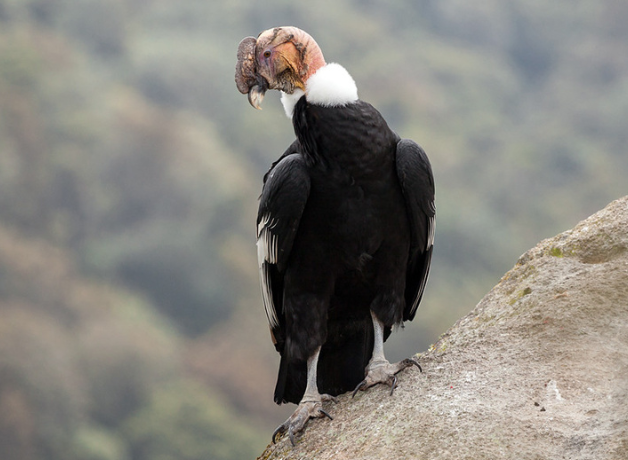

© Sergey Pisarevskiy
The Andean Condor is one of the largest flying birds in the world. With a wingspan that can stretch over 10 feet across, the condor doesn’t flap so much as sail, using rising thermals to glide across the Andes for hours. Once revered in Inca mythology as a messenger of the gods, the Andean Condor now graces the coat of arms of Bolivia, Chile, Colombia, and Ecuador. But like many scavengers, condor populations are declining due to threats like lead poisoning and habitat loss.
BirdNote®
Andean Condors Sail the Wind
Written by Lucina Melesio
This is BirdNote.
[Sound of wind; Instrumental music "El Cóndor Pasa"]
The massive Andean Condor doesn’t fly… it sails the wind.
With wings that stretch more than ten feet across, they glide for hours without flapping above the Andes Mountains from Colombia to Argentina. Because they are so heavy – up to 33 pounds – condors save their energy by riding the thermals rising off the cliffs and mountains: A black silhouette drifting across the clouds with a white collar and white feathers on top of their wings.
In the mythology of the Incas, the condor was a sacred creature who carried messages between the heavens and Earth. But the Andean Condor is more than a symbol. As scavengers, they play a vital ecological role cleaning up the landscape and preventing the spread of disease.
Like many vultures, condors don't always get the gratitude they deserve and their populations are declining. Andean Condors don’t reproduce until they’re at least six years old and raise just one chick every two years. So when lead poisoning or habitat loss strikes, recovery is painfully slow.
[Soft wind continues]
Still, the Andean Condor persists thanks to conservation efforts across South America where several countries have adopted this majestic raptor as their national emblem – including Bolivia, Chile, Colombia and Ecuador. They may not dazzle with color or song, but their silent presence above the peaks remains sacred even today.
For BirdNote, I’m Lucina Melesio.
###
Senior Producer: Mark Bramhill
Producer: Sam Johnson
Producer: Kizaya Studios
Managing Producer: Jazzi Johnson
Managing Producer: Ariana Remmel
Content Director: Jonese Franklin
Bird sounds provided by The Macaulay Library of Natural Sounds at the Cornell Lab of Ornithology, Ithaca, New York.
BirdNote’s theme was composed and played by Nancy Rumbel and John Kessler.
© 2025 BirdNote December 2025
Narrator: Lucina Melesio
ID# ANDCON-02-2025-12-16 ANDCON-02

Lucina Melesio
Writer Narrator
Kizaya
ProducerSights & Sounds