

Join BirdNote tomorrow, November 30th!
Illustrator David Sibley and actor H. Jon Benjamin will face off in the bird illustration battle of the century during BirdNote's Year-end Celebration and Auction!
Indigenous Water Justice
Bring Birds Back Season 7: Episode 3

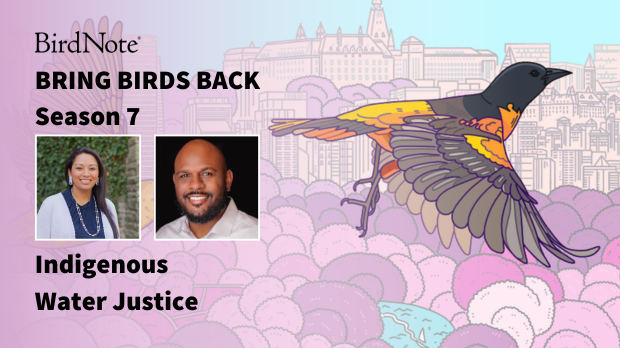
Host Billy Almon speaks with Indigenous water scientist, legal scholar and advocate Dr. Kelsey Leonard. Kelsey incorporates both her Indigenous knowledge and practices along with her western science studies to advocate for a better world for us all. From the importance of birds to Indigenous cultures, the critical role water plays in the health of land, and her fight not only for the rights of rivers but also the legal need for Earth law, there’s so much here to learn!.
Want more Bring Birds Back? Follow us on your favorite podcast app and on Instagram @BringBirdsBack!
For more about BirdNote, sign up for our weekly newsletter. And for ad-free listening and other perks, sign up for BirdNote+ here.
And for more information about how to get involved in our From Love to Action campaign, visit this page.
BirdNote is a nonprofit. Your tax-deductible gift makes these shows possible.
Bring Birds Back Season 7 is sponsored by the Cornell Lab of Ornithology and Bird Academy.
Billy Almon: BirdNote Presents
[Bring Birds Back Stinger]
Welcome to Season 7 of Bring Birds Back. I’m your co-host, Billy Almon.
[music shift]
The Akan tribe of Ghana have a term that’s central to my approach to futurism. The term is “Sankofa”. It translates to "go back and get it" and it speaks to the idea of reaching back into our past to gather what we need for the future. This idea of connecting past wisdom to present and future needs is why I'm so excited for this episode.
Since time immemorial, Indigenous peoples have been gathering, building and cultivating knowledge of the natural world, known as indigenous science… passing down their learnings and observations through rituals and oral traditions. Today, western science is slowly catching up with what Indigenous scientists have known for a very long time: everything is connected, and everything in nature has something to teach us.
Indigenous science comprises the beliefs, practices, and knowledge that Indigenous peoples have developed over generations of deep connection to the land. It’s rooted in the preservation and sustainability of our planet, and our guest today is here to share both how and why.
Dr. Kelsey Leonard is an Indigenous water scientist, guardian, and advocate. In her work, she affirms her cultural practices with scientific studies, particularly in the realm of water conservation and with international legislative analysis.
In this episode, Kelsey takes us on a learning journey and reveals what it means to have water as a relative, the fascinating relationship between birds and water, and the critical role rivers play in ecological solutions to battling climate change.
[musical shift]
Billy: Dr. Leonard. Thank you so much for joining us. I can't tell you how excited I am to speak with you and dive into your work. Can you tell us who you are and what you do?
Dr. Kelsey Leonard: [Indigenous greeting] Aquay, wunne kesuk. Hello. Good day, everyone. My name is Dr. Kelsey Leonard. I am an assistant professor in the faculty of environment at the University of Waterloo in Ontario, Canada, and also a Canada Research Chair in indigenous waters, climate and sustainability. I'm an enrolled citizen of the Shinnecock Nation, which grounds a lot of the science and research that I do in the space of ocean and climate justice for the protection of our waters and planet.
Billy: Your work focuses a lot on indigenous waters and its connection to climate change and sustainability. Can you explain what that connection is and why it's important?
Kelsey Leonard: So as Indigenous peoples, we understand water not as a resource, but as a relative. I often will say to folks, in conversations with Indigenous peoples or in my community, we don't say, ‘what water’ we say, ‘who is the water?’ The same way that you might talk about an auntie or a sister or grandmother.
There is this living spirit that's embodied in water and how we as Indigenous peoples connect to water. So it's a relational worldview that guides our responsibilities. And in the context of the crises we see across our planet, today, climate change isn't just warming the planet, it's straining that kinship relationship that we have with water.
So when I note indigenous waters, whether they be salt water along the Atlantic coast from where I'm from, or freshwater rivers that run through a variety of our homelands across Turtle island, or what we know as North America, they're currently under threat, both from pollution and climate change, extractive industries and more so in terms of some of the work I do– they are being erased through a process of legal erasure.
Billy: Having this relationship with water, I think that's such a beautiful thing, there's just something about it that really resonated with me and it makes me curious. What drew you to this work? Was there an influence or a particular experience that you had?
Kelsey: I often get asked this question and I think for many years I don't know that I had a clear response but it's become even more profound I think, at this stage in my life. Really understanding who I am as a Shinnecock scientist.
And so in our language, Shinnecock means “people of the Stony Shore,” and I feel that our ancestors had this amazing foresight to name us that. And in the same foresight, they understood that if we are calling ourselves Shinnecock, it means that we are embodying that responsibility to protect that shore, to protect that place where fresh water meets salt water.
And so for me, it's about living up to that responsibility and that duty to protect the shore and hopefully do so from a lens of sustainability. And I think from an indigenous relational accountability perspective, sustainability is about generational continuity. We ask ourselves, how are the decisions we're making today honoring the waters that sustained our ancestors, and will continue to sustain future generations?
Billy: What does it mean to be a water guardian? And are there some real world examples of this in practice that you can share?
Kelsey: Definitely I think ideas around conservation or protection of water are really just about principles, about how to be good human beings on this planet.
[music begins]
We're not in a climate crisis, we're in a human crisis. And if we constantly ask ourselves is this making me a good human being in relationship and in a loving relationship with the planet? I think they would change a lot of the ways in which we operate as a global society. There's wonderful Indigenous scholars like Dr. Deb McGregor and Dr. Robin Wall Kimmerer, both Anishinaabekwe scholars, who talk about that science doesn't necessarily need to be done in a myth of objectivity.
And what they say is, we should be doing science through an ethic of love and an ethic of care. And I think the same is true in how we think about water conservation and protection of the environment around our planet. We need to be operating from a space of care and love.
Billy: I'm so glad you brought that up because there is a quote from Robin Wall Kimmerer, that I've seen you mention a lot. The quote says, “Knowing that you love the earth changes you, activates you to defend and protect and celebrate. But when you feel that the earth loves you in return, that feeling transforms the relationship from a one-way street into a sacred bond.”
Kelsey: Exactly. It's one of those quotes from Dr. Kimmerer's work that has always just sat in my heartspace, because I think it speaks to who we are as Indigenous scientists. That when we think about water conservation, conservation of the broader environment, we're thinking about this as relational accountability, as forms of enactment of reciprocity, as forms of ceremony, and ultimately that is reflective of our governance systems, our kinship systems. But we also need to think about how do we ensure that the water itself is able to live to its fullest potential.
In my work, water science and conservation practice, it looks about how do we empower indigenous sovereignty, and indigenous legal approaches to water, which can manifest in a variety of ways from water gatherings to restoring coastal wetlands to, really identifying and documenting our unique forms of indigenous water governance, which, in many instances are part of the global movement for Earth law, which is a recognition of the inherent rights of water, and many other natural beings around our planet. But this inherent right to exist, to flow and to thrive.
[Music fades out]
Billy: One of the last things you just mentioned was, the other natural beings, and I was curious if you can speak to the significance, if any, between birds and water in indigenous practices and beliefs?
Kelsey: These are kin that are inextricably interwoven into our cultural, political, ceremonial, spiritual existence- and into our governance. There's a wonderful program out of the University of Victoria, I believe, called the RELAW program, which is about documenting indigenous stories and indigenous law that is embodied through our ethic of storytelling. And so many of our stories from stories about the ravens, stories about the eagles, stories about the turkey; they teach us about how we are to be good human beings on this planet. And so I don't think there's one way to pinpoint our relationship with birds, it's just so interwoven to who we are.
I'm excited to get to talk more about birds and some of the science research that we're doing out of my lab, but also just culturally growing up. It- it's been so powerful to reflect at this stage on what that relationship looked like. It's the way in which turkeys are interwoven throughout our cultural attire and our stories and ever present on our territory on Shinnecock. It's an extreme reverence and sacred relationship with eagles. It's a story of restoration and resilience.
[Gentle, warm pulsing music begins]
So for many years, decades, we didn't see eagles in our territory. And in recent years, in my lifetime, I've seen them rebound and they now dot our shorelines in many ways.
Billy: That decline in eagle populations was due to a now-banned insecticide broadly known as DDT. It was originally used during and after World War II to control insect populations like mosquitoes that can carry diseases such as typhus and malaria. But researchers later discovered that DDT was harmful to humans and animals, with dire consequences.
When Bald Eagles ingested DDT by way of fish and other contaminated prey, they laid eggs with shells so weak that they cracked before the chicks could develop. The birds were placed on the endangered species list in 1967 and the Environmental Protection Agency officially banned DDT in 1972, a key factor in the eagle’s recovery and eventual removal from the list in 2007.
Kelsey: We've got stories and relationships with owls and then of course the osprey and the osprey nests and, the stewardship that we have around caring for those nests so that they have a home on our territory is just all have been stories and memories of how I've grown up as Shinnecock woman.
Billy: So incredible.
And it connects to something that I believe strongly, which is that our society as a whole is missing out on so much because that connection to the land is no longer part of most of our daily lives, individually and collectively. As we try to help equip our listeners with better habits and behaviors that can help all of us become better guardians of both land and water, what are some things you would suggest?
[music starts]
Kelsey: So one of the things I think everyone in our society can enhance and do better at, for lack of better words, is really understanding the state of loss and threat that is posed to both our freshwater systems and thereby to the ecosystems and kin that rely on those freshwater systems, particularly birds. So a lot of this work to embolden conservation practice is about education.
We have a lot of uneducated people around the world, unfortunately, because our education system doesn't really prioritize indigenous science or indigenous knowledge in the K through 12 curriculum. And so that's definitely an area for growth we can be leaning into whether that be[h] through children's books, through other books, through listening to podcasts like BirdNote, and all of these other different spaces we can be building our knowledge. And, and why that's important is because we've lost over one third of freshwater species globally. When the World Wildlife Fund did their report a few years back, they identified that the greatest decline in biodiversity is in aquatic environments. And so for me as a water scientist, it's very disheartening. But it's also very empowering because it means that if we start with restoring those water systems, it could potentially be the place where we have the biggest impact.
And for North America, you know, we know that through the Cornell Ornithology Lab and others, we've seen this statistic of about 3 billion birds have been lost, particularly breeding birds, since 1970. Many of those are migratory water birds, whose wetlands have been drained – and those are a species that are kin to us at Shinnecock. You know, very much integral to eastern Algonquin, coastal tribal nations along the eastern seaboard that we've formed a relationship with over centuries and so some of the scientific practice work I've been doing in recent years, in my lab, the WAMPUM Lab, which is an indigenous science lab based out of the University of Waterloo, is trying to understand and document where we as eastern coastal tribal nations, we carry this memory of abundance and particularly a memory of abundance around biodiversity and thereby.
A way in which to strategize both through adaptation and mitigation efforts around climate change impacts, we've been looking at that in the context of ethnobotany and plant relatives. And in the coming years, we're really looking at it in the context of birds. So for Shinnecock, in our community through, again, a really storied relationship with our bird relatives and what we like to call winged relatives, we have harvested birds for many centuries, and in that process we developed what are called decoys. And we're not the only tribal nation to do this. I think the oldest one, there's like a millennia old duck decoy; might have to do a fact check on that out of the Smithsonian. But it's beautiful. It's from a tribe out of Nevada and it's sort of a woven decoy.
Billy: Those hand-crafted birds are known as the Tule Duck De-coys and they are estimated to be over 2000 years old, dating as far back as between 400 B.C. and 100 A.D. They were found in Lovelock Cave, Nevada, a historically significant site for the native peoples of the Great Basin. In many indigenous traditions, the creation of bird decoys served multiple purposes. Decoys made from clay, reeds, and stuffed skins would attract migrating birds by making it seem like it was safe to land. This technique was often used to lure the birds within range of the spears and arrows of hunters. It’s an artform and hunting practice that continues on today.
Kelsey: We, at Shinnecock, we carved those out of different varietals of tree species, wood, and they represent just this broad swath of shorebirds, waterfowl, different types of ducks like a mallard and a Canadian goose. And so why that is so important is because we have decoys for birds that no longer perhaps migrate to or have been seen on Long Island. And that relationship is very important for how we document a loss of biodiversity and how we document a loss of in relationship to climate change. But I think it also shares with us ways in which we can work towards restoration and resilience. Those species may not potentially be extinct, but their migratory patterns may have shifted. And so these carvings, they're not just artifacts, they're a testimony to that relationship and how intimate, just one individual had to have such a unique relationship with that bird to understand how to draw with such meticulous care, the shape of feathers, to make them so real life, that they confused and deceived other birds, who see them every day.
[additional words from recording]
Billy: What I find so fascinating about how you describe that, is that you describe it both as an art form and as a science. And that leads me to my next question which is about the WAMPUM Lab. You’ve previously mentioned that the WAMPUM Lab, a research group that you lead, and some of the studies you all are conducting concern the livelihood of birds. Can you tell us more about the work you all are doing around renewable energy and offshore wind development? And what is the connection between that and the protection of birds?
Kelsey: So in this current research on offshore wind development, we've been engaging deeply with the question of how large scale renewable energy projects intersect with our rights as Indigenous peoples, our coastal ecosystems, and even Earth law. So as we're seeing this proliferation of offshore wind as a powerful alternative to fossil fuels, because we know that we need to reduce our carbon emissions, many Indigenous peoples that we've been working with, they're concerned that transition is perhaps not occurring in a just manner and potentially to the expense of our bird kin.
Especially those birds who have migratory paths that trace ancestral relationships between our land, sea, and sky. And so these offshore wind developments are happening right now, this sort of proliferation has happened along the Atlantic coast. Some of them have been paused due to administration changes. Some of them are still ongoing. And so, through conversations with different tribal citizens across these Atlantic coastal nations, we've heard real concerns about how the placement of these turbines along critical flyways could be potentially disruptive to nesting habit habitats or have an overall cumulative impact on waterfowl that depend on these shorelines to be undisturbed and to have these open waters.
And so we're at this critical juncture where we need more scientific research. We need more investment in science. And I think in this current political climate, this is making the case for why that's important. We need to understand the ecological relationship between renewable energy proliferation and, um, our bird kin. And I think, in that space there's also a need for understanding how Earth law and indigenous legal orders for the protection of birds and the ocean are really important in how we see that future evolving. And I think we can't ignore the well-being of birds in the name of a green development or in the name of renewable energy.
And oftentimes what we say in the work that we do is not all renewable energy is just energy. And so we have to be asking ourselves, how can we move towards a just transition, a renewable energy future that honors indigenous sovereignty, upholds the rights of nature, the rights of birds, and ensures that these waters are protected and not the casualty of our climate solutions?
Billy: The project titled, Indigenous Energy Justice and Offshore Wind Development, is ongoing. Kelsey and her team at the WAMPUM Lab are currently finalizing their observations and findings, but the paper will be made public at its earliest availability. The topic of energy rights and water rights are not new, but the indigenous perspective certainly has not yet been widely adopted. While a lot of sustainability work is focused on land-based systems, Kelsey emphasises the importance of water and says both land and water are deeply interconnected.
Can you talk about why protecting rivers specifically is so vital to the protection of land and everything else, and why or how - by helping rivers - how do we also help other systems in need?
Kelsey: I think for when we think about how to protect rivers, we have to understand that for many centuries, within the United States and with other British colonial legal thought, we carried out this practice of trying to treat rivers as property, treat them as a resource and confine them within boundaries that really don't exist in the natural system. And so a lot of what we're seeing today in terms of the laws that we have created, they legalize the destruction of rivers up to a certain threshold. And that threshold is at which point would they lose utilitarian benefit to humans? And what that has done is it's also created this disconnection that we don't see rivers and water broadly as a holistic, interconnected, woven web of life systems, including birds and other non-human kin that rely on that ecosystem – that aquatic system – to thrive.
So in a lot of ways, as I mentioned earlier, that the climate crisis is a human crisis, it's also a crisis that's rooted in disconnection; disconnection from the earth, from each other, from our responsibilities. And so Earth law, or the recognition of the inherent rights of a river, it teaches us that river provides enough when we live by laws of reciprocity and not greed. The problem is not that water is scarce, it's that the rights that are inherent to that water are not being honored, and that's really what this emerging legal movement of Earth law is working to change.
------------------------
Billy: After these messages, we’ll talk with Kelsey about ongoing efforts to give rights to rivers, what it means to be a lawyer practicing "Earth law," and how you can benefit from joining the cause.
We’ll be right back.
MIDROLL/SPONSORS
Billy: And we’re back. We’re speaking with Kelsey Leonard: water scientist, policy advocate and enrolled citizen of the Shinnecock Nation. Kelsey is currently involved in efforts to grant rivers legal rights through her work practicing Earth law. Can you talk and explain what Earth law is, what Earth lawyers do, and why it's an imperative that we have more in this present moment?
Kelsey: So Earth law, there's a little bit of debate as to when it emerged on the scene, if we'll call it that. It's very much connected to indigenous legal systems. So for indigenous law, we see it as being an inherent and integral portion of how our legal systems have operated for millennia. But we often will date it to a legal article that was done by Christopher Stone in the 1970s called Should Trees Have Standing, and it was this idea that there could be a recognition of the rights of unnatural being such as a tree or as it later evolved to a river, to have a certain bundle of rights that are protected from pollution, from manmade harm and interference.
And so that's what we're seeing today as this emerging Earth law movement, which is to protect the planet's life support, and stability as a key way in which we as humans and the rest of the natural world are able to maintain our life, right? The planet and all of its life support systems enable us to continue our societies. And so Earth law is about how do we protect that system of life-giving on our planet?
And so from a rights of rivers perspective, Earth law recognizes that the river has a right to flow, to support biodiversity and to perform its ecological functions without human interference. And so this is often coded as a right to flow, a right to exist, a right to thrive. And in recent years, you've seen a lot of these rights for rivers initiatives led by Indigenous nations. so one of the most famous ones is the Whanganui River out of Mount Tongariro, New Zealand, which was recognized as a legal person.
We've seen a rights of river recognition led by the Yurok tribe for the Klamath River in Yurok territory, which is adjacent to what is currently known as California, and the Menominee Nation also did a recognition of the Menominee River adjacent to what's currently known as Wisconsin. And so we see all of these different river initiatives emerging out of indigenous law. And what is also really interesting from some recent science and legal analysis work that we did, is that these initiatives classify a bundle of rights for the river that are inherent, but they're also constantly evolving. So one of the things that I found was really interesting coming out of the Yurok tribe, recognition of the rights of the Klamath River, is they also said the river had a right to data and it's building off of indigenous data sovereignty. It was really innovative for an Indigenous nation to say, ‘this river has a right to its own hydrological data’. So I'm really excited to see where these legal innovations go in the coming years ‘cause they're just getting started.
Billy: That is incredible to just think about, that rivers have a right to their own history. There's something very visceral and emotional about that idea and there's so much about this conversation around the rights and the sense of being allowed to have the right to your own being that I think as a Black man who knows that I come from Indigenous people who were brought to this country – part because of the indigenous ingenuity and connection to the land that my ancestors had, there's just so much hitting me in a very, just deep and profound way.
You've talked about the idea of the rights of rivers as living things. And I know this is also a very central part of your advocacy. Can you share more about that idea from an Indigenous perspective and take our audience through how you frame a legal argument to give rivers rights?
Kelsey: So, at its core, it's really not even a giving or a grant. And I think that's something that is a nuance that goes undetected sometimes in how - in the verbiage and the language that we use - especially for Indigenous nations and within our legal systems: rivers, water, has already inherent rights. We are in a reciprocal relationship with the natural world. And so it's less of a recognition, less of a grant of personhood or a grant of rights. See, that's something that is inherently colonial; this idea that the master or the colonial government polity can bestow that upon you because you are a subject of that coloniality. But for Indigenous legal systems, we understand that we are all equal: non-human and human. And so for us, in these contemporary legal systems that we exist within, it's about how do we recognize those already existing, innate and inherent rights and responsibilities to the water.
Billy: Your work highlights how there are laws that legalize the destruction of nature. What are some of the laws you find most damaging and destructive to our nature today and why?
Kelsey: Firstly in the context of Earth law as an emerging body of law, it's an evolution from our current environmental laws. Which, we're not saying those need to go away, we're saying in a lot of ways those environmental laws are stagnating or they're not able to respond at the rate of change that we're seeing due to our climate “slash” human crisis.
Recognizing that Earth law, also known as “ecocentric” law, is this emerging field that prioritizes the protection, stabilization, and restoration of Earth's life and life support systems. And so we need things that can respond in real time. And so that's where these new forms of law and legal mechanisms to protect the natural world are emerging. A really strong example of that is the back and forth we've seen in the past two decades. It's not even attributable just to one administration, but over the past two decades of a variety of administrations and changing political understandings of water and of how we relate to water, shifting the Clean Water Act and what constitutes navigable waters of the US.
And what's been inherently a disservice of the Clean Water Act is it doesn't account for a holistic approach to water conservation and water protection. It really leans into water that is quote-unquote, “navigable”. So can it be by ship? And for many years, many conservationists have argued that. Incongruency and inconsistency of interpretation has lent itself to the degradation of critical wetlands around our planet and around the United States, and so that keeps coming up before the Supreme Court and different courts of law. There are just these administrative challenges that keep rolling and then lead to rollbacks of these Clean Water Act protections.
And so I think these types of laws and the deregulation of the environment that we're seeing across the United States are some of the most pressing concerns. And that also is going to be impacting the Endangered Species Act and different types of birds that are protected under those pieces of legislation.
And so I think now more than ever, it's a great time for us to be re-visioning our legal system and to rethink what types of local actions for local protections through innovative legal initiatives can be led to protect these very vibrant ecosystems.
[music/ends]
Billy: So glad that you said that. Earlier you mentioned how the responsibility of the Shinnecock is to carry the memory of the land. And in a recent presentation with Change Now, you said, “This myth of scarcity being solely claimed by the natural world removes our responsibility and culpability as a human species.” And I just want you to know, I love this quote. Can you say more about this, what is that myth of scarcity and why do you think it's worked so well?
Kelsey: The myth of scarcity is around this idea that there's a finite amount of water, a finite amount of bird species or animal populations, and more so that finite amount is there as a resource or a property for consumption – commodity for consumption by humans – fully to the point of extinction or depletion. When in reality our planet is abundant. But how we relate to that abundance is where we have crafted harm and violence and atrocity. So, even within Earth law, I like to talk about it as a tree. And there are many branches on this emerging body of law, one of them being rights of nature. So the recognition of the inherent rights of a river to flow, to thrive, to exist.
But another branch is also the crime of ecocide. And so when we talk about this myth of scarcity fueling our over consumption, our gluttony, our continued commodification of the natural world even now – so as we move into false solutions such as biodiversity credits, where we monetize the way in which we think about conservation, we are culpable as a human species to this loss. It's not just manifesting without our intention. Every day we make choices that either say we are going to fight ecocide, or we're gonna be culpable in it.
Billy: There's a quote from Audrey Lorde that says, "For the master's tool will never dismantle the master's house. They may allow us temporarily to beat him down at his own game, but they will never enable us to bring about genuine change.” And I say that quote in response to what you just said because I think there's so many conversations around what the right technology and approach to climate change is, but you very rarely hear the idea of being responsible for our own consumption and our own behavior. And this idea that we can have everything at all times, all at once. That's a critical conversation that you don't really hear in a lot of sustainability spaces, and I was curious what you thought about that and why you think that is.
Kelsey: I think it stems, again, from a difference in worldview and approaches. I've heard often that in the dominant conservation space that isn't something that is commonly discussed. But in indigenous systems and Indigenous communities and in the indigenous science space, we talk about that all the time. It's inherent to the ways in which we ask scientific questions and conduct different forms of scientific inquiry. And one of the ways that this came forward for me in recent work with tribal nations is around sea level rise. And how we were thinking about adaptation frameworks, the ways in which you craft strategies to adapt to a changing environment.
And very frequently it came up that we need to pay attention to the natural world. They are witnesses. And many, many times it was mentioned about birds and our relationship to birds. And community members would talk about birds are our witnesses, their presence or absence signals whether the water, the land are being cared for properly. When we see an absence of shorebirds, an absence of waterfowl, it's often because their nesting grounds have been polluted or their feeding domes have disappeared or they are noticing salt water intrusion in our wetlands, and they're finding it, you know, uninhabitable. And so they're, um, they're warning signs, right? Because if, if these spaces become uninhabitable for our bird relatives, very soon thereafter, they'll become uninhabitable for us as humans. and so to understand that birds are messengers is integral to who we are as Indigenous people.
Billy: The idea of birds as messengers is both beautiful and kind of concerning, when I think about what message they might be delivering to us right now. And in a field that has you exposed to the very sobering realities of the state of health of our waterways, I can only imagine how daunting it may all be, but that's not the feeling I get from you. What are you most excited about in your progress forward?
Kelsey: As we're thinking about these innovations that Indigenous nations and other communities around the world are leading to protect the natural world through rights of Earth law initiatives, we need lawyers who are trained in that to be able to help and assist with litigation, with drafting these new types of laws.
And we're really excited; the Earth Law Center published a law textbook – I believe it was 2020 or 2021 – and the second edition of that textbook is gonna be coming out in the next year.
I have colleagues through the Earth Law Center who right now are running a summer course that's open to students around the world to learn about Earth law. And we're seeing that Earth law is also being added to curriculum of law schools around the United States and other parts of the world. The Earth Law Center has a great Latin American program team who have been teaching it throughout law schools in Latin America. And so again, we need this new generation of Earth lawyers, because we have generations of folks who've been trained in environmental law and we need folks who are now trained in these new initiatives.
For law students who are, like, feeling so maybe jaded or dejected by this current political climate that we live in, not really sure what the future of law is for them. And particularly for what the future of environmental law or law that protects the environment is, I think Earth law is a space where they are finding hope and a home to hone their craft.
Billy: What are some resources people can look up to learn more?
Kelsey: So the Earth Law Center has something that's called the Earth Law Portal. You can go to the EarthLawPortal.org, and from there you can see a slew of different types of models and templates for recognizing the natural world, protecting the natural world, from ecocentric zoning laws to resolutions for the recognition of the right of the river. Then we also have this other tool that was created by myself and other colleagues called the Eco Jurisprudence Monitor. You can type in “Eco Jurisprudence Monitor” into Google and it will come up. It is a database of Earth law initiatives, ecocentric jurisprudence initiatives from around the world that have been developed.
It's constantly being updated and you can either search by political jurisdiction, so country, a state province, et cetera, or you can search by ecological actors. So you can say, what are all the rivers in the world that have been recognized as a legal person or with inherent rights?
And it is such a really powerful tool and it's constantly being updated. There's a team and staff members there who make sure that database is up to date, as best as possible. And it's just such a really great resource for communities. And I would recommend folks take a look at the rights of Southern Resident Orca Whales initiative. They could take a look at the recognition of the rights of sea turtles by the nation state of Panama, which happened a few years ago. There has also been a really amazing campaign for the recognition of rights of bees, in different localities. And so I think those are all really inspiring initiatives that can inform how to perhaps craft something for the protection of a particular bird relative or kin.
And I did look to see if there was a bird that had been recognized. As of yet, I haven't seen one on the monitor. But that doesn't mean it doesn't exist. And so that may be a call out to your listeners to either let us know if there's a bird out there that has been recognized under law as a legal person or having inherent rights or responsibilities, or let us know if you wanna start one. Find a template from the Earth Law Portal and work through your local legislative process to recognize that bird and maybe it'll lead to greater forms of protection.
Billy: Dr. Kelsey Leonard, it has truly been an honor speaking with you, learning from you and absorbing not only the sense of urgency, but also a sense of hope from the work that you are doing. Thank you again so much for your time.
Kelsey: Thank you, [Indigenous greeting] Tabutni, for having me. It was great to be in conversation.
Billy: Deep diving into the power of our connection to water, specifically, has been the highlight for me in this conversation. I admire the Shinnecock people for their relationship with the water and their advocacy for its right to be free, its right to exist in a healthy state and our collective right to be one with nature in profound ways. When we are connected to something, our empathy for its well-being grows, and the greater our empathy, the more resilient we are as advocates. My hope for our listening audience is that the next time you see water, whether it's falling from the sky or in a glass on the table, you’ll see every drop in a different light.
Many thanks to our guest Dr. Kelsey Leonard for sharing her insightful scholarship on indigenous science and traditions with us. And, of course, thank you for listening!
To read this episode’s transcription, learn more about Kelsey and Indigenous water science, and find other resources mentioned earlier— check out our show page at BirdNote dot org.
And please follow us @ Bring Birds Back on Instagram for the latest updates and behind-the-scenes.
This episode of Bring Birds Back was created by our production team, including Fact-checker Ariana Remmel; Producer Josh Fisher; Senior Producer Mark Bramhill; Managing Producer Jazzi Johnson; and Content Director Jonese Franklin.
Our music is by Blue Dot Sessions. And this episode was hosted and co-produced by me, Billy Almon.
Remember: to change the world– dream boldly, and start where you are. Until next time…
[Music ends]
Post-credit blooper:
Billy: [Laughs]
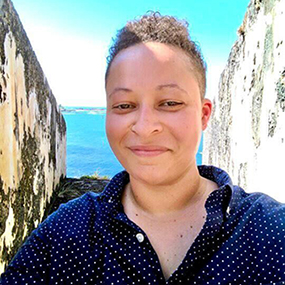
Jonese Franklin
Content Director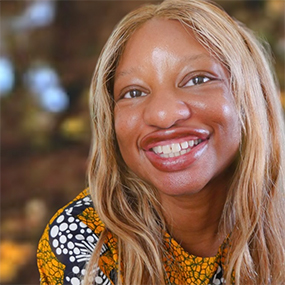
Jazzi Johnson
Managing Producer
Mark Bramhill
Senior Producer
Josh Fisher
Producer
Ariana Remmel
Fact Checker
Billy Almon
HostBlue Dot Sessions
Music
Dr. Kelsey Leonard is a Canada Research Chair in Indigenous Waters, Climate and Sustainability and an Assistant Professor in the School of Environment, Resources and Sustainability at the University of Waterloo. She is an enrolled citizen of the Shinnecock Nation and a leading scholar in Indigenous water governance, climate justice, and Earth law. Her work brings together Indigenous science and law to support water protection, ocean kinship, and community resilience.
Dr. Leonard’s connection to water is rooted in the cultural practices of her Nation. As a coastal Indigenous Nation, the Shinnecock have a long-standing tradition of duck decoy carving—an artform used not only for ceremony and expression but also to document the rich biodiversity of Shinnecock homelands. These waterfowl decoys reflect generations of ecological and ornithological knowledge. This tradition informs Dr. Leonard’s approach to Indigenous research and storytelling, where relationships with birds and water shape understandings of sustainability and justice.

