
Join BirdNote tomorrow, November 30th!
Illustrator David Sibley and actor H. Jon Benjamin will face off in the bird illustration battle of the century during BirdNote's Year-end Celebration and Auction!
Pelagic Birds by Boat
All aboard for a birding adventure at sea!

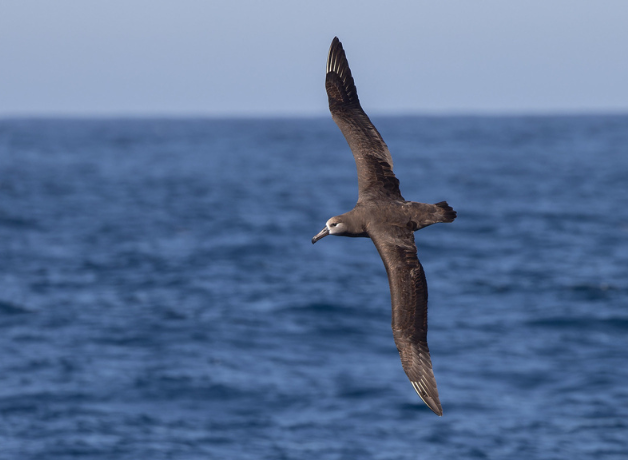

© Eric Ellingson
Some birds spend most of their lives on the open ocean, only coming to land when it's time to breed. These high-sea specialists are called pelagic birds, which include jaegers, petrels, and albatrosses, among many others. The best way to see them for yourself is by setting sail on a pelagic birding tour or whale watching cruise!
BirdNote®
Pelagic Birds by Boat
Written by Ariana Remmel
This is BirdNote.
Some birds spend most of their lives on the open ocean, only coming to land when it's time to breed. These high-sea specialists are called pelagic birds, and the best way to see them for yourself is by setting sail!
[Sound of a large wave breaking; calls of gulls along the shore]
Pelagic birding tours and whale watching cruises are a great way to experience oceanic species in their element. These voyages often begin with the raucous calls of gulls, terns, and pelicans that frequent coastlines.
But just a few miles off shore, these species give way to true maritime marvels like jaegers, also called skuas. These dark, gull-like birds are fearsome hunters and skilled thieves who use their aerial prowess to snatch fish from other animals.
[Parasitic Jaeger]
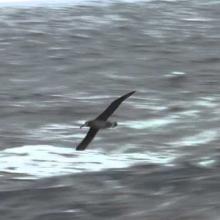
Even further out to sea, petrels, shearwaters, and albatross make life on the wind look like a breeze. They sport tubular structures above their bills that help them excrete salt from seawater and navigate by smell. Their long, pointed wings are perfect for gliding vast distances with minimal effort.
[Black-footed Albatross call]
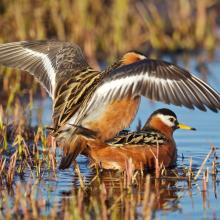
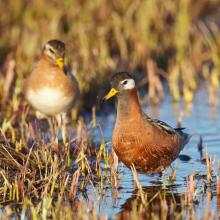
Keep an eye out for dainty seafarers too, like the robin-sized Red Phalarope. During the winter months, these slender shorebirds' plumage turns a ghostly gray — blending seamlessly into the frothy waves.
[Red Phalarope]
For BirdNote, I'm Michael Stein.
###
Senior Producer: Mark Bramhill
Producer: Sam Johnson
Managing Editor: Jazzi Johnson
Managing Producer: Ariana Remmel
Content Director: Jonese Franklin
Bird sounds provided by The Macaulay Library of Natural Sounds at the Cornell Lab of Ornithology, Ithaca, New York. Red Phalarope ML105630251 recorded by Tom Johnson. Parasitic Jaeger ML532792591 recorded by Cullen Hanks. Black-footed Albatross ML566525231 recorded by Rich Hoyer.
QP16 1977 Ocean Shores HE Day Birds Active Waves Gulls recorded by Gordon Hempton for Quiet Planet.
BirdNote’s theme was composed and played by Nancy Rumbel and John Kessler.
© 2025 BirdNote June 2025
Narrator: Michael Stein
ID# pelagic-02-2025-06-23 pelagic-02
Reference:
https://wpbo.org/2020/09/11/on-jaegers/
https://coastalstudies.org/connect-learn/stellwagen-bank-national-marin…;
https://www.allaboutbirds.org/guide/Red_Phalarope/overview

Michael Stein
Narrator
Ariana Remmel
WriterSights & Sounds