
Join BirdNote tomorrow, November 30th!
Illustrator David Sibley and actor H. Jon Benjamin will face off in the bird illustration battle of the century during BirdNote's Year-end Celebration and Auction!
Black Kites And Wildfires
Australia's firehawks hunt with flames.

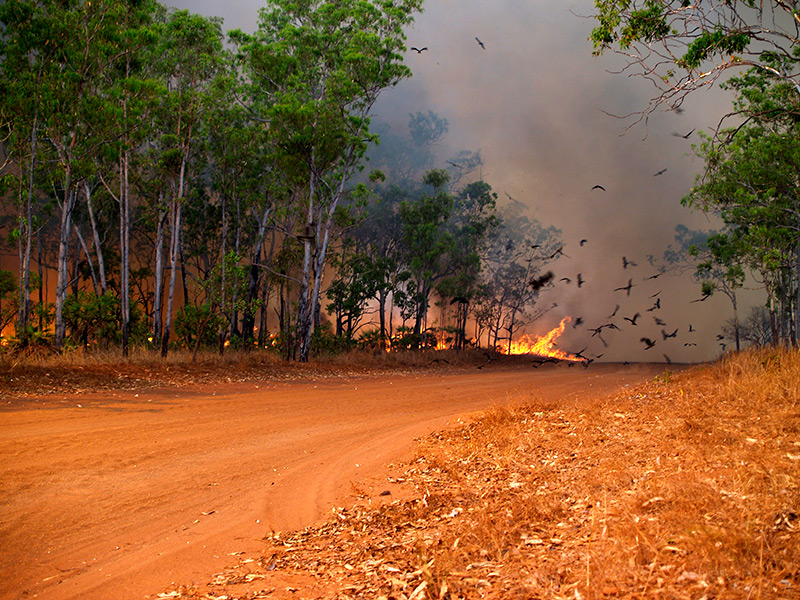

© Shane Bartie
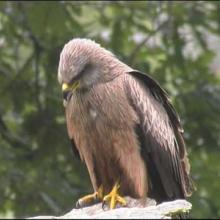
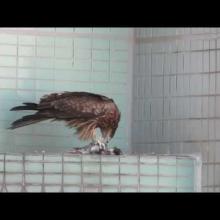
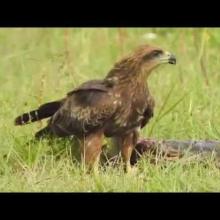
The savanna country of northern Australia is one of the most fire-prone natural habitats in the world, and its plants have evolved to thrive with frequent, low-intensity blazes. As flames sweep across the savanna, Black Kites watch for prey like grasshoppers and lizards that flee the fire. Indigenous Australians have long known that Black Kites aren’t just opportunists — the birds actually create some of these fires by carrying burning twigs in their talons and dropping them on a patch of savanna away from the original wildfire. The kites then pick off the escaping prey. Research suggests that setting a new area ablaze allows these "firehawks" to feed in a space where there aren’t so many rival predators.
BirdNote®
Black Kites and Fire
Adapted from a script by Bob Sundstrom
This is BirdNote.
[Sounds of fire burning, crackling]
The savanna country of northern Australia is one of the most fire-prone natural habitats in the world, and its plants have evolved to thrive with frequent, low-intensity blazes. As a fire sweeps across the savanna, raptors such as Black Kites stand or hover near the edge of the flames, awaiting prey such as grasshoppers and lizards fleeing for safety.
[Black Kite calling]
Indigenous Australians have long known that Black Kites aren’t just opportunists — the birds actually create some of these fires by carrying burning twigs in their talons, dropping them on a patch of savanna away from the original wildfire, and picking off the escaping prey.
[Sounds of fire burning, crackling]
In a 2017 study of Australia’s firehawks, researchers collected first-hand accounts of Black Kites, Whistling Kites and Brown Falcons intentionally spreading fires. It’s thought that setting a new area ablaze allows these firehawks to feed in a space with fewer rival predators.
[Black Kite calling]
It’s possible that humans might even have learned how to use fire long ago by watching these birds carrying burning embers. Today, fire ecologists are learning to account for firehawks in sustainable wildfire management.
[Black Kite calling]
For BirdNote, I’m Michael Stein.
###
Senior Producer: Mark Bramhill
Producer: Sam Johnson
Managing Producer: Jazzi Johnson
Managing Producer: Ariana Remmel
Content Director: Jonese Franklin
Bird sounds provided by The Macaulay Library of Natural Sounds at the Cornell Lab of Ornithology, Ithaca, New York. Black Kite ML97532 recorded by Lucienne Wilmé.
BirdNote’s theme was composed and played by Nancy Rumbel and John Kessler.
© 2026 BirdNote January 2017 / 2019 / 2022 & March 2026
Narrator: Michael Stein
ID# BLAK-01b-2026-03-31 BLAK-01b
Reference:
https://bioone.org/journals/journal-of-ethnobiology/volume-37/issue-4/0278-0771-37.4.700/Intentional-Fire-Spreading-by-Firehawk-Raptors-in-Northern-Australia/10.2993/0278-0771-37.4.700.full
https://wildfiretoday.com/did-humans-learn-how-to-use-fire-as-a-management-tool-from-birds/
https://www.abc.net.au/news/2016-03-03/smart-bushfire-birds/7216934

Bob Sundstrom
Writer
Michael Stein
NarratorSights & Sounds