
Join BirdNote tomorrow, November 30th!
Illustrator David Sibley and actor H. Jon Benjamin will face off in the bird illustration battle of the century during BirdNote's Year-end Celebration and Auction!
Lewis's Woodpeckers and Pine Forests
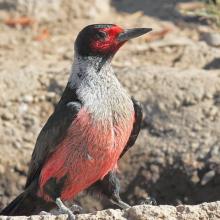
This bird breeds in mature ponderosa pine forests, then moves south in winter.


© Frank D. Lospalluto CC
A century of logging and fire control has taken its toll on the mature pine forests of the West, the preferred nest site for this Lewis's Woodpecker. But there is hope. Lewis's Woodpeckers also nest along rivers in large cottonwoods, trees of little value for timber. Also, many remaining tracts of old-growth ponderosas are protected on public lands, and the trees are growing larger day by day.
BirdNote®
Lewis's Woodpecker and Pine Forests
Written by Dennis Paulson
This is BirdNote.
[Lewis’s Woodpecker drumming on tree]
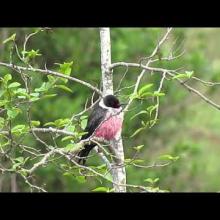
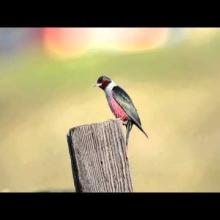
The Lewis's Woodpecker’s glossy dark-green back, red face, and pink belly make it look as if it belongs in a tropical forest. But this species is, in fact, an icon of the American West. A temperate migrant, this bird breeds across the western states, in mature ponderosa pine forests and then moves south in winter.
[Calls of Lewis's Woodpecker]
A century of logging and fire control has taken its toll on these mature pine forests, the preferred nest site for the Lewis's Woodpecker. It takes a long time for a ponderosa pine to grow large enough for the woodpecker to carve out a nest cavity.
As nest-holes have become scarcer, so have many other species that rely on them. For example, the tiny Flammulated Owl has also declined.
[Hoots of Flammulated Owl]
The moths that make up its diet are absent during northern winters, so it is highly migratory, wintering in Mexico and Central America. Thus its fate is also tied to the health of tropical habitats.
But there is hope. Lewis's Woodpeckers also nest along rivers in large cottonwoods, trees of little value for timber. Furthermore, many remaining tracts of old-growth ponderosas are protected on public lands, and the trees are growing larger as we speak.
[Drumming of Lewis's Woodpecker]
For BirdNote, I'm Mary McCann.
###
Senior Producer: Mark Bramhill
Producer: Sam Johnson
Managing Producer: Jazzi Johnson
Managing Producer: Ariana Remmel
Content Director: Jonese Franklin
Bird sounds provided by The Macaulay Library at the Cornell Lab of Ornithology, Ithaca, New York. Recorded by D.S. Herr and G.A. Keller. ML235836671 recorded by E. Hynes. Crickets recorded by Nigel Tucker. Ambient sounds recorded by C. Peterson.
© 2010/2017 Tune In to Nature.org March 2017/2019 & December 2025
Narrator: Mary McCann
ID# SotB-LEWO-01-2019-03-24 SotB-LEWO-01

Dennis Paulson
Writer
Mary McCann
NarratorSights & Sounds