

Join BirdNote tomorrow, November 30th!
Illustrator David Sibley and actor H. Jon Benjamin will face off in the bird illustration battle of the century during BirdNote's Year-end Celebration and Auction!
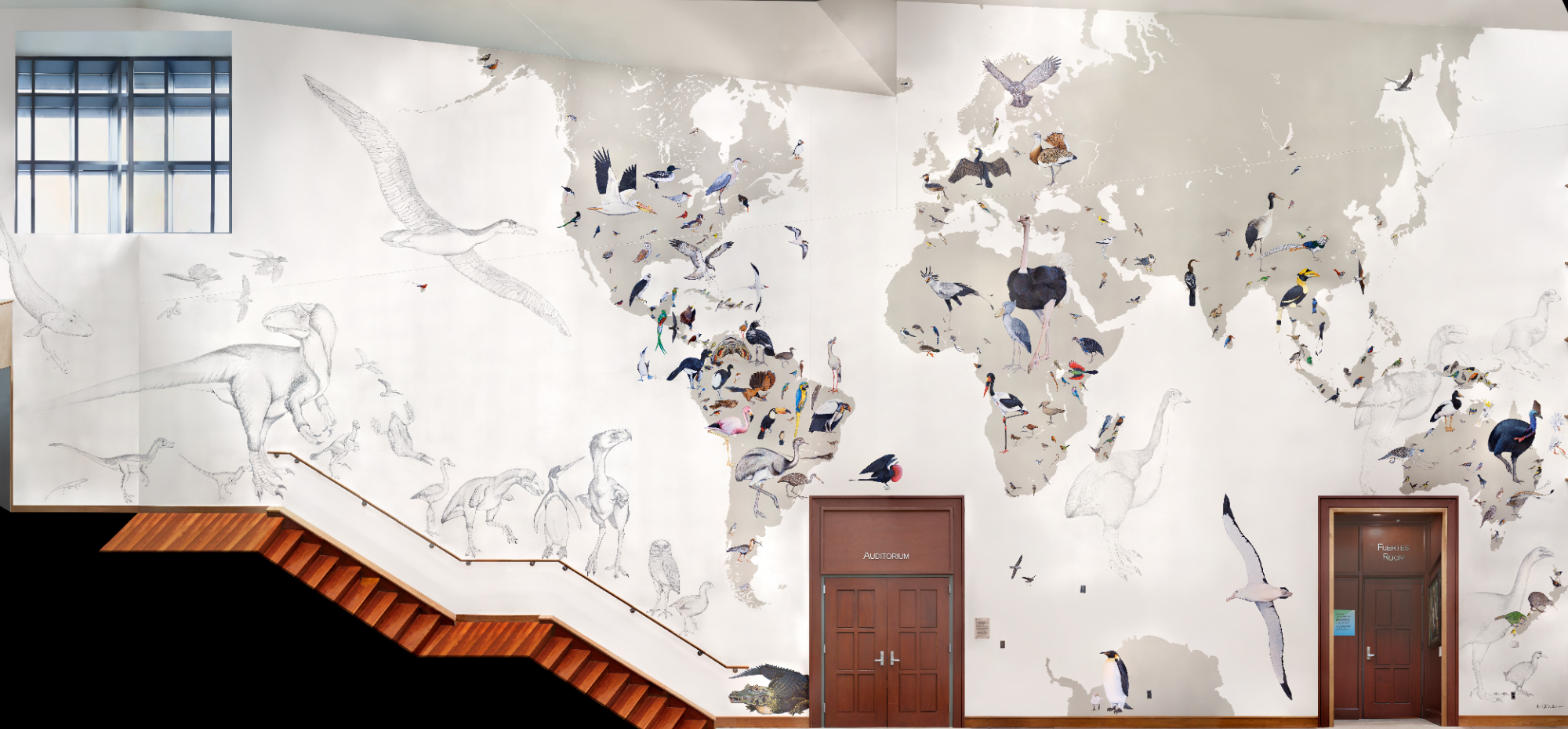
When visitors walk into the Cornell Lab of Ornithology’s Visitor Center, they’re greeted not just by birdsong, but by an extraordinary work of art: the Wall of Birds. Stretching across a towering wall, this mural by artist Jane Kim, founder of Ink Dwell Studio, celebrates the diversity and evolutionary history of birds through life-sized portraits of a representative from all the modern families of birds that were described in 2015, as well as their extinct relatives.
This massive mural turns 10 this year, and Kim recently spent time with BirdNote reflecting on what it meant to bring the project to life — and how it continues to resonate a decade later.
At first glance, the Wall of Birds looks like a world map dotted with feathers and wings, but dive deeper and discover intricate details and depth. There are 270 portraits of birds, their ancestors, and their relatives featured, and each is painted to scale and placed precisely in its natural range, with the living birds painted in color and extinct species are represented in grayscale.
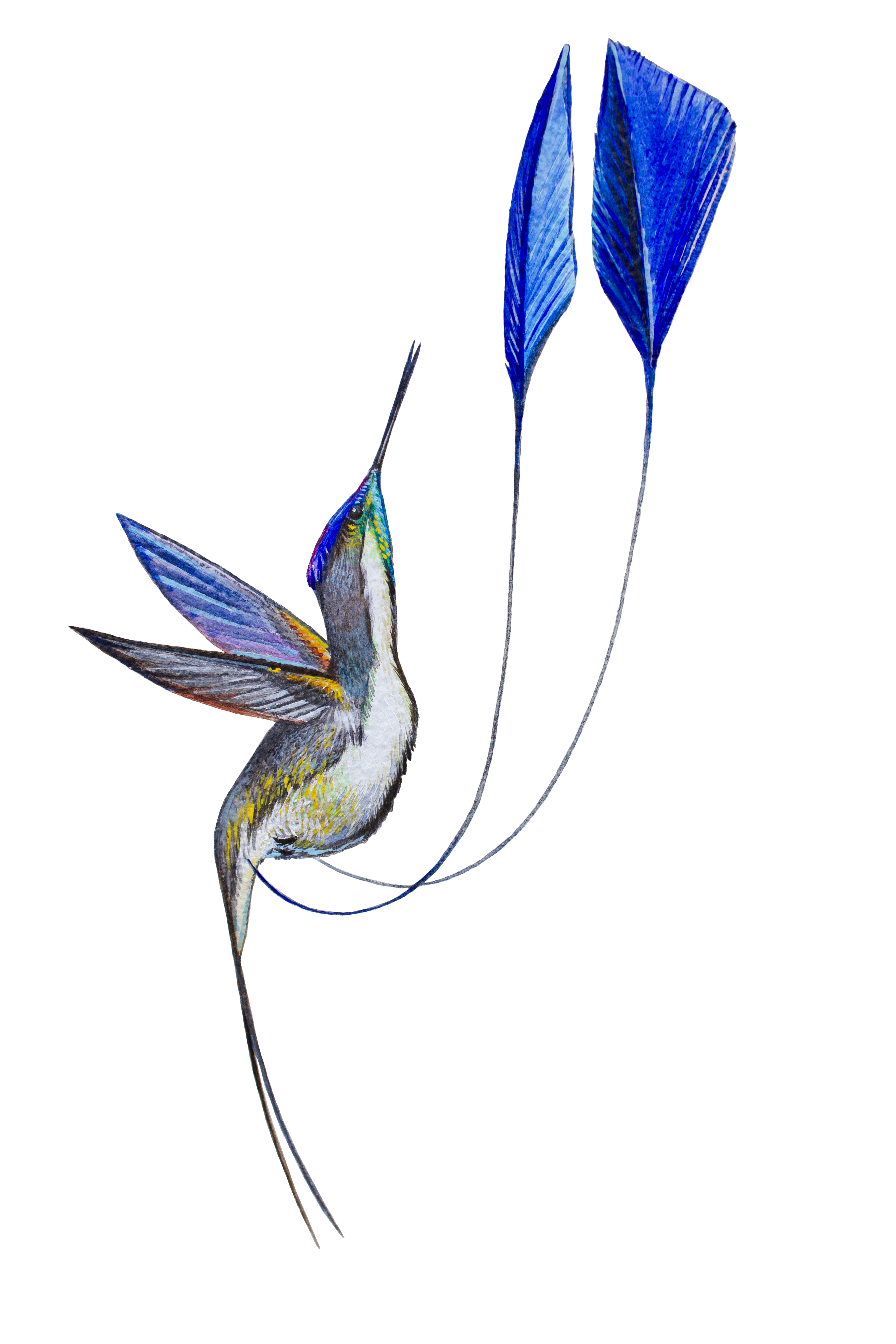
The tiny Marvelous Spatuletail hummingbird flutters near the Andes as the smallest bird depicted, while the Yutyrannus hauli, a dinosaur known as the “beautiful feathered tyrant”, stretches 30 feet from head to tail tip, and the Bermuda Petrel flies across the Atlantic Ocean.
For Jane Kim, the artist who took on the massive project, the Wall of Birds is more than just a map. It’s what Kim calls “one giant scientific illustration,” that takes the viewer on a journey – a project where art and science intertwine and where people are able to ask themselves where they fit in on the map.
Each posture, placement, and delicate detail was vetted for accuracy by scientific advisors at the Cornell Lab of Ornithology. And yet Kim was determined to go beyond field guide precision. She wanted to bring the birds to life, which meant rethinking how she posed them. “They should really be in a posture that is true to their behavior,” she said.
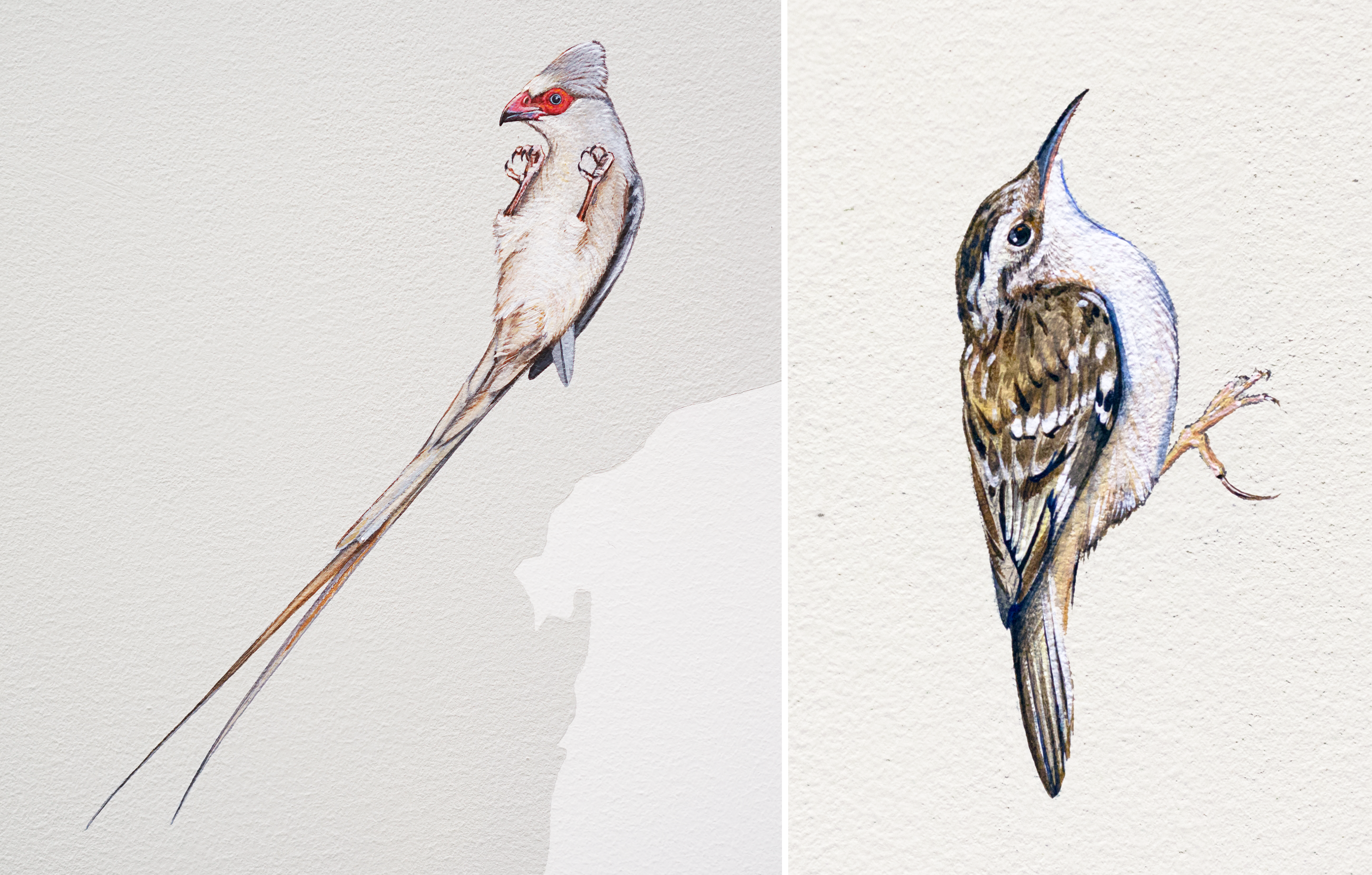
For instance, the Red-faced Mousebird and Brown Creeper look like they’re clinging to a branch or trunk of a tree, and waterfowl are depicted as swimming, so they're “floating with their legs in postures that would make them feel like they're in an environment,” according to Kim. The mural brims with movement, its subjects caught in moments of action rather than pinned down like specimens.
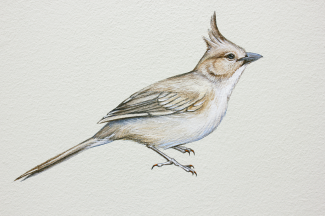
Even the so-called “little brown jobs” – like sparrows and wrens that often fade into the background – were treated with care. “They already have a reputation of being dull brown birds,” Kim said, “so I really wanted to give them a lot of love.” In her hands, even the most overlooked birds carry their own quiet charisma, like the Chiming Wedgebill in Australia. She describes the bird as “really sandy,” but “if you look closely, there are these hints of colors that you wouldn't normally expect – ultramarine, blues, oranges and pinks.”
Some of the mural’s most enchanting qualities can’t be seen at all. Thanks to an interactive feature created by the Lab, visitors can listen to the sounds of many species on the wall, including the haunting call of the Common Loon and the virtuoso vocals of the Superb Lyrebird. For Kim, painting birds best known for their voices was especially rewarding. She wanted the image itself to feel like a song. “I really hope the call looks like you can hear it,” she said of the Three-wattled Bellbird, famous for a metallic “bonk” that is as startling as their plumage.
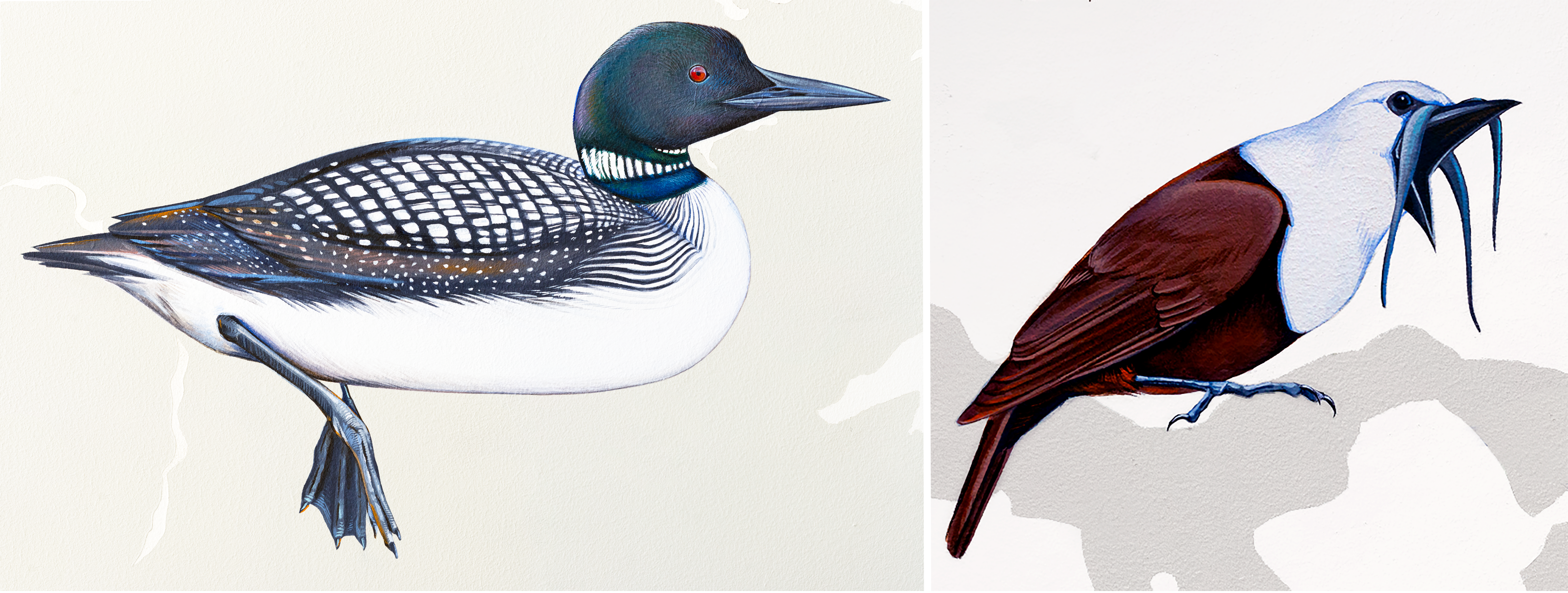
The Cornell Lab’s visitor center is nestled in the heart of Sapsucker Woods Sanctuary, and the soundtrack of the forest was always with Kim as she painted. Late nights brought “a chorus of not just birds, but the insects and the wildlife, the calls of the water splashing, it just made me feel very connected to the natural world, " she recalled. “That’s how alive the world is if you stop and listen – even in the dead of night.” For her, those nocturnal soundscapes became part of the creative process, as integral as each brushstroke.
While the sights and sounds of each bird are important, Kim reflected that the mural captures an essential truth that is easy to forget: birds pay no attention to the borders humans draw on maps. “We didn’t choose to put the lines of the countries on the map,” she explained. “It’s just a massive land, and the birds are moving about without the human constructs of boundaries.” In that way, the mural doesn’t just show where birds live — it reminds us that the natural world flows free of the walls and divisions created by humans.
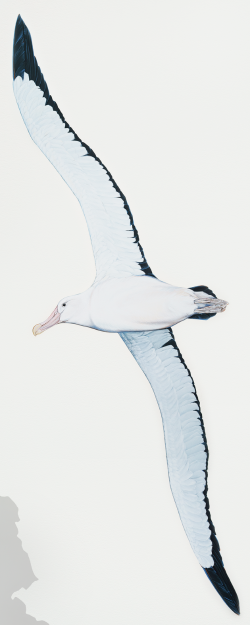
Though the Wall of Birds was completed in 2015, its life has only expanded. It inspired a book, educational programs, notecards, even a playful blue-footed booby shoe. The artwork has become both a lasting piece of cultural heritage and a reflection of science’s constant evolution. “The information is now somewhat outdated – 2015 was a long time ago, and we know more now,” Kim explained. “This mural was a timestamp, but that timestamp should hopefully remind us that that is the nature of science and that it's always evolving.”
Looking back, Kim still marvels at the scale of the project she took on so early in her career. Many artists before her had turned it down, calling it too big, too daunting. But she said yes. “I was hungry for it,” she explained. “Now I think – wow, if someone asked me today, it would require a very different way of doing it. But I’m still incredibly proud that I did.”
That one “yes” created a legacy. Today, the Wall of Birds continues to stop visitors in their tracks, connecting them not only to the beauty of individual species but also to the bigger story of our shared planet. For Kim, the mural is a reminder that the world is alive, always changing, and that we, like the birds, belong to it together. “It does give a sense of how no matter where you are, we're so connected by an explosion of different diversity of these species,” she recalled.
About Jane Kim

Jane is a visual artist, science illustrator, and the founder of Ink Dwell. Her art career started when she was a little girl obsessively painting flowers and bears on the walls of her bedroom. She received more formal training with a BFA in Printmaking from RISD and then attended California State University Monterey Bay, where she received a master’s certificate in science illustration. She has created large-scale public art across the country, including the Wall of Birds at The Cornell Lab of Ornithology, and produced works for the National Aquarium, the de Young Museum, Leigh Yawkey Woodson Art Museum, and more. She is the creator of the Migrating Mural campaign, a series of public installations that highlight wildlife along migration corridors it shares with people. She still enjoys painting flowers and bears, though nowadays she doesn’t get in trouble for painting on the walls.