
Image: The Ultimate Bird Drawing Throwdown Showdown Graphic featuring images of David Sibley and H. Jon Benjamin

Join BirdNote tomorrow, November 30th!

Illustrator David Sibley and actor H. Jon Benjamin will face off in the bird illustration battle of the century during BirdNote's Year-end Celebration and Auction!

RESERVE YOUR SPOT

Shows With Contributions by Michael Stein

Anhinga stretching its long angled neck out of calm blue water, and pointing its narrow slender beak upward.

Anhingas — Snakebirds

In the black water of a Louisiana bayou, the water ripples where a slender form glides just beneath the surface. It appears to be a snake, but look closer at the long, narrow spike of a beak. It’s a snakebird, a colloquial name for the Anhinga, swimming with just its head and neck above…
Osprey perched with talons on branch

The Superbly Adapted Osprey

This Osprey looks similar to other birds of prey. But the species is truly unique among raptors. For example, the Osprey is the only raptor with oily feathers. And the Osprey’s long, slender, arched wings help it clear the water as it takes flight after catching a fish. The Osprey we see…
Akiapolaau perched on branch

Kipukas and Akis

One of Hawaii’s rarest forest birds is this ‘akiapola’au. Some of the roughly 1,000 'akis left on earth live and breed in kipukas on the lower slopes of Mauna Loa, Hawaii’s largest active volcano. A kipuka is an island of native forest surrounded not by water but by recent lava flows - a…
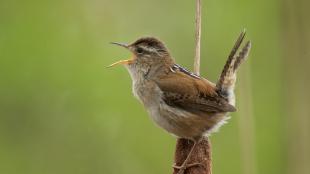
A Marsh Wren singing while perched on a cattail reed.

The Marsh Wren

Some bird-lovers have tagged the Marsh Wren the "Heinz 57 variety" bird, because scientists have recorded 57 different variations of its song. And nightfall doesn't faze these birds. A male may sing straight through the night. Marsh Wrens usually forage out of view, hopping up only for…
A Laysan Albatross flying over open water.

An Albatross Surfs the Wind

By moving from the faster high air to slower low air, or vice versa, an albatross can propel itself forward. In a series of sinuous loops, the albatross surfs the wind, up and down, repeating the pattern over and over again as it moves thousands of miles across the ocean.
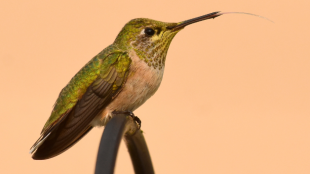
A Calliope hummingbird with its tongue out

The Surprising Secret of Hummingbird Tongues

Hummingbirds use their long tongues to sip nectar from flowers. They’re able to roll their tongues into a tube-like shape. Since the 1800s, scientists thought those tongues worked through capillary action, like how water instantly rises into a straw in a full cup. But when scientists spent…
A Helmeted Guineafowl walking across dry grass.

Helmeted Guineafowl Sound the Alarm

Helmeted Guineafowl are known for moving in frantic flocks, often running and squawking about. In their native range – from Senegal to South Africa – these chicken-sized birds are favored prey of wild cats and Martial Eagles, so they need to be alert! Because they’re also spooked by…
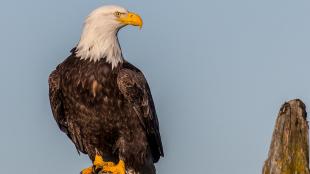
Bald Eagle perched on driftwood at the beach, in sunshine, it's head turned to the left in profile against a blue sky

The Bald Eagle, a National Symbol

Immature Bald Eagles look so different from mature Bald Eagles that early ornithologists thought they were a different species entirely! Sitting about three feet tall, these majestic birds have wingspans of more than six feet. Stretch your arms as far as you can, and imagine a bird whose…
Male Baltimore Oriole perched on half an orange

The Baltimore Oriole

Not all blackbirds are mostly black. This Baltimore Oriole is orange! The bird's common name is a nod to Sir George Calvert, First Lord of Baltimore, whose coat-of-arms carried a gold and black design. In spring and summer, you may see these orioles in the Midwest and eastern U.S…
A male Blue-winged Teal stands at water's edge as sunlight highlights the colors on his feathers

Traveling with Blue-winged Teal

Noticeably smaller than Mallards, Blue-winged Teal wings have large patches of powder blue edged in emerald. Blue-winged Teal are long-distance migrants, traveling from nesting areas in Canada and the U.S. to South America for the winter. They feed in shallow water with a preference for…