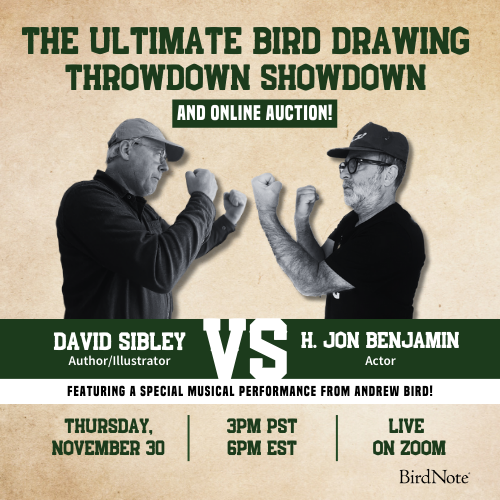
Image: The Ultimate Bird Drawing Throwdown Showdown Graphic featuring images of David Sibley and H. Jon Benjamin

Join BirdNote tomorrow, November 30th!

Illustrator David Sibley and actor H. Jon Benjamin will face off in the bird illustration battle of the century during BirdNote's Year-end Celebration and Auction!

RESERVE YOUR SPOT

Shows With Contributions by Michael Stein

Three blue-and-white birds with long tails perch near each other amidst branches and greenery

Magpie-Jay Flocks Are Led by Females

Found in much of Central America, White-throated Magpie-Jay flocks are family groups led by a dominant female. They include a mate and several female offspring that bring food to the primary female and her young. It’s an example of cooperative breeding, when birds other than the parents…
Song Sparrow

Mating for Life

Most bird species in North America mate for a single breeding season. Some may team up again the following year, just because both stay in - or return to - the same territory. Fewer than one-fifth of Song Sparrow pairs are reunited. Hawks, eagles, and ravens have wide territories, thus few…
Close view of a Blue Jay looking over its shoulder on leaf-strewn grassy area

Join the Great Backyard Bird Count

Over the course of four days in February, the Great Backyard Bird Count gathers heaps of info about birds all over the world — and helps people connect with their local birds. Anyone can participate with the Merlin Bird ID app. And if you’re familiar with your neighborhood birds, you can…
A House Wren nest with several nestlings inside it

Participate in Project NestWatch

Organized by the Cornell Lab of Ornithology, Project NestWatch is made up of volunteers around the world who monitor bird nests, reporting whether the birds successfully raise their young. Joining the project involves a bit of online training, finding a nearby bird nest, and briefly…
American Robins

A Bird in the Hand

You’ve probably heard the old saying: “A bird in the hand is worth two in the bush.” Well, it’s a very old saying, and it’s gone through some changes over the years. In each era, the pragmatic wisdom is clear: Hold on to the sure thing rather than taking a gamble on something better. The…
Pair of Sandhill Cranes in flight

To Breathe Like a Bird

Birds have a highly efficient breathing anatomy that powers the exertion of flight. It is driven by large, thin-walled air sacs located throughout the body cavity that operate like bellows. This parabronchial system for extracting oxygen from the air has a far greater surface area than the…
Photo comparing a House Finch on the left and a Purple Finch on the right

Voices and Vocabularies: House Finch or Purple Finch

In parts of the United States, House Finches overlap with similar-looking Purple Finches. Their distinct songs help us sort them out. House Finch songs are jumbled and have a sharp, buzzy note — especially during the breeding season. Purple Finches’ songs, on the other hand, are smoother…
A Pink-footed Goose (grey body, short orange bill, and pinky legs) stands on a green field.

Wild Goose Dacha

No human dreams of relaxing on the shores of Novaya Zemlya, an archipelago in the Arctic Ocean that’s best known as a Soviet testing site for nuclear weapons. Yet a growing flock of Pink-footed Geese have begun to make this militarized zone their summer home. Though this region was once…
Broad-tailed hummingbird hovering while drinking nectar from a coral-colored blossom

The Heart of a Bird

Birds’ four-chambered hearts run larger than those of mammals, relative to body size, and they are coupled with extremely efficient cardiovascular systems. The energy demands of flight require these adaptations. An exercising human has a heart rate around 150 beats per minute. In contrast…
American Robin with orange breast and dark brown head pulls a worm from a grassy area

The Early Bird

We've all heard that the early bird gets the worm. But research shows that birds dining early and heavily may lower their life expectancy. Socially dominant birds stay lean (and agile at avoiding predators) during the day, and then stoke up later, before a cold night. Subordinate birds…