


Join BirdNote tomorrow, November 30th!
Illustrator David Sibley and actor H. Jon Benjamin will face off in the bird illustration battle of the century during BirdNote's Year-end Celebration and Auction!
Swainson's Hawks Migrate South
Follow a Swainson's Hawk on migration

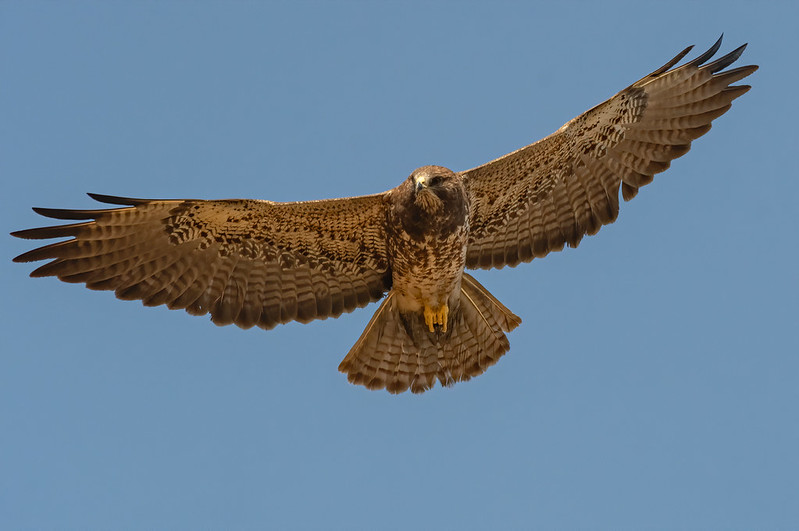

© Wendy Miller
In autumn, hundreds of thousands of Swainson's Hawks migrate to South America. With the help of a satellite tracking device, let's follow an individual male. On September 14, he leaves his breeding territory near Hanna, Alberta; reaches southwest Saskatchewan by September 23; passes through Nebraska, October 1; Tamaulipas, Mexico, on October 7; Honduras, October 14; and on the 7th of November, this Swainson's Hawk arrives at Marcos Juarez, Argentina - a migration of more than 6,000 miles. The American Bird Conservancy has Swainson's Hawk on their watchlist at ABCBirds.org. Learn more about hawk migration at the Hawkwatch International website.
BirdNote®
Swainson’s Hawks Migrate South
Written by Chris Peterson
This is BirdNote!
[Wind]
In autumn, hundreds of thousands of Swainson’s Hawks migrate to South America. They’re leaving prairies in Saskatchewan and the Dakotas, rangelands in the Great Basin, deserts in Arizona and New Mexico. Raptor-counters for Hawkwatch International have counted more than 3,500 Swainson’s over Corpus Christi, Texas, 900 at Nevada’s Goshute Mountains, 2,900 at New Mexico’s Manzano Mountain.*
Up to 845,000 were counted one autumn in Veracruz, Mexico.
With the help of a satellite tracking device, let’s follow an individual male.
[Call of a Swainson’s Hawk]
On September 14th, he leaves his breeding territory near Hanna, Alberta; reaches southwest Saskatchewan by September 23rd; passes through Nebraska, October 1st; Tamaulipas, Mexico, on October 7th; Honduras, October 14th; and arrives at Marcos Juárez, Argentina, on the 7th of November2 – a migration of more than 6,000 miles.
[Tango: “Hernando’s Hideaway”]
And there’s yet another remarkable feature of these hawks. In North America, Swainson’s feed on rodents, rabbits, reptiles, and insects. But in Argentina, they feed almost exclusively on insects, mainly grasshoppers.3
Birds – adapting to differences – and bridging cultures gracefully.
[Continue Tango]
For BirdNote, I’m Michael Stein.
###
Call of a Swainson’s Hawk provided by The Macaulay Library of Natural Sounds at the Cornell Lab of Ornithology, Ithaca, New York, recorded by R.S. Little.
Senior Producer: Mark Bramhill
Producer: Sam Johnson
Managing Editor: Jazzi Johnson
Content Director: Jonese Franklin
© 2014 Tune In to Nature.org October 2016/2021/2024 Narrator: Michael Stein
ID# SotB-SWHA-01-2011-10-09
Tango: Hernando’s Hideaway performed by Orquesta Tipica Argentina, album Tangos Famosa
Permission for figures granted from Hawkwatch.
(1) Birds of North America online Swainson's Hawk, Issue No. 265 – Revised: August 16, 2010
Authors: England, A. Sidney, Marc J. Bechard, and C. Stuart Houston Revisors: Bechard, Marc J., C. Stuart Houston, and Jose H. Sarasola, p.
(2) Ibid; “Timing and Routes of Migration”
(3) Ibid; “Food Habits”
*The narrowing landmass of Central America concentrates these southbound migrants causing huge numbers. “Nearly 350,000 have been counted passing over a single point in Panama City in October and November.” Up to 845,000 were counted one autumn in Veracruz, Mexico.]”1

Chris Peterson
Writer
Michael Stein
NarratorSights & Sounds

Related Field Notes

Male Marsh Wrens will build several--as many fifteen--dome shaped shells in the reeds to woo fema
The Osprey is the only North American raptor to eat fish almost exclusively, and it's well adapte