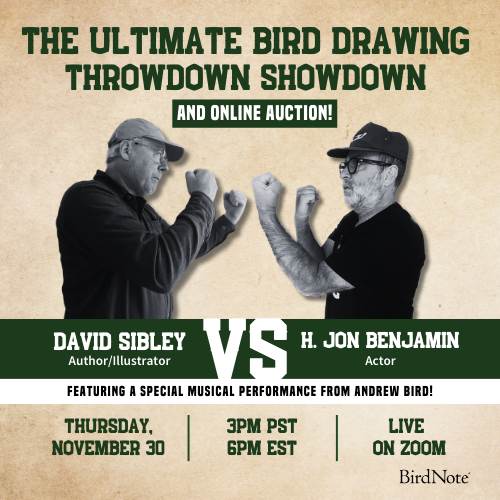
Join BirdNote tomorrow, November 30th!
Illustrator David Sibley and actor H. Jon Benjamin will face off in the bird illustration battle of the century during BirdNote's Year-end Celebration and Auction!
Scott’s Wild Bird Preserve
Conservationist Isaiah Scott returns to share his next big vision. (Season 9 Episode 1)

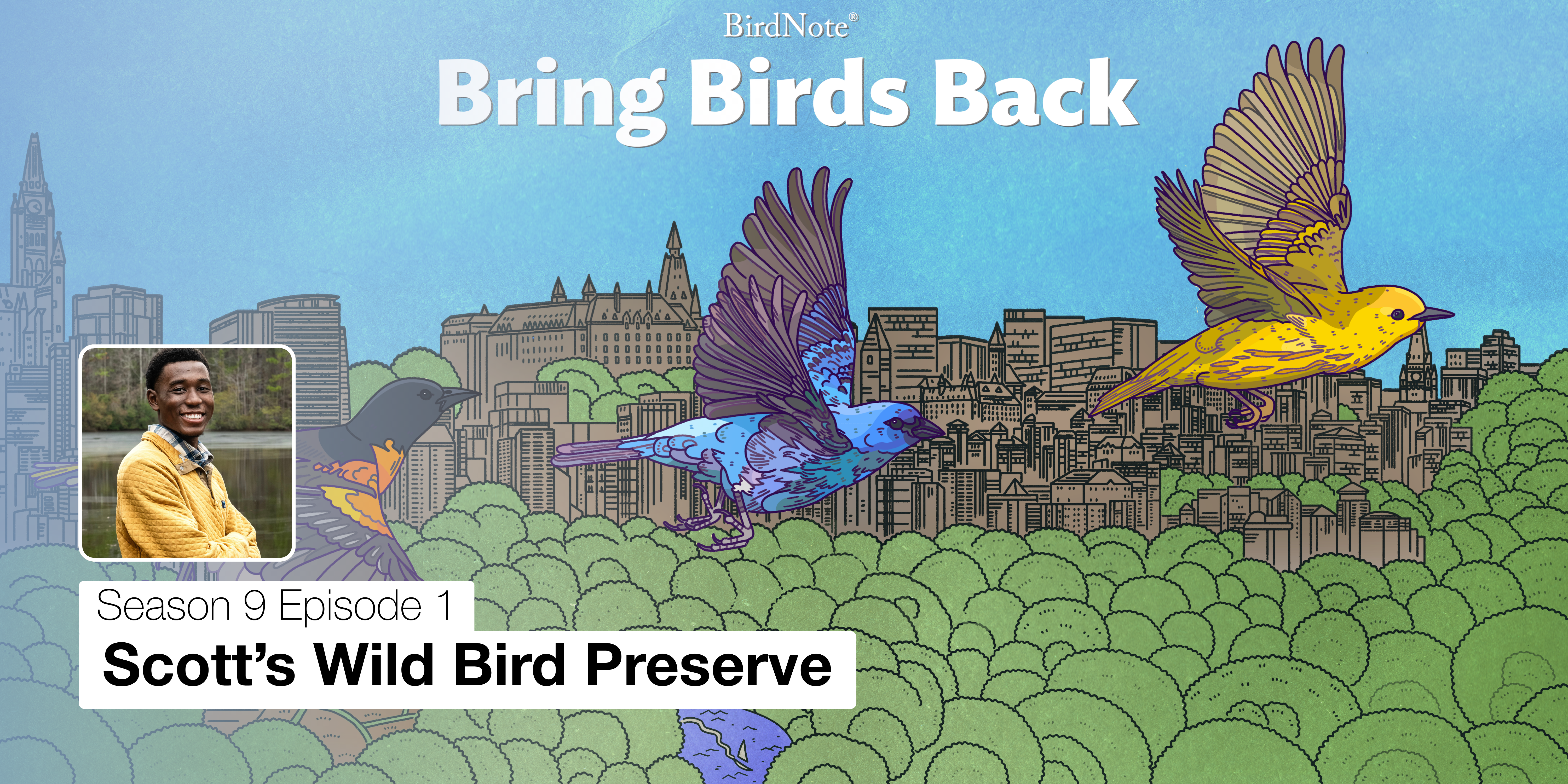
When we first interviewed Isaiah Scott a few years ago, he was a sophomore in college with big dreams about conservation. Now, as a Cornell graduate, he’s back to talk about using his influence to turn those dreams into reality as founder of his non-profit, Rookery & Roots. Isaiah shares some exciting stories -- and challenging ones, too -- of becoming a young, Black landowner, building his forthcoming bird preserve from the ground up in his hometown of Rincon, Georgia. Additionally, he shares his concerns about a growing development just miles away from the preserve: a proposed, record-breaking massive AI data center, and what that could mean for the wildlife and communities he’s working to protect. Tune in today.
Want more Bring Birds Back? Follow us on your favorite podcast app and on Instagram @BringBirdsBack!
To learn more about this topic and guest(s), read the episode transcript and other resources from this episode, visit our show page on BirdNote.org. Consider signing up for our weekly newsletter to stay up to date on what’s happening. For ad-free listening and other perks, sign up for BirdNote+ Plus here.
Get involved in our From Love to Action campaign when you visit this link!
BirdNote is a nonprofit. Your tax-deductible gift makes these shows possible. Please consider donating today!
Bring Birds Back Season 9 is sponsored by Teton Science Schools and the Cornell Lab of Ornithology’s Bird Academy.
Deja Perkins: BirdNote Presents…
[Bring Birds Back Stinger]
Welcome to Season 9 of BirdNote’s Bring Birds Back podcast. I’m your host, Dr. Deja Perkins. And this season, we’re focusing on small ideas that turned into major concepts, innovations and discoveries! And the people? Well, they’re also big dreamers, dedicated to seeing a more robust, restored, thriving world! And the thing they all have in common? As you can imagine, it all started with a bird…
Bird Conservation can take a variety of shapes. On a global scale, large organizations like Audubon Society, Cornell Lab of Ornithology, American Bird Conservancy, and many other non-governmental orgs, or NGOs, tackle issues nationally and internationally. They have both the people-power and expertise to handle everything from research, policy, and advocacy, to on-the-ground habitat management.
On a local scale, non-profits and birding organizations accomplish very similar actions but on the community level; think about the Windy City Bird Lab, In Color Birding, and other collective groups in the US and abroad.
Still, when it comes to land-based impact, much of the land in the US is privately owned, so many of those larger orgs can only do so much on public land. That means the individual decisions you and I make on our own land and in our neighborhoods matter most.
However, land-ownership is expensive and can seem out of reach for many, especially those under 40. Typically, individuals who have the most conservation impact skew older and “more experienced,” but our guest today is a bit of an anomaly.
Back for the first time– our guest, Isaiah Scott, was first introduced to the show in 2023, due to his famed social media presence as a birder and lead guide of Ike’s Birding Hikes. In this episode, we are speaking with a slightly different Isaiah. Older, graduated, artist, birder, and now– founder of Rookery and Roots Conservancy. We’re talking about what it takes to create your own outdoor conservation area as a young person of color with a big dream in an uncertain world.
--------------------
Deja: Hi, Isaiah. Welcome back on the show. Can you introduce yourself to our audience for those who may not know you, and share a little bit about your background?
Isaiah Scott: Yes. Well, hi, Deja. Glad to be back. My name is Isaiah Scott. I am 23 years old. I'm a bird watcher. I'm an artist, conservationist. I graduated from Cornell University last year in 2025 with a bachelor's in environment and sustainability. I live near Savannah, Georgia. From there, I actually started my own nonprofit called Rookery Roots Conservancy. We're a 501[c][3] environmental protection organization, and I'm creating a nature preserve through my nonprofit called Scott's Wild Bird Preserve. And I'm excited to share more about it with Bring Birds Back.
Deja: That all sounds really exciting. And you've had a lot of evolutions in your life since we've last spoken to you. So the last time you were on the show, you were a sophomore. But you were also in the early stages of creating your field guide on birds in Gullah Geechee culture. Since you graduated, can you give us a quick update on your field guide?
Isaiah: Absolutely. The title is A Field Guide to Birds of the Gullah Geechee Cultural Heritage Corridor. It will be published by the University of South Carolina and the expected date of completion is June 2027. And [I] can't wait to share once it's published and out there for people to read and learn about birds significant in Gullah Geechee culture.
Deja: That's super exciting and we can't wait to see the final results of this project. So, like you said, you've started this nonprofit and I'm curious, how did you go from college student to landowner? What is the story of Rookery and Roots, what inspired you to start it? Tell us all the things.
Isaiah: So, while I was in college, and it was around sophomore year, I really learned a lot about the changes in our environment, you know, things such as climate change, deforestation, the loss of three billion birds, over time. And so, all of these things I was learning just really hit me and stuck with me and it motivated me to do something about it.
Mainly, I think the most important thing is sharing the beauty of nature and helping other people protect our environment. I had this very hopeful thought process about what's happening in the natural world. I imagine a future where people and nature can sustainably coexist. So, from there, the idea of a nonprofit kind of started.
This was something I really had a dream of when Ike's Birding Hikes was actually birdwatching hikes I would lead here in Rincon, Georgia. And I thought that it would be cool to have my own place to host birdwatching events and to protect as a nature preserve. So from there, I just kind of ran with that idea, and I knew that after I graduated, I wanted to come back to Georgia to start this nonprofit.
Deja: How did you come up with the name and what were the steps you took to make it a reality
Isaiah: Eventually the name came along of Rookery and Roots Conservancy. The idea behind that is tying the connection between nature and culture. And rookery, like a breeding and nesting congregation of birds, particularly like wetland birds—it's very inspired by the nature and biodiversity here in coastal Georgia. And the roots part represents our connection and heritage that we have on the landscape and with nature and basically how nature and culture is just inseparable. I really wanted to represent that in the name.
From there, I graduated, came back home, and just started working. You know, just doing everything from, "Okay, let's make a website and let's start our first project." I was like, I wanna try to create a nature preserve and protect land.
So through the nonprofit, whenever I announced the idea of like land searching and looking for different places I was just getting tons of support. Not only through social media, but a lot of local people were supporting and saying, "We need something like a nature preserve around in our area," because a lot of deforestation and development has been occurring, especially with fragile places such as our wetlands.
Deja: In 2022, Isaiah began receiving donations online for the project from friends, family, fans and followers of his work as a social media influencer and creator of Ike’s Birding Hikes. And in December 2025, he purchased the land with additional support and guidance from his parents, who have been helping him every step of the way. He even credits his mother’s intuition for leading him to this specific plot of land.
Isaiah: The day that we actually started looking for land, was actually from the help of my mom.
[mid-tempo, whimsy music]
The story behind it is that one day, I was in church with my mom and she was telling me that while she was in church, she was praying to God. And basically, she heard an answer from God saying start looking for land for Isaiah. And so ever since that day, she was like, "Okay, we're gonna do this. Here, I know a friend who has a land realtor. I want you two to go out, look for land for this nature preserve."
And I was like, "Thank you, Lord. Let's get it going." So yeah, I was working with a very skilled and experienced land realtor, and we just started looking at places that were listed. We had like a budget, and of course, we couldn't buy, you know, hundreds of acres that were listed, but something more, in the range of like 100,000 dollars. So we're looking at different places and, I think like the fifth visit, I found this 16-acre parcel that's actually in the middle of Rincon, which is basically a growing city.
Not like an urban tall building city, just like a spread of neighborhoods. And, here in the middle of the city, there is these acres of land that's not developed, that still has green space. So it was this area that was kind of in the back of this neighborhood. And I was looking on the map and it had two ponds so I was like, “Let's go and see if this is something that we want." So we went, and it was just beautiful. As we were walking, one of the first signs of birds were turkey feathers, just like scattered on the ground. And the land realtor, he used to be a game warden, he was like, "Yeah, this is really good habitat for Wild Turkeys." And I was really, really drawn to that. For a 16-acre parcel, there was a lot of diversity.
There's different forest types; we have the ponds, the creek. The other thing that was crazy and that really confirmed that this was a very special place, was that the street name was called Zero Scott Avenue, it's almost named after me. And it was almost like it was in God's plan or just, a divine moment.
[music ends]
Deja: Yeah, that was destined for you. That was in alignment. Just– it was the vision that your mother saw.
Isaiah: Exactly.
Deja: There was really a lot to unpack in that story, and a few things that I thought were really notable about this process is that, Rookery and Roots, you got this idea from the way that birds roost together in community, in rookery. And then you also have this goal of serving community and being rooted in your own community, literally with the land that you purchased being smack dab in the middle of the town, hosting your name.
So it's like all of these tiny pieces that really are fitting together to show the mission and the vision of Rookery and Roots, from ideation to conception, which I think is really cool.
Can you tell us more about what you have in mind for the land and your vision for the nature preserve?
Isaiah: Absolutely. So the name of the nature preserve is Scott's Wild Bird Preserve because I really wanted to hone in on bird conservation specifically. So we kinda use birds as a model to conserve and manage the ecosystems.
In addition to bird conservation, we also focus on environmental education. The idea is to have the preserve be a living classroom for students or for visitors to gain experience and this opportunity to explore our ecosystem and to learn about different plants and animals, and connect with the natural world.
Deja: I'm sure it's tough coming right out of college and having such big dreams to make change. I mean, having 16.1 acres is no small feat. That's a lot of land. And so I'm curious, what has been your overall management plans or goals for your property thus far? I know you're managing for birds, but can you share a little bit more about what that looks like for you?
Isaiah: First in terms of, like, bird habitat and just the natural ecosystem– there's two habitats that I'm hoping to kinda help restore on the site and that's longleaf pine savannas and then cypress tupelo swamps. With longleaf pine savannas, which is a habitat that covered 90 million acres across the Southeast, but, I believe it's less than 10% of that exists today.
The main management strategy for that is, obviously, planting longleaf pines. We have one longleaf pine but most of the property is dominated by loblolly pines and then also sweetgums. When the forest is left without disturbance from natural wildfires or any other kind of disturbance, it basically grows into this very dense, mixed forest that just crowds out the understory, and then that, in turn, decreases biodiversity, decreases bird diversity.
And so, really having nice, open areas, we're hoping to create more of that on the property. I have someone from the Georgia DNR [Department of Natural Resources] who helps private landowners restore savanna habitats with fire, so doing prescribed burnings.
And then with the cypress swamps- in the creek, I believe that we used to have cypress trees in our creek, but there is signs of historical logging so, you know, just replanting cypress trees. And then in addition to that, canebrakes is another endangered ecosystem. And, we have a remnant canebrake in our creeks. Also that's really good habitat for Swainson's Warblers and for other songbirds and also turkeys.
So there's a lot to manage for bird habitat and for just wildlife.
[sound design]
Deja: Scott’s Wild Bird Preserve is just the beginning of what Isaiah has in mind for the land. In addition to installing Wood Duck nesting boxes in hopes of attracting actual Wood Ducks, they plan to construct a bird observation deck expected to stand two stories high overseeing their ponds. The native plant garden will be in honor of his late grandmother, Willie Mae Johnson-Taylor, a bird lover and gardener who inspired his own love for the outdoors. And at the time of this recording, they’re currently accepting donations for their latest campaign, the Rincon Branch Bridge, to build a walkable and accessible pathway over the creek into the bird preserve.
Home to Eastern Bluebirds, Canada Geese, Belted Kingfishers, owls, vultures, and woodpeckers — just to name a few — there’s so much more in store.
Deja: I know you mentioned the Swainson's Warbler. But I'm curious, are you hoping to attract maybe Prothonotary Warblers or even, the now threatened Red-cockaded Woodpecker? Or are there any other particular species that you might be managing for on your property?
Isaiah: Yeah. The Wild Turkey; that's a species that has been considered like an umbrella species because they use an assortment of different habitats throughout their life stages. And I've mainly been seeing turkeys in the fall and winter. I haven't experienced the property in a full year yet but we have a-- I think, a good, forest habitat for turkeys, but not any habitat for their breeding season, so a lot of open grassy fields or shrublands.
I noticed after the spring, they're just gone throughout the summer, and that's because they're looking for open early successional habitat to raise their poults in. And this goes back to having open savanna areas with longleaf pines. I think that could help.
A really amazing bird to have on the preserve - even though it is still pretty difficult to attract - is the Bachman's Sparrow, which is a longleaf pine savanna species. I've had people tell me that they've seen records of them in areas that was recently turned into longleaf pine savannas or even small little patches of savanna. So that would be a really good goal.
I did have one Prothonotary Warbler on our pond during migration, and I was hoping that they would breed on the preserve. But I haven't seen any breeding activity, mainly because we just had a drought, and so the creek was basically all dried up, and they basically require water, and of course, a nearby nesting hole. One thing that we could do is put up Prothonotary nesting boxes along the ponds or maybe when there's a year when we have more rain and have more water in the creek, we could expect Prothonotary Warblers breeding.
I know another breeding bird that we just had, which I'm super excited, was Cooper's Hawks. And there was actually a nest of Cooper's Hawks; there was three fledglings, and they're basically all grown up into juveniles. Last week on the preserve, I would hear them basically all the time, just calling in the back of the forest, and then sometimes they would fly out to the ponds for a drink. And so it's just really fun. That was a bird I didn't expect to nest.
[/end sound design] [music transition]
Deja: After this break, Isaiah shares more about his preserve journey so far, including struggles with wildlife he’s encountered and even a battle to keep his city free of AI data centers.
We’ll be right back.
MIDROLL
[Music starts]
Deja: We’re back. I’m Dr. Deja Perkins and we’re still chatting with Isaiah Scott, the founder of Rookery and Roots Conservancy. Since graduating from Cornell in 2025, Isaiah’s already doing the work of environmental sustainability, but not without its challenges.
[Music ends]
Since we've been going deeper into the different stories that you've been experiencing on your property, you have been sharing your journey online for Scott's Wild Bird Preserve @rookery_and_roots on Instagram. And there have been a lot of interesting stories that we've been seeing. Do you have a favorite personal memory or accomplishment so far?
[curious music begins]
Isaiah: Yeah, uh, one day I was actually on the preserve — it was interesting because I was practicing archery and I decided to just take a walk around the pond. I noticed that there was a bird that just flew up from the edge of the pond and into the wax myrtle bushes. But I noticed that it didn't fly very far away, and it actually flew back down onto the ground.
And so then I realized, ‘Oh, this is an injured hawk.’ [Hawk bird call] And so, I was thinking about what to do, and my first thought was like, ‘Okay, let me just get it from the pond edge so it doesn't accidentally fall in.’ So I actually first used a stick to pick it up and I was able to get it to perch on the stick. I just kind of moved it away, and then it flew off the stick. So I got a glove, next thing I knew it was sitting on my glove. So I just took it towards the front of the preserve and was thinking about what to do next.
And I was looking for wildlife rehabilitators or, you know, a raptor center I can deliver the hawk to. And there really wasn't anything close to me at that time. And this was, like, in the evening, so I didn't have time to drive. So I actually came back the next day and found the hawk again. And it was still injured, so I was like, "Okay, I have to do something fast.” And there was actually a place in South Carolina, about 40 minutes away from me, a vet, they're connected to a raptor center in Charleston, South Carolina. They take any wild birds or raptors, and so I was like, "Okay, great. I can just plan a day to catch the hawk."
And I decided to name the hawk Bo, because I was practicing archery that day. And I think it's a he because of the size. So I was able to re-catch Bo and put him in a little plastic box with a cover on it. And so, basically, it was a whole night where Bo was in my room. And that was just a crazy experience. I never thought I'd have a Red-shouldered Hawk in my room.
And it was funny 'cause I think we bonded very fast, and, it was a point where Bo wasn't really afraid of me anymore, and I really hoped that he figured out that I was trying to help him. So I took Bo. We drove 40 minutes to the vet. I was able to successfully drop him off, and they were gonna deliver him to the raptor center in Charleston.
I got a call back. They told me that Bo had a bullet in his left wing.
[end curious music]
This was basically a crime; someone shot Bo. I was very disheartened by that. And I figured that whoever shot Bo had to be near the preserve because how would it have hopped on the preserve, from far away? And I've also been hearing gunshots from one side of the preserve. But anyways, they were telling me, like, eventually they can take out the bullet. And they're just gonna keep me updated. About a couple weeks later, I got a call back and they let me know that Bo actually did not make it. Basically the wound was just really severe. And I was really surprised because the whole time that I had Bo, I didn't notice any, you know, external injury or anything. But yeah, he actually didn't make it. So, sorry that was a- turned into a- sad story.
Deja: That's really sad. But, I'm sure you gave him potentially more than he would've had if he were out just on the preserve with no help.
Isaiah: Yeah, and I'm glad I was able to do something, like just do everything I can. I think I definitely learned a lot through that experience. It made me aware of threats to wild birds, and people who just have this cruel mindset to shoot wild birds. It just gave me this change of perspective of like, okay, now I know what else I could be doing to help.
Deja: Yeah, you might have to put up some no hunting signs around the edge of the property just to even help with that 'cause unfortunately there are some people who have, you know, this very sick mindset of wanting to use wild animals for target practice and not adhering to the federal laws that they are protected under.
I also wanna ask you a little bit about some of your more recent posts regarding the threat of AI data centers to birds, natural wildlife and, essentially, humanity at large. Can you share a little bit more about what is happening locally for you and why this matter is important? Because you've been getting into your advocacy bag a little bit.
Isaiah: Yes. Obviously, this is just heartbreaking news.
[serious/intense music begins]
It was something I wish I didn't have to deal with. And, you know, so many people in our area don't wanna deal with it either; the amount of data centers coming up here in Georgia. The thought of having the largest one in the US, like within five miles from the preserve and then from where I live is just very disappointing.
So about two weeks ago, OpenAI, which is the company that runs ChatGPT, just proposed what's going to be the largest data center in the US here in Effingham County, Georgia and it's gonna be 1,400 acres - which is huge - and it's gonna have huge consequences for our environment. As far as destroying hundreds of acres of habitat for birds and also usage of water. We just went through a drought, now we have a data center that's gonna be using lots of water. Noise is also a huge concern. And it's gonna be in the middle of schools, of residential areas, within five miles of Scott's Wild Bird Preserve, which is not ideal.
Deja: OpenAI’s data center is projected to be the largest of its kind. Currently– the biggest operating data centers in the US rest on about 100 acres of land and the largest of them all uses 1500 MW of power. This proposed project would be over 10 times bigger in land area and require 3200 MW of power– over twice as much electricity as the largest data center in operation. Moreover, there are proposals for other centers nationwide that would triple this power usage per day. Isaiah says he - and his community - intends to fight it.
Isaiah: I've been trying to figure out, okay, what can I do? I started Rookery Roots Conservancy basically for this purpose to, speak out and to call for more protection of our natural resources of cultural heritage in this area. So I've been attending meetings. There was, like, a big AI open house; not like a traditional meeting, but like a nice little community fair, and you go to these booths and learn about how they're gonna just take a bunch of water.
The project is called, Camellia Project. And I spoke with the environmental lead for this data center, and he actually knew who I was. And, he told me that he follows me, and he also is a birdwatcher. And I was just like, "Wow." "Okay, at least someone on this team can see the impacts that it's gonna be having on our birds." But why you gotta work for a data center? Anyways, I was just asking him, ‘what are you doing to mitigate the effects that this project is gonna have on wildlife habitat and our environment?’ He didn't really give me specific answers, just things of like, ‘Oh, we have this code,’ and ‘we did the IPaC,’ which is basically through the US Fish and Wildlife Service.
They try to identify any threatened or endangered species, and he was telling me there wasn't any on the site. But what about migratory birds? Species that aren't considered threatened, but declining and in the near future, they could end up threatened or endangered. I was just trying to get as much information I can about it. And yeah, I'm still going to be just trying to fight against [it].
It seems like this deal and how it was all done, was basically approved before any of the public can have a say, which I just think is crazy as well. And, I just hope that there's enough public pushback and enough people who are saying no to this data center that hopefully it could be stopped or a call for a moratorium; that's what I'm hoping the outcome will be.
[serious music ends]
Deja: Yeah. absolutely. It's really disheartening to have purchased this property right in your community and to have this goal of conserving and preserving land for wildlife, specifically birds, and then to have this data center come in and try and start building. And the impacts not only to the local community, but the local resources and, like you said, diminishing habitat for wildlife. The only bright side I can see is that your preserve does exist and will serve as a space for all of the birds and wildlife that are getting pushed out by this data center.
But it is really frustrating - just even thinking about our university is a part of this data consortium with Amazon. And I've been asking these questions about ethics of teaching AI and promoting AI at an HBCU when it comes to the fact that these data centers are being put in our communities and harming the communities of the population that we're serving. And, like, how do we do this? How do we navigate preaching that, "Oh, you should learn how to use AI," while knowing the harms that comes to our community and the land and the environment?
So, I'm sorry that you are also experiencing these effects firsthand, but it's great that you have the boots on the ground to be able to share these stories about what's happening in your community. And I really do hope that other folks are able to advocate against this data center and push back because we see the harms that it has.
Just thinking between everything that you've experienced so far fighting against the data centers, purchasing this land, your age - being only 23 - and being successful, in my opinion, in your own right, what keeps you motivated during times like this?
Isaiah: So what keeps me motivated is how resilient nature can be. Like with the 16 acres, just birdwatching I was able to find basically within five months, 102 species on the preserve. And not only that, other species such as 13 different species of amphibians and just so much biodiversity that's still there in a place that is just rapidly changing.
That just inspires me a lot. But also, seeing people who still care and still just have a concern for nature and for being outside. That just kind of makes me very hopeful about the future of people and wildlife living sustainably together and coexisting together.
I still hold on to that future because I think you really need a vision and a dream just to have a sense of direction to move towards, to achieve that. That's what kinda kept me going, to actually create Scott's Wild Bird Preserve, that vision and having a curiosity to just pursue it and just having that courage to fly.
Deja: Yeah, perfectly stated. I'm curious, out of everything you've done, what are you the most proud of?
Isaiah: I guess the leader that I was able to become from successfully graduating from Cornell to adjusting back at home and being able to purchase and acquire land at 23 years old as a Black man. I think I'm really just proud of myself for seeing the vision through and just remaining steadfast and not giving up. Being able to create this movement of conservation, that I really hope inspires different communities here locally in Effingham, you know, the Black community, just communities all over the world.
Don't think you can't have a big impact because of your age or how small you may feel or other people may make you feel. Anything you do can be the start of something big. Keep going, keep being curious, keep exploring, keep seeking the next opportunity and the next path on your journey, 'cause you never know how big of an impact you're gonna have in the world.
Deja: Yeah. That is a lovely message. [Pause] Thank you so much for coming on the show and sharing your story, Isaiah. You are definitely going to inspire a lot of our listeners, no matter their age.
And you've inspired me, and I'm pretty sure so many other people who follow you on social media. So thank you so much for coming on the show today.
Isaiah: Well, thank you for having me back, Deja. It's been a pleasure. I really appreciate you.
[music transition: outro]
Deja: More and more, we are seeing examples of how young people are leading the way, pushing for environmental change and being the change they want to see. One message that stood out for me from Isaiah is the importance of community. Not only is he bringing a positive change to his home town, but his family, friends and neighbors are part of what inspires, motivates, and supports him on his journey just like the birds we admire and strive to protect.
Isaiah plans to open the bird preserve in 2027, with his book – Field Guide to Birds of the Gullah Geechee Cultural Heritage Corridor – coming out in June of that year. To learn more about the Rookery and Roots Conservancy and how to support it, go to rrconservancy.org.
Many thanks to Isaiah Scott for coming back to the show! And a huge congratulations to him - and all who contributed to the creation of Rookery and Roots Conservancy. We’re looking forward to seeing all of the great work that lies ahead. And, of course, thank you for listening!
To learn more about Isaiah Scott, Rookery and Roots Conservancy, his forthcoming guide book and all other things relative to this episode– check us out on BirdNote dot org
And follow us @ Bring Birds Back on Instagram for the latest updates about the show– and tell us about your favorite moment in the comments!
This episode of Bring Birds Back was created by our BirdNote production team, including Fact-checker Conor Gearin; Producer Josh Fisher, Producer Sam Johnson, Senior Producer Mark Bramhill; Managing Producer Jazzi Johnson; and Content Director Jonese Franklin.
Our music is by Blue Dot Sessions and Cosmo Sheldrake. And this episode was hosted and co-produced by me, Dr. Deja Perkins.
Thanks for listening!
[Music ends]
[post-script]
Isaiah: Man, these are some tough questions, Deja.
[Deja and Isaiah laugh]
Isaiah: Ummm… hmmm… hmm….
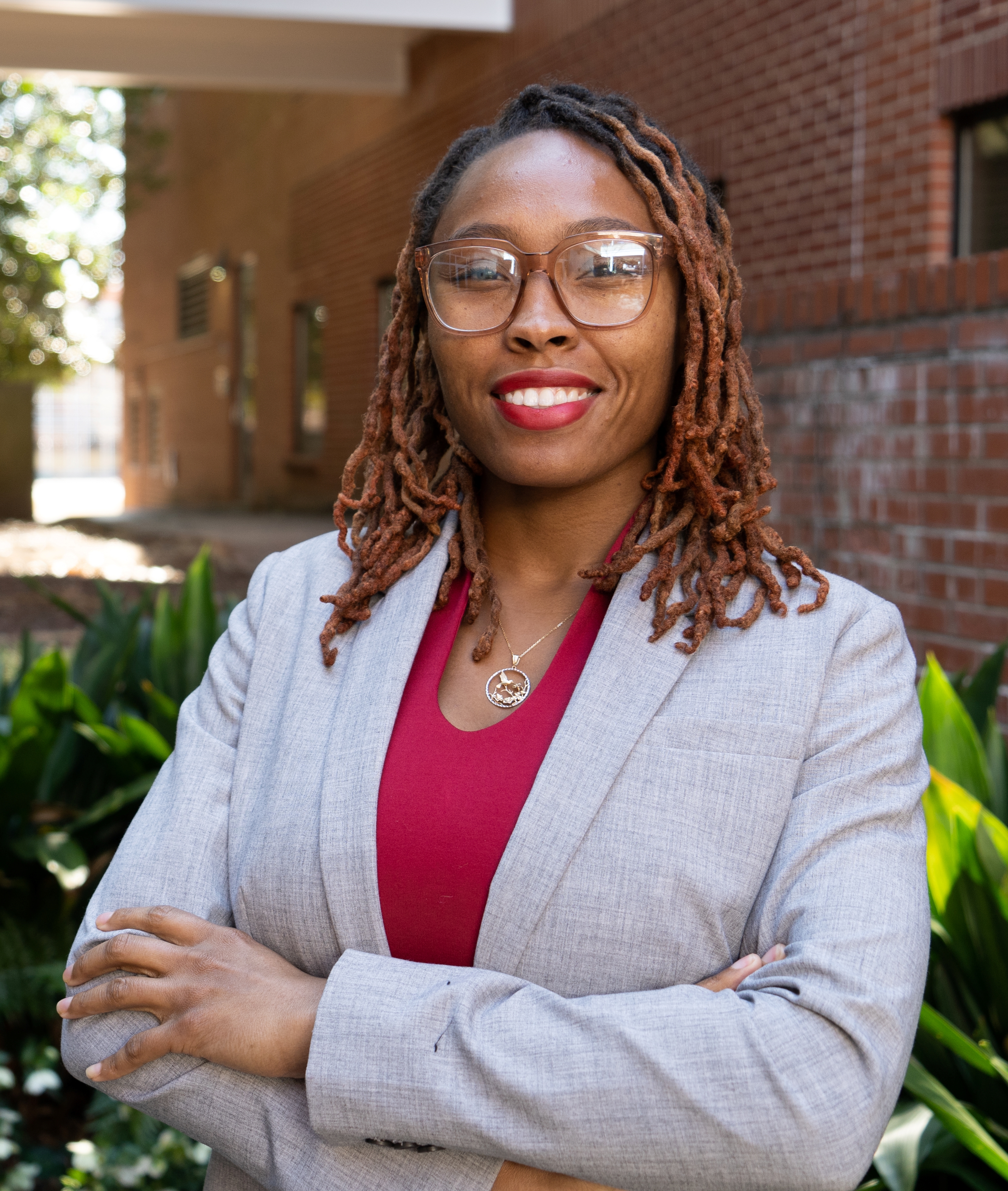
Deja Perkins
Host Narrator
Jazzi Johnson
Managing Producer
Sam Johnson
Producer
Josh Fisher
Producer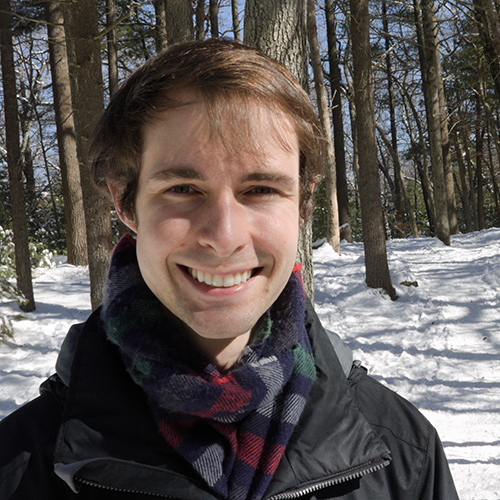
Conor Gearin
Fact Checker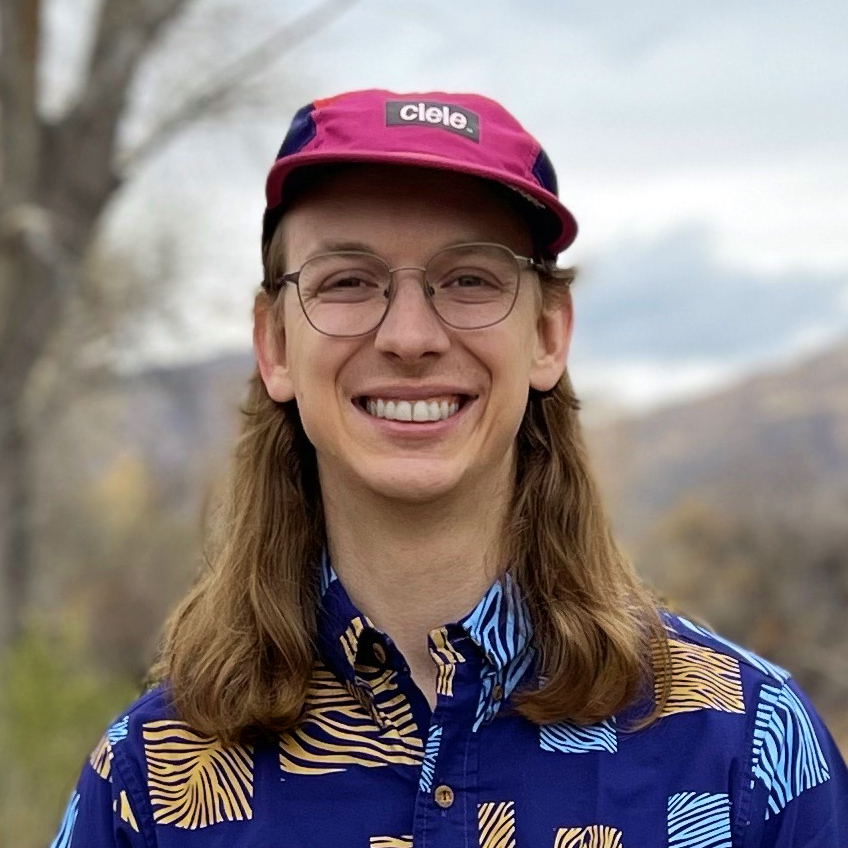
Mark Bramhill
Senior Producer
Jonese Franklin
Content Director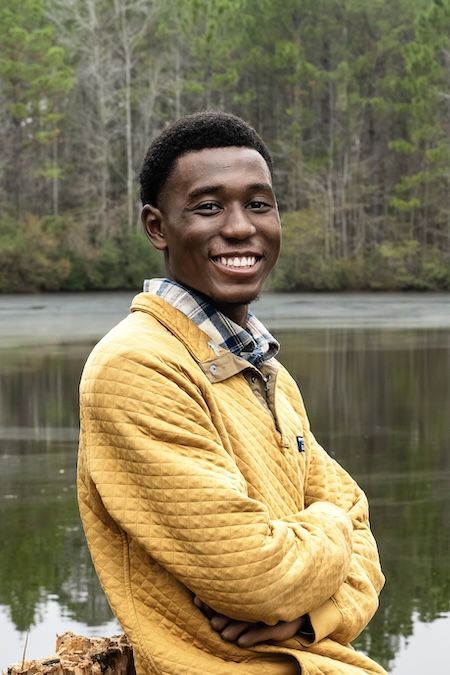
Born and raised in Savannah, Georgia, Isaiah Scott is an avid birdwatcher, science communicator, conservationist, and wildlife artist whose passion for birding began at an early age. Known online as Ike’s Birding Hikes, he is a popular birding influencer and active member of Georgia’s birding community, regularly leading bird walks and sharing insights into local ecosystems. He graduated from Cornell University, where he studied Ornithology and Science Communication, and was named the 2021 Eckelberry Fellow for his upcoming field guide on birds in Gullah Geechee culture.
Scott is also the founder of Rookery & Roots Conservancy, a nonprofit focused on preserving the culture and biodiversity of the Lower Coastal Plain. Among the organization’s achievements is the protection of 16 acres of critical bird habitat in his hometown, now recognized as Scott’s Wild Bird Preserve. Through his art, advocacy, and conservation efforts, he continues to inspire others to explore, learn, and protect the natural world.