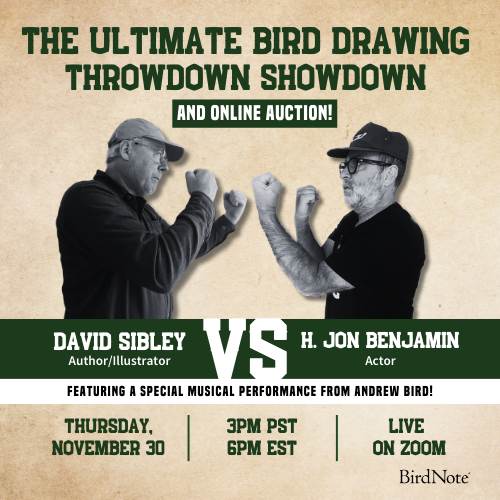
Join BirdNote tomorrow, November 30th!
Illustrator David Sibley and actor H. Jon Benjamin will face off in the bird illustration battle of the century during BirdNote's Year-end Celebration and Auction!
Hummingbirds and Humans
A Hummingbird a Day: culture, community, and conservation. (Season 9, Episode 6)

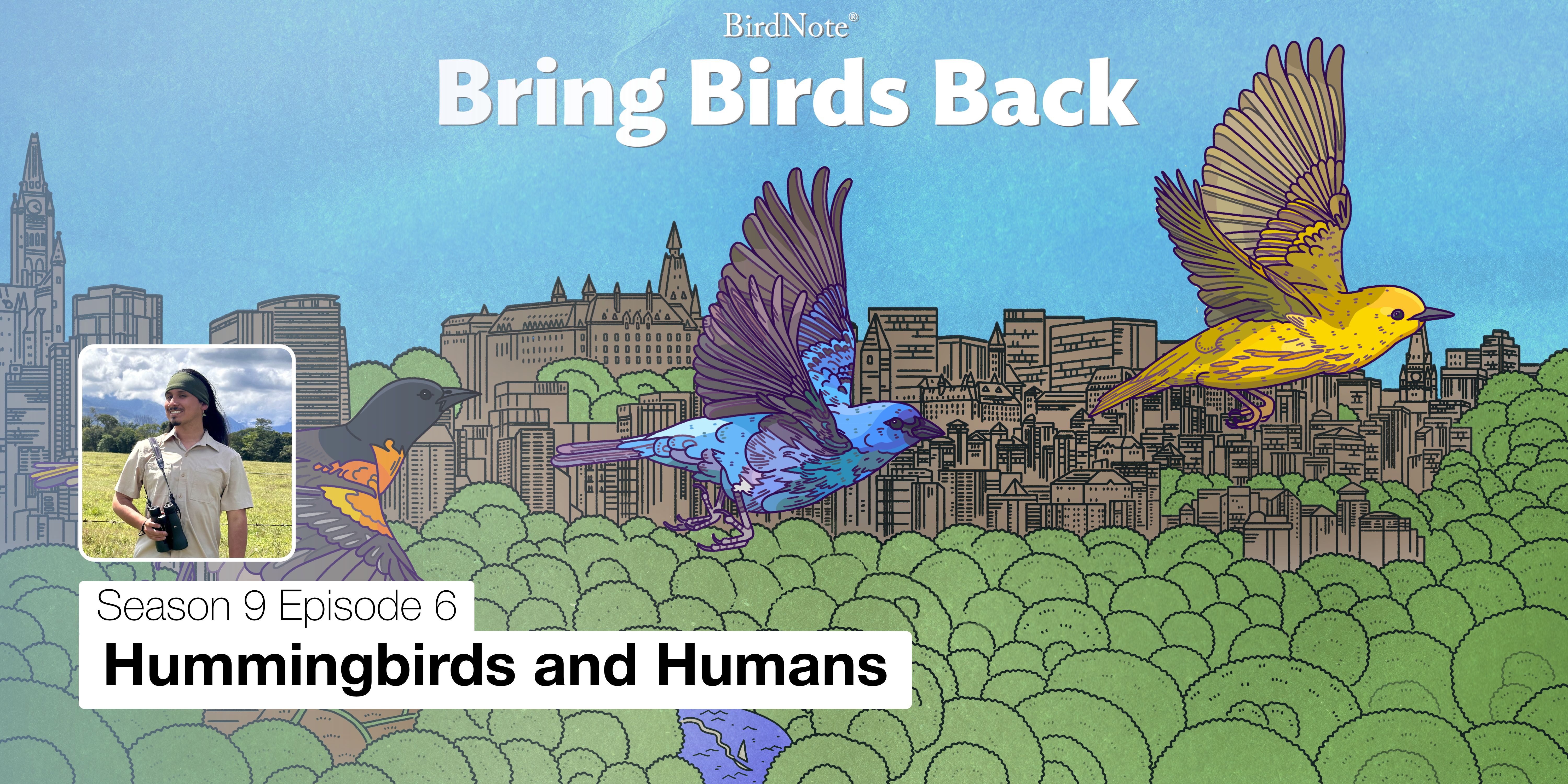
What can hummingbirds teach us about culture, conservation, and our connection to nature? Dr. Deja Perkins talks with Em De Blas, birder, photographer, and community engagement coordinator, about their project, A Hummingbird a Day. Em shares how Indigenous and Latin American cultures uniquely treasured hummingbirds and what we can learn from them to navigate newer approaches to conservation and connection to the natural world. Explore with us how celebrating these teeny tiny, remarkable birds can guide us to greener pastures. Available now!
Want more Bring Birds Back? Follow us on your favorite podcast app and on Instagram @BringBirdsBack!
To learn more about this topic and guest(s), read the episode transcript and other resources from this episode, visit our show page on BirdNote.org. Consider signing up for our weekly newsletter to stay up to date on what’s happening. For ad-free listening and other perks, sign up for BirdNote+ Plus here.
Get involved in our From Love to Action campaign when you visit this link!
BirdNote is a nonprofit. Your tax-deductible gift makes these shows possible. Please consider donating today!
Bring Birds Back Season 9 is sponsored by Teton Science Schools and the Cornell Lab of Ornithology’s Bird Academy.
[Bring Birds Back Stinger]
Deja Perkins: BirdNote Presents.
[music starts]
This is Bring Birds Back and I’m Dr. Deja Perkins.
One of my favorite things about birds is that they exist on every continent and in every climate across a variety of habitats. No matter where you go, from the backyards of Chicago to the forests of Colombia, and even the Arctic Circle, you have the potential to see them. Given that birds are quite literally everywhere, it only makes sense that many cultures throughout time have documented the unique ways they value birds.
In the West, hummingbirds are celebrated as symbols of bravery, joy and agility, and marveled for their teeny, tiny bodies and epic flight journeys.
In this episode, we’ll explore how these pocket-sized birds, in particular, have been valued in Indigenous and Latin American cultures, past to present. And what their stories can teach us about a more empathetic approach to conservation.
—------
Deja Perkins: Hi, Em. Welcome to the show. For our audience who may not know you or be familiar, can you introduce yourself and your work?
Em De Blas: Hi, my name is Em De Blas. I use he/they pronouns. I am currently a graduate student at Miami University. And through this program, I am running this fun little project titled Hummingbird a Day, which I am very excited to talk to you about.
Deja: Awesome. I remember first meeting you in Chicago at a Windy City Bird Lab event, and I'm curious, how did your love for birds and animals manifest?
Em: I'm glad you asked birds and animals, because it really did not start with birds first. Ever since I was a little kid, I always kind of knew I liked science, I liked biology, I liked nature a lot. My dad and I would go on hikes growing up, this was in Mexico, by the way.
Um, we would go out and hike, and catch lizards, and just see all sorts of beautiful parts of nature. But really, my like for animals started with sea creatures, watching sea creature-related movies and documentaries, up until high school when I started working and volunteering at Shedd Aquarium. That was the perfect place. I had so much fun there. I learned a lot. Also, really liking reptiles and amphibians, as well. I'd go out into nature, look for those. And it wasn't until I was gifted a pair of binoculars that I just intuitively used it to look at birds, and then it was really the easiest thing to get into. My spark bird is the Vermilion Flycatcher.
Deja: Nice, what a wonderful bird. And it's crazy how we have so many similarities because I also did volunteer work and programs at the Shedd Aquarium when I was, like, in high school, and I loved, loved, marine animals and I thought I was gonna be a marine biologist. So it's actually crazy how we intersect in that way.
Em: That is a very crazy coincidence.
Deja: Absolutely. So, when we first met, you shared your social media project, "A Hummingbird a Day," which is also your master's project, and we started talking a little bit about ethno-ornithology. Can you explain to our audience what ethno-ornithology is and wh[f]y you chose hummingbirds as a focal species?
Em: Yes. Ethno-ornithology is, broadly, the field that seeks to explore the intersection between humans and nature. And humans, specifically relating to birds, right? And how humanity has valued birds, in what ways they understand them, in what ways they appreciate them. The way I got into that is because a professor in college once asked me a question I have not stopped thinking about: "How do you know a crow is called a crow?"
And it's such a silly question 'cause it's like, yeah, 'cause in the movies or your parents told you and whatever, right? But it really made me think, "Oh my God, yeah, what's going on in societies, that is allowing us to learn about birds or not learn about birds and which birds?" So it really is just the intersection of exploring humanity and birds, how they relate with each other.
And I chose hummingbirds specifically because I had already known that they were my favorite birds. But out of all birds, in Latin America, you see that this bird has very interesting stories surrounding it, very interesting beliefs surrounding it, that I was not seeing with other groups of birds.
And when I really started looking into the scientific names and just reading more about it, I found that there was a lot of people talking about this. And I was like, "Oh, wow. That really is a bird that has a very unique relationship with human beings."
Deja: I really like that because when I was taking ornithology, they talked about how we use scientific names because bird common names are different in different languages and different cultures, but it just kind of stopped there.
It's like, okay, you just say the scientific name, but you don't really dive into the actual common names across different cultures and how you can connect with people from other cultures through being able to talk to them about their local birds in their native language.
Deja: So do you have a favorite hummingbird species?
Em: That's the hardest question anyone could ever ask me. But you know what? I had a very special moment with the Rufous Hummingbird when I was in the town I grew up in Mexico some two years ago. We were hiking in this mountain that has always decorated the background of my life growing up there. You always saw the mountain; it has a very distinct shape, 'cause it has this big rock that's just like, so sharp looking, and it's called Picacho.
And we were hiking up there - me and my dad - and we were just taking this break, and we're talking about movies and just talking about random stuff. And a Rufous Hummingbird starts flying around, and I was like, "Oh, wow, Rufous Hummingbird." I just did not expect that at all, and neither did eBird; eBird was like, "Oh, that's a rare bird for the area." I was like, "Oh, okay, cool." And my dad looked at it through the binoculars and he was like, "Oh, wow, I've never seen an orange hummingbird.” And he was amazed by that. And I was like, "Wow."
When you look into the Rufous Hummingbird, they are the birds that perform one of the most spectacular events in the animal kingdom. They migrate, right? But they migrate some several million times their body length, and that's just impressive for such a tiny little bird, right? Their range worldwide is similar to that of Mexicans, right? Of people like me, people like my dad. They migrate, we migrate, it's all completely natural, and it's all an act of courage.
Deja: Yeah. And I, I love that because I, I think it really hits at the core of why ethno-ornithology is important. It's because we have these connections with birds that are relevant to our cultures and that is exactly why it's important for us to have these conversations or think about birds in this way.
So, I really love that you're doing this project. I also love that it's tied to your Master's thesis paper: Hummingbirds: An Ethno-ornithological Tour, which you shared with us as an unfinished, unpublished draft:
[music shift]
In their paper, Em argues that the most dire need for conservation is the human connection, the ability to see nature as a part of one’s self and not a separate thing that needs saving. And leading by example, their project, A Hummingbird A Day, seeks to do just that.
A Hummingbird A Day is a social project, one that they intend to expand into Spanish-language and other potential mediums in the future. With more than 360 hummingbird species, Em has taken it upon themselves to highlight one bird, per day, for an entire year. At the date of our interview, they had already achieved 243 posts. They record a one-minute video that highlights a hummingbird, with a photo (of course) and they share interesting tidbits related to its name and theme.
As Em mentioned, they chose hummingbirds because they uniquely suit the five themes they deem crucial to connecting humans with nature. By utilizing these themes for storytelling, they’re also creating deeper means of connection to a world most of their audience may not truly know. So, how are they categorizing these hummingbirds and what are these five themes?
Em: I am running this project in order of oldest to youngest lineages, starting with a group of hummingbirds called the topazes, then the hermits, mangos, coquettes, brilliants, mountain-gems, bees, and then emeralds. And what I do is, I just go through each and every single species in their order in a cool little spreadsheet, which I'm looking at right now; I write down the name, the name in Spanish, and specifically the region that they predominantly live in and then the brief topic, right?
I actually have five themes that those topics must kind of abide by. Briefly, that's hummingbirds and humans, hummingbirds and place, hummingbirds and ecology, hummingbirds and evolution, and hummingbirds and birding.
[/musical shift ends]
Deja: So let's walk through each of the five themes you cover in your project. I'll list a theme and I want you to tell me its significance and give us your favorite examples.
Em: Okay, cool.
Deja: Let's start with humans. I'm assuming these are hummingbirds who have stories that are tied to humans or connections like what you mentioned with the Rufous Hummingbird.
Em: Yes. Um, so hummingbirds and humans have had a long relationship.[v] Sharing this historical appreciation or drawing these two closer may help us understand them and each other.
One of my favorite ones is the White-tailed Goldenthroat. Scientific name is Polytmus guainumbi. Every time I look at any hummingbird, when I see a very interesting looking specific name, I'm immediately like, ‘I need to know what that means.’ And guainumbi, the specific name is the Guaraní word for hummingbird, right? The Guaraní is an Indigenous group in Central South America, what is now today Paraguay, Argentina.
They have a legend there of two lovers from enemy tribes, right? That's Guaynumi and Poti. They love each other, but they're from enemy tribes– they couldn't possibly ever love each other. And their god noticed that and was like, I'm a very just god. So you know what I'm gonna do? I'm gonna convert Guaynumi into a hummingbird and Poti into a flower." But I'm not gonna tell you which flower. You just have to look for her. And so that explains why the hummingbird just nonstop, flower to flower to flower, always looking for Poti.
And that's beautiful 'cause it's like, oh, wow, we've all seen hummingbirds. They fly from flower to flower. But to give it a deeper story like that just lets us relate to nature more, lets us understand it a little more, and that's just another perspective you can add to it. There's another story very, very similar of the Boruca in what's now southwestern Costa Rica. That's the story of Turé Huá and Porubirí. You could pretty much copy and paste the same story, right? And that's, that's not the last time that'll happen, by the way. There's several instances throughout the Western Hemisphere that that story is basically the same throughout.
Deja: Wow. It's always interesting to me how several cultures can have such similar stories and connections even across such wide geographies. I know some of my research looks into the importance of place or place connection for humans and conservation, and, like, how do we get people to care about ecology, about conservation in places that are local to them. Um, so why is place important to or for hummingbirds?
Em: So, the biggest thing about that is that hummingbirds are completely endemic to the Western Hemisphere. You can explore all of Afro-Eurasia and Oceania the rest of your life, and you will never once come across a hummingbird. You'll come across things that are very closely-looking to hummingbirds, but hummingbirds only live on this side of the world and because of that, they reflect the land they live on. And in many ways the people that live there, as well. Hummingbirds help us unravel the complexity of geographical space in the Western Hemisphere, giving them life and deeper meaning.
And there's this quote from a humanist geographer, Yi-Fu Tuan, “Space becomes place”. When you look at a map, you might just be looking at space. But if you maybe attach a hummingbird to many parts of that land, you'll start looking at it as places, as habitats, as ecoregions, as unique areas in the world. You give them deeper meaning; that space becomes place.
Deja: Yes, and I think that's one of the reasons why I love geospatial analytics too. Do you have a favorite species that you feel like highlights this idea of place in hummingbirds?
Em: Yes, first, um, I'll start with the Merida Sunangel.
[sound design/bird sounds]
It's named after the city of Mérida, which is in western Venezuela. So that right there, off the bat, that's your connection. What about this city? What about this place? It's actually part of the Andean Venezuela, right? So Venezuela, as far north as it is in South America, it still has parts of the Andes in it. And the Merida Sunangel is one insight into that. They live in a habitat called the páramo, páramo. It's a tropical habitat, but it's very, very high in elevation, so it's cold. It's actually dominated by a specific kind of plant called frailejón, which in English would translate to like monk, big monk.
Again, it's in the clouds, but that specific plant is very important to Andean societies because that plant literally grabs the fog, it grabs the clouds, and it turns it into water. It brings the water back into the ground. So a lot of rivers are born from these plants, and would you know who pollinates these plants and who hangs out with these plants? Merida Sunangel, and all other páramo-dwelling hummingbirds.
Deja: That is such a beautiful name for a hummingbird, and it's also such a beautiful example of that hummingbird and place connection.
Em: Yeah, Oh, my God. There's also the Tepui Goldenthroat, right?
Deja: Tepui, OK.
Em: Yes, Tepui Goldenthroat. It's a kind of mango, a subfamily. They live in and around these specific habitats, what would be southern Venezuela, touching a little bit into Guyana, and maybe, maybe far northern Brazil. They are named after a geographic feature of land called a tepui. What they are is, they're tabletop mountains. They almost look like a literal building.
They're ecological islands and the, the habitat on the top is completely distinct from that on the bottom. What lives on the top can't live in the bottom, and what lives in the bottom, essentially, can't live up there, either. These hummingbirds just, kind of, break through that. They live at the base of those tepuis.
And now, the Indigenous people in that area, specifically the Pemón, their word ‘tepui’ actually means house of the gods, 'cause of course their belief is that, high up in there, is where the gods live, right? And to associate that hummingbird with it is to place the spiritual value of it, that these guys are worth quite a lot to some people.[aa]
Deja: I don't think that I've ever had a conversation that has made me want to travel to see birds more than this conversation here.
[/end bg music]
So, in your project, A Hummingbird A Day, another one of the five themes you use to distinguish birds is ecology. What does that theme mean? What's the significance of it? And what are some species that highlight that theme?
Em: Yes, So the brief description of that one is hummingbirds play a vital role in the ecosystem, helping us understand the grander functions of our natural world and that which threatens it. So for me, I wanted this platform to be like, "Hey, if you don't understand anything about ecology, this is your place," because I'm going to break down all of these ecological terms.
And there's so many hummingbirds to break down. But one of them is the Black-throated Hermit. They're called hermits because they like living in the understory.
They like living in the dark, they like living down where nobody sees them, right? They're not very colorful, right, because they live in the understory. They can help you understand what goes down in the understory, what's the ecology down there, what's the everything.
Hermits are also trapliners. What they do is they go like, "Hey, I don't want to fight all of these other hummingbirds for food sources. I'm just gonna have a few select flowers that I'm gonna run a circuit around, feed what I can off of it, that way I don't have to fight everybody for a patch of flowers.” A lot of hermits are trapliners because they don't like to fight as much. So, this group of birds right here is very excellent for understanding ecology. Another brief example is the White-throated Daggerbill. They do something called nectar robbing. Now I, I don't really like that term myself, right? But, basically, it's just obtaining nectar without actually getting yourself full of that, like, Cheeto-dust pollen and spreading it onto other flowers.
What they do is, they pierce a hole at the base of the flower, and they just get that nectar, and they don't actually pollinate. And it's a real ecological thing that many, many creatures do, and you can study through hummingbirds.
Deja: Yeah, it sucks that they got stuck with this term of nectar robbing, just because they don't have that reciprocal relationship. I mean, don't be mad at them just because they found a better way.
[Laughs together]
Em: Literally.
[/start bg music again]
There's also Turquoise-throated Puffleg.
Deja: Turquoise-throated Puffleg?
Em: Yes, unfortunately, the Turquoise-throated Puffleg is possibly extinct. And when you hear the word ‘extinct,’ you might think of the Dodo bird or other creatures that are completely extinct, you can't do anything about it. That's it. That's the end of it, right?
When you hear ‘critically endangered,’ you maybe think of pandas, maybe something that has a lot of conservation effort behind it. But when you hear the seldom talked about ‘possibly extinct,’ it allows for that interesting question of like, okay, when something is extinct, is that it? And of course, right, that's not it. That's not the end of it, right?
When something goes extinct, you're removing a part of a system that was built with that part in mind. The system has to do a whole bunch of things to adjust for the fact that that part is now gone. And what that could mean is, oh, now several species of plants aren't getting pollinated, not getting their seeds spread around. Now several predators are not having a source of food, right? Now several species of bugs are probably thriving more because their predator is not around. There's so, so many things that are changing. It's almost incomprehensible how many things may be occurring with the extinction of a single species. And that, of course, is a conversation that is spurred by taking a look at the Turquoise-throated Puffleg.
[/end music]
Deja: Yeah. That explanation is so powerful. Like, this potentially lost bird is a catalyst for all of these other things in the ecosystem. It's like their tiny existence could potentially make an entire ecosystem just collapse in on itself. And I think that is just such a powerful and, and meaningful thing to kinda think about now, especially when we talk about the climate is changing and what do these changes mean for different species? Mean for the planet? What does this mean for people? And by looking at such a tiny bird, you can kinda see some of those, um, relationships.
[music transition]
Next up, Em and I talk over the final two hummingbird themes in their project. And we dive deeper into their favorite folktales surrounding one of history's most treasured Indigenous civilizations. We'll be right back.
MIDROLL
Deja: Welcome back. Em De Blas is still here with us, and I’m your host, Dr. Deja Perkins. Later, Em talks more in detail about the connection between their project, A Hummingbird a Day, and conservation. They even share some super cool folktales you won’t want to miss. But first, we’re still focused on the five themes of A Hummingbird a Day. We’ve already gone over hummingbirds and humans, hummingbirds and place, and hummingbirds and ecology. Next up?
[musical shift/ends]
Deja Perkins: Let's talk: evolution. I'm sure there are some crazy adaptations for hummingbird species, especially given that there are 366 of them.
Em De Blas: Yeah, absolutely. Hummingbirds are uniquely adapted to their environments. Probably one of the most perfect examples of explaining evolutionary processes is through co-evolution. And a good example of co-evolution is the White-tipped Sicklebill. Um, there's also their sister, the Buff-tailed Sicklebill. Both of those two, their bill is shaped like a sickle. It's very, very strongly curved and that's because they have specialized themselves to feed off of flowers that are very, very curved like that. And it secures them a source of food, essentially.
“We're gonna secure our source by really specializing ourselves into this shape of bill. And when we do that, right, we won't have to fight all these other people, and that's because we're perfectly adapted for this environment.”
Deja: That's awesome.
Em: And then the Green-headed Hillstar. Hillstars are incredible. I love, love, love that name. When you think of a hill, you think of, like, a little tiny little thing. These guys are not hanging out in, like, these tiny little mountains. They're hanging out in the Andes mountain ranges. Very, very, very high elevations, right?
And what happens when you're in high elevations is that the air gets thinner. And when you're a bird trying to hover, you are now trying to figure out, also, a way to save energy because, wow, is hovering hard. Now you have to do it in air that's thinner. Are you crazy? What they'll do instead is when they feed on flowers, they'll actually cling onto that flower. That way they don't have to hover, and they can just feed off of that as well.
There's another, the Olivaceous Thornbill, right? Those guys will feed on the ground. Like they'll hover to the flowers on the ground, but they'll just land on there and feed off of that. That saves them a whole bunch of energy to be in these habitats.
Deja: I can only imagine. I've, I've gone hiking, led a bird walk in Colorado, and being in the mountains up there, I'm like, it's hard to breathe. So I can't even imagine having to fly. Like, that is crazy.
All right, so last but never least, let's talk about the theme I'm sure most of our listeners will enjoy, of hummingbirds and birding.
[Fun, upbeat music begins]
Em: Yes, this one I kind of created to be a little bit miscellany, right? So that anything that kind of strays from all of these can fall into that. But my thing is that hummingbirds are excellent agents for bird joy, understanding and analyzing general birding culture, and other aspects of studying ornithology and conservation, right?
And I'll bring up the Black-bellied Hummingbird, of course. That specific hummingbird I have not actually made a video on for A Hummingbird a Day, but that is my most recent lifer, right? I saw several of them in Costa Rica. I was just over there maybe about a month ago.
Now, when I come back from a trip or birding or anything like that, I immediately get asked by my friends, "Oh my God, did you see a bunch of birds?" And I'm like, "Yeah, I got a lifer," or something like that, right? They're immediately like, "What?" And that's because there's often this failure to recognize that, yeah, we literally have our own little culture here that has its own little words, has its own little terms, right?
There's also the term ‘spark bird.’. There's this specific species of hummingbird, the Scintillant Hummingbird, Selasphorus scintilla. The specific name part, scintilla, it means ‘spark.’ They are very sparkling looking birds. They're very bright looking birds, especially their gorget, right? That little patch. And of course, that immediately brings up the conversation, "What's your spark bird?" And of course, I opened with mine, right? The Vermilion Flycatcher. What's yours, Deja?
Deja: Hmm. I think my spark bird was the barred owl.
Em: There we go. And there's more I've yet to cover, such as the term vagrant, right? A bird is vagrant when they are found very, very far away from where they normally live or they normally hang out in, right? That's the Mexican Violetear. Oh my God. The thing about them is that for many reasons, for storms, for winds, for one thing or the other, they have been spotted as far north, I believe as central southern Canada. They've been seen very, very, very far away from their quote-unquote normal range. I believe, actually, they've even been seen in Cook County here in Chicagoland.
You're telling me that there's this ch- tropical, subtropical bird in Chicago. What? Next thing you know, people are - pun intended - flocking to this old lady's feeder going like, "Hey, can I please see this bird that's at your feeder?" I believe it was with a Broad-billed Hummingbird here in Chicagoland as well that of course was making news articles going like, "Hey, there's a bunch of people gathering around this bird that should not be here."
And that, of course, enters the conversation of rare birds and then people who chase rare birds, and people who list their birds, and movie listers, you get into the movie The Big Year or all sorts of stuff that open with that conversation that starts with this little hummingbird.
[/end fun, upeat music]
Deja: I've definitely had a few instances of vagrants like the Rufous Hummingbird in North Carolina and we had this whole group chat about, you know, rare birds and people would post their sightings and then if you were free, you'd go. Like, I don't consider myself a chaser, but there were a couple instances where I was like, ‘let me go see if I can find this bird,’ and I've had a couple of instances of success, and those were some pretty cool moments. But absolutely, I can definitely see the connections between those terms and how these birds can bring them up, for sure.
So I know that the historical significance of hummingbirds throughout time, it really can't be understated in your paper. You outlined some very interesting details about how indigenous cultures revered hummingbirds, such as the Mexica and the Mayans. What are some of your favorite facts about the importance hummingbird played in various cultures?
Em: Yes. So, I actually would go on and say that the most popular example of how hummingbirds were seen as gods is through the Mexica. The Mexica revere a god by the name of Huitzilopochtli, and it means ‘hummingbird of the south’ or ‘hummingbird on the left.’[bc] This god represents the sun. It represents war. It represents warriors, right? And it's a little bit crazy 'cause, why is, why is a tiny little hummingbird associated with war, with battles, with fighting?"
And you take five minutes to look at hummingbirds, you'll realize, oh my God, they're really aggressive. They like to fight. They like to really fight for their patches. And the Mexica know that, and they represented that through their god, Huitzilopochtli. And that's a very clear example of just how much hummingbirds have embedded themselves as gods in some cultures.
Now, for Mesoamerica, there's also a story there as well, right? Specifically for the Yucatec Maya, quite literally thinking of the Yucatán Peninsula. Throughout those societies there, their word for hummingbird is ‘ts’unu’um,’ which is also phononimic, right? It's just like saying hummingbird because they literally make those sounds: ts’unu’um, right? They have a tale as to how they came about.
It's believed that all life forms on Earth were made out of mud and clay. But when everything was made, the gods were like, "Wait, we need someone to communicate between us and them, like between the sky and the land."And because they ran out of clay, they were like, "Alright, alright.” And they found this little piece of jade, which is a mineral that's highly valued in, in, in many Mesoamerican cultures.
And the gods, they take this little piece of jade, and they just blow onto it. And out of that flies a hummingbird. And ever since then, many cultures throughout Mesoamerica view the hummingbird as the messenger, right? That's my great-grandma. That's my grandma speaking. That's my mom, my sister, my- my brother, a passed relative going like, "Hey." They got a message for me or they wanna see me. They just wanted to stop by.
And the thing is that when you start to view nature like that, when you start to view nature as like, "Hey, that's my brother. That's my sister. That's my grandma," right? The loss of biodiversity then becomes a personal crisis as much as an ecological one, right? Very often is the lost biodiversity talked about as like, "Oh my God, that's bad because, um, we're not gonna be able to, you know, pollinate our crops or, we're not gonna be able to get the wood from the trees anymore. We're not gonna get material from the ecosystem."
But when you start to view nature as your brother, your sister, as your kin, you start to conserve nature because it means something personal to you. And I think that's a very interesting perspective that I think a lot of Western cultures could benefit from.
Deja: Can you say more about that? In your paper, you mention a similar sentiment, that ancient cultures used cultural service resources, like spirituality, like place, like science and art and other themes you've mentioned here today, to really help us all feel more connected with nature. Can you tell us more about that idea of conservation?
Em: Yes. There's always this talk about, like, "Hey, we need to conserve nature because that's where we get our food, and that's where we get all the wood for our houses, and that's where we get all the stuff for our shirts and our stuff."
We look at nature very materialistically. There's a kind of ecosystem service called cultural ecosystem services. And that's the one we really need to talk about because it really helps us to not only view nature as material, but also as something that needs to just be conserved because it conserves you and it conserves the community you're a part of. And when you look at hummingbirds like that, you really start to deepen the gaze from viewing nature as just a source of goods, to viewing as part of yourself and your community, and then conserving nature just becomes second nature at that point.
Deja: Yeah, I love that. When I've taught about ecosystem services, I feel like these cultural services have been the hardest for my students to grasp. But maybe that just means that I'll have to share this podcast episode with them because I think you've been explaining it beautifully.
Em: I think it really is taking in that perspective of like, ‘hey, just because it isn't in a book, it doesn't necessarily mean that it's just not valid.’ But I think my biggest part is really that, like, if you can view nature as yourself, if you can view yourself in nature, then you should be able to view nature and the loss of nature as personal.
It's like, ‘oh, you see these forests being cleared near you, that's personal. My favorite birds live there, and that those birds I associate with people, I associate with values, with lessons.’
I'm hoping that you can relate to nature, and you can find ways nature relates to you, and then you can start to conserve nature only because you see yourself in it.
Deja: Yeah. And one of the cultural resources you mentioned is folktales. And how those stories really helped connect the people to the nature that thrived around them. Are there any additional hummingbird folktales that personally inspired you, either before or during your research?
Em: I'll share with you two.
[Slow curious music begins]
So, one I actually just learned recently when I was in Costa Rica. I already made a video on the Fiery-throated Hermit [Hummingbird]. Panterpe insignis is their scientific name. I shared that love story of Turé Huá and Porubirí with you earlier. But when I was in Costa Rica, I was told about how their god, by the name Sibú, said to the Fiery-throated Hermit "Hey, I need you to paint the world."
"So here's this little bag here so that you can paint the world with it. But you have one rule. Don't touch the bag. Go paint the world, but don't touch the bag," right? So the Fiery-throated Hummingbird goes around, right, starts painting the world, right, and at some point gets curious. He's like, "Ha, I'm gonna touch the bag." And next thing you know, they become engulfed with all these colors and everything.
And Sibú goes like, "Okay, you touched the bag. You're now full of all of these very, very beautiful colors," right? "I'm gonna leave you like that. But as punishment, you're never gonna stand still ever again in your life." So that explains why the hummingbird is just, like, darting around, fighting, going from flower to flower to flower because they didn't listen. They didn't listen to Sibú. They were, they, they touched the bag.
One that was very rewarding was Andean Hillstar. Um, now my thing about that hummingbird is that I was reading and reading and just looking up all sorts of things with hillstars, right? And I wasn't finding a topic that I could talk about. And it wasn't ‘till I came across this article from the Museum of pre-Colombian Chile.
The story of the condor and the shepherdess, and it's basically the story of how a condor - the Andean Condor - steals a little girl, right? And the little girl is freed by a hummingbird. And the hummingbird's like, "Oh, no, I can free you. I just want one thing in exchange. I want that green little necklace that you have."
And I screamed out loud. I was in my basement reading this thing, and I just screamed out loud because I was like, "Oh, wow, green. Why green?! Is it because, you know, the Aymara coexist with the Andean Hillstar, and they just so happen to observe nature a lot and love this hummingbird so much they have this story for it?" Of course. Absolutely. Absolutely. And I just screamed there 'cause at no point does the article say Andean Hillstar. It just says hummingbird. And, you know, there's a bunch of other hillstars, and I don't think that all of them have a green gorget like the Andean Hillstar.
So, I was just amazed. I was like, "Oh, wow, like, this obscure little website maybe doesn't just have to stay there. It can be spread around." And there's platforms like Hummingbird a Day that can do that.
Deja: Yeah.
[/end sound design]
Em: And when it comes to specifically the topic of Indigenous visibility, it's not on there, it's not up there. A lot of the stories, a lot of these beliefs are just not online. You have to go out there into the world and talk with people, have conversations with them, and connect yourself to the land, connect yourself to the individuals out there to hear these things.
Deja: Yeah, there's so much to unpack in all of those different stories, and I think one that really sticks out to me the most is just, like, the importance of local knowledge, Indigenous knowledge, and thinking about how knowledge is shared differently across Western society, Western culture versus Black and brown cultures.
Especially even thinking about how a lot of the history of my family and of Black Americans is passed down orally, and that's how you get your history. That's how you learn about the land. And just because it's not in a book doesn't mean that it's any less valid than more traditional, scientific methods of the way that you prove things or these connections are true.
Um, so as we wrap up, do you have any final thoughts you'd like to share for the future of conservation or hummingbirds, in general?
Em: Yes, just to add on, onto that; I went around with, um, the Chicago BIPOC birders. I love them. They are my favorite. Every video I make, I make it with them in mind.
And when I started A Hummingbird a Day, because hermit hummingbirds are some of the older ones, it had to start with them. And that was the hardest part because it's very hard to convey that these birds are very different from each other when you're not, like, actually out there in very, very distinct parts of the world. Like, unfortunately, hermits really do look a lot like each other. I found a lot of relating with that, because very often with BIPOC birders, right, Brown, Indigenous or, Black or People of Color, they are very often getting confused for each other, getting mistaken for each other.
And I know it's hilarious. It's happened to me. It's happened to so many of my friends, and it's like, oh, my God, how many times have you confused a bird for another? Maybe because you weren't approaching it intentionally, maybe just because it was just a mistake, right? That was it, right? But I found a lot of motivation in that. I found a lot of inspiration in hermits, and I just hope that everyone can find a specific group of creatures out there that you can relate to, and you can find a beautiful story out of, and to share that story because it's all perspectives that are worth sharing.
And when we all share these perspectives of how you can relate to nature, we kind of gather this, like, view of nature that doesn't view nature as an object but as part of a community, and that, that will alone let us conserve nature without objectifying it.
Deja: Where can the people find you, your work, and just dive into your projects?
Em: Follow me @hummingbirdaday on Instagram, TikTok, or YouTube. My personal, you can follow me @EmDeBlas on Instagram. Through there I will often share pictures I take and just some of the perspectives I'm having with hummingbirds, with birds in general.
[outro music begins]
Deja: Awesome. This has been a beautiful, wonderful conversation, and I hope that we get a chance to see some hummingbirds together in the near future.
Em: That would be very, very cool, Deja. Thank you. Thank you for having me. It's been awesome being here.
[music transition starts]
Deja: Depending on the lens you look through, birds can signify different meanings, symbols and lessons.
Have you ever arrived at a place feeling one way, and left feeling another, based on the context of learning its historical or cultural significance? For some, that context changes a bird from just being a bird, to representing ancestors, love stories, or simply new ways to learn about the environment. Em taught me a few new ways to appreciate and think about hummingbirds in particular.
So now whenever I see a bird, I’ll challenge myself to think about the meaning behind the name, its connection to humans and place, and its ecology and evolution. And I challenge you to do the same. Who knew such tiny birds could teach such big lessons?
Well, season 9 of Bring Birds Back has now come to a close– but the fun doesn’t have to end here! Be sure to revisit our previous episodes this season, from Scott’s Wild Bird Preserve in Georgia, to bird tourism in Latin America and the Caribbean, and explorations to find long-lost birds across the world, just to name a few! Plus, we have 8 whole other seasons available now!
Many thanks to Em De Blas for sharing their research and this new lens through which we can think about conservation and birds.
To learn more about Em De Blas and the Hummingbird A Day Project, check out the resources for this episode at BirdNote dot org.
Share your favorite moments from the season with us on Instagram @ Bring Birds Back, and follow us for the latest updates about the show!
This episode of Bring Birds Back was created by our BirdNote production team, including Fact-checker Conor Gearin; Producer Josh Fisher; Producer Sam Johnson, Senior Producer Mark Bramhill; Managing Producer Jazzi Johnson; and Content Director Jonese Franklin.
Our music is by Blue Dot Sessions and Cosmo Sheldrake. And this episode was hosted and co-produced by me, Dr. Deja Perkins.
Thanks for listening! Until next time!
[Outro music ends]
Post-Credit
Deja: [Reads from script] "In your paper, you-- mention a similar sentiment: that ancient [Deja begins to slur the last word] cul...tures...” Wow.
[Everyone begins to laugh hysterically]
[Producer] Sam: Oh my God.
Deja: Wow.
[Laughter builds more intensely]
[Managing Producer] Jazzi: I'mma cue you in, so you can hear the bit before. I can't.
[Skips forward with a twinkle sound]
Jazzi: Awesome. Ummm, I.. think that's...
Sam: I believe that's it, yeah.
Deja: That's a wrap.
Jazzi: That's a wraaaap!
Sam: That is a wrap.
Deja: Uh, it's like I'm happy but sad at the same time.
Sam: Mmmhmm.

Deja Perkins
Host Narrator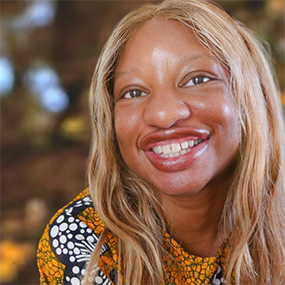
Jazzi Johnson
Managing Producer
Sam Johnson
Producer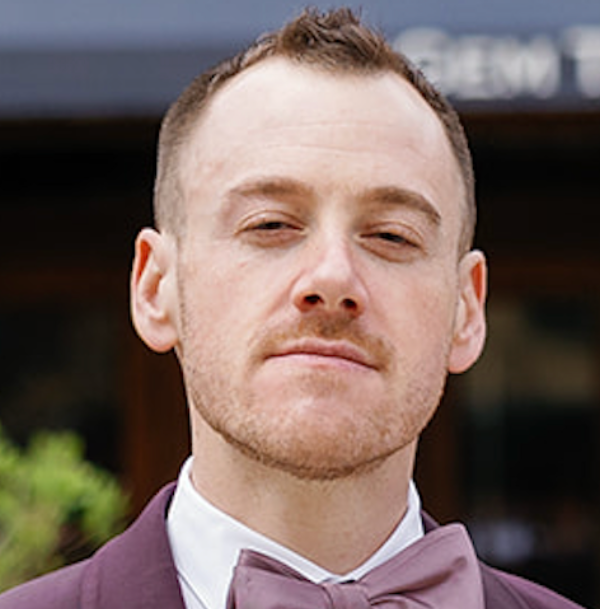
Josh Fisher
Producer
Conor Gearin
Fact Checker
Mark Bramhill
Senior Producer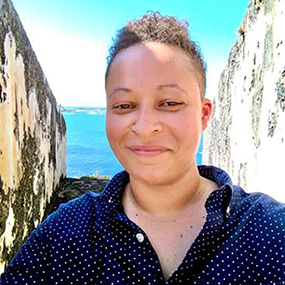
Jonese Franklin
Content Director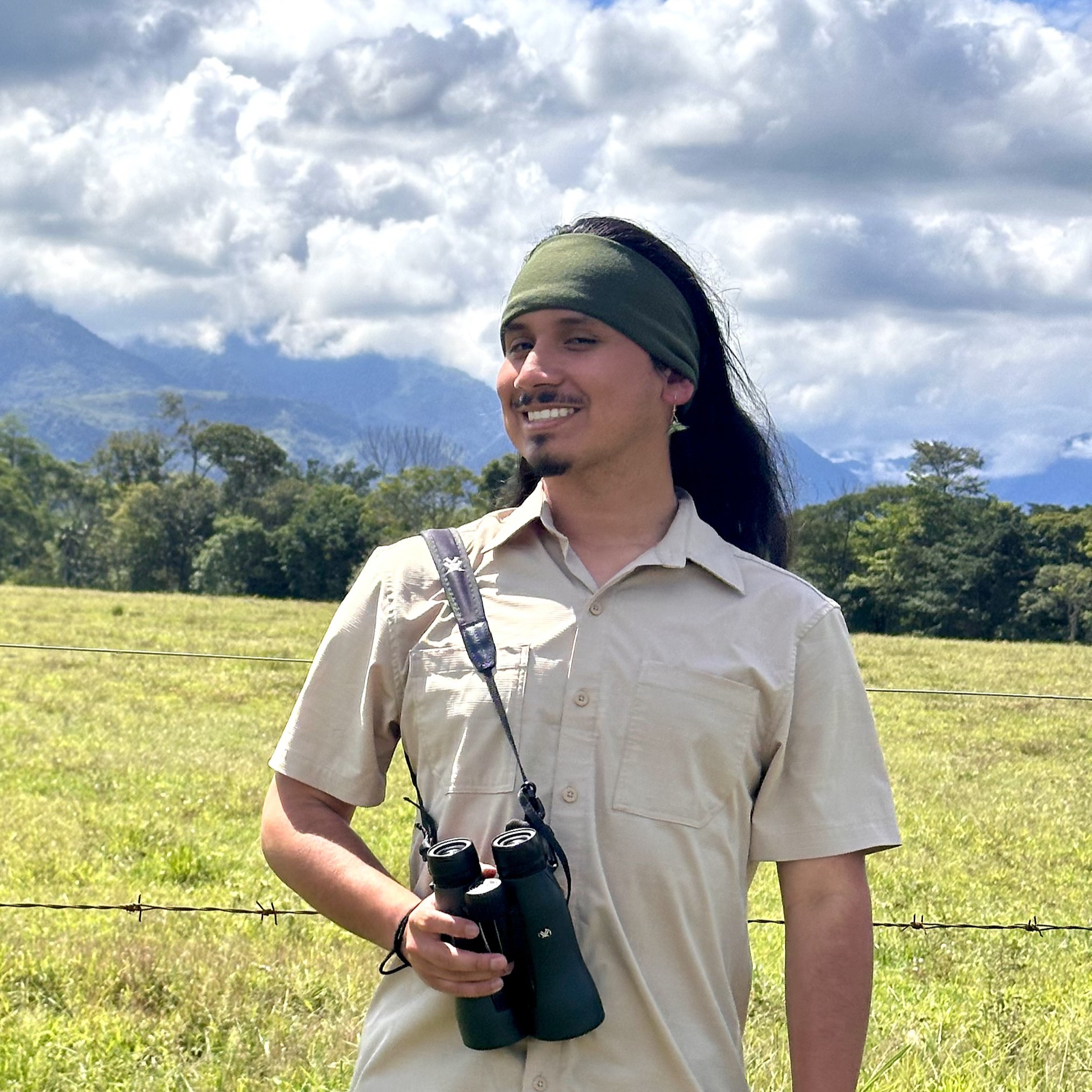
Em De Blas, C.I.G. (Certified Interpretive Guide)(they/he), is a birding leader in Chicagoland, but grew up in San Luis Potosí, México where they picked up a love for nature. They are an active board member of the Chicago Ornithological Society and an organizer for Chicago BIPOC Birders. In 2026, Em started Hummingbird a Day, a project dedicated to sharing the stories and lessons within hummingbirds for the learning, healing, and uplifting of BIPOC individuals.