
Join BirdNote tomorrow, November 30th!
Illustrator David Sibley and actor H. Jon Benjamin will face off in the bird illustration battle of the century during BirdNote's Year-end Celebration and Auction!

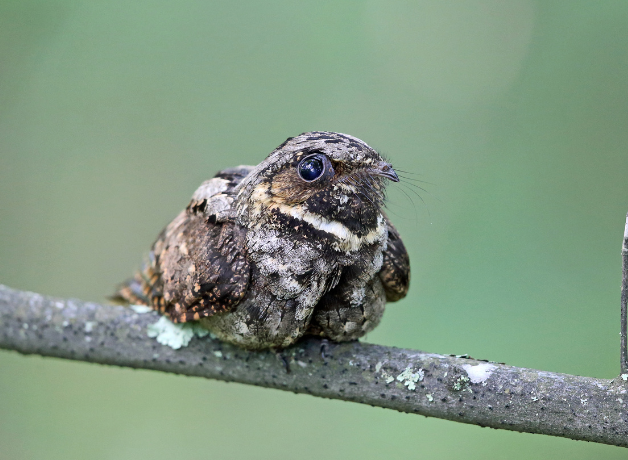

© Tom Murray
Near their frog-like mouths, Eastern Whip-poor-wills sport long, thin feathers that look a little like cat whiskers. Called rictal bristles, scientists are still investigating what these feathers do. They might help nocturnal birds sense air currents in dark environments, allowing them to orient themselves in three dimensions, dodge obstacles, and catch their prey. It’s also possible that whiskery bristles do different things for different birds!
BirdNote®
The Whip-poor-will’s Whiskers
Written by Conor Gearin
This is BirdNote.
[Eastern Whip-poor-will song and forest ambience]
When Eastern Whip-poor-wills sing, they say their name — whip-poor-will! whip-poor-will!
[Eastern Whip-poor-will song]
Whip-poor-wills belong to the nightjar family, a group of nocturnal birds that hunt flying insects. Sticking out beside the nightjars’ gaping mouths are long, thin feathers — kind of like a cat's whiskers. They’re called rictal bristles, and many other bird species have them, too.
[Eastern Whip-poor-will growl-cluck calls and wing noise]
Surprisingly, scientists still don't know exactly what rictal bristles do. It was long assumed the whiskers help birds sweep insects into their mouths when hunting prey on the wing. But when researchers used high-speed cameras to film flycatchers, well, catching flies, the birds didn’t appear to use the bristles that way at all.
Recent studies suggest that nocturnal birds use the sensitive bristles to feel air currents in the dark, not unlike an airplane's finely tuned instruments. Rictal bristles might make nightjars better hunters by helping orient themselves in three dimensions, especially near obstacles such as trees and rock walls.
It’s also possible that whiskery bristles do different things for different birds. We still have a lot to learn about the amazing adaptations found throughout the birds’ branch on the tree of life.
[Eastern Whip-poor-will song and forest ambience]
For BirdNote, I’m Mark Bramhill.
###
Senior Producer: Mark Bramhill
Producer: Sam Johnson
Managing Producer: Jazzi Johnson
Managing Producer: Ariana Remmel
Content Director: Jonese Franklin
Bird sounds provided by The Macaulay Library of Natural Sounds at the Cornell Lab of Ornithology, Ithaca, New York. Eastern Whip-poor-will [ML169843211] and [ML235705721] recorded by Wil Hershberger.
BirdNote’s theme was composed and played by Nancy Rumbel and John Kessler.
With thanks to Andrew Beckerle for this idea.
© 2026 BirdNote August 2026
Narrator: Mark Bramhill
ID# EWPW-02-2026-10-26 EWPW-02
References:
https://www.nature.com/articles/s41598-022-24781-7
https://ornithology.com/rictal-bristles/
https://sora.unm.edu/sites/default/files/journals/wilson/v084n02/p0193-p0197.pdf

Mark Bramhill
Narrator
Conor Gearin
Writer