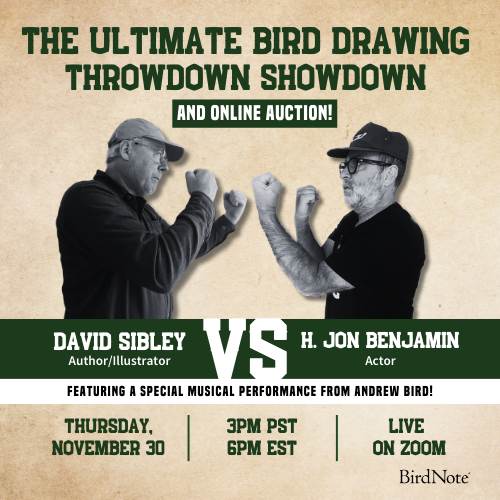
Image: The Ultimate Bird Drawing Throwdown Showdown Graphic featuring images of David Sibley and H. Jon Benjamin

Join BirdNote tomorrow, November 30th!

Illustrator David Sibley and actor H. Jon Benjamin will face off in the bird illustration battle of the century during BirdNote's Year-end Celebration and Auction!

RESERVE YOUR SPOT

Shows With Contributions by Ariana Remmel

A Long-eared Owl perched in a dry bush with their feathers all puffed up, looking cold and sleepy.

Owl Sounds with Becca Rowland

When author and illustrator Becca Rowland first started learning to identify bird calls, they were delighted to discover that owls say more than just ‘who’! In her new book Bird Talk: Hilariously Accurate Ways to Identify Birds by the Sounds They Make, Becca dedicates a whole chapter to…
A Flammulated Owl perches on a bare branch. The tiny raptor's feathers are brown and streaky with a few flecks of orange.

Quirky Words for Patterned Birds

Descriptive names can be a great help when you’re getting to know a new bird. Some species have common names that put their plumage pattern front and center – like the Five-striped Sparrow. If you encounter a bird described as flammulated, lineated, banded, or barred, keep an eye out for…
Three Least Auklets, dark gray and white seabirds, looking to viewers' right while sitting on rocks

Seabirds Thriving on Volcanic Slopes

In August 2008, Kasatochi Island erupted in the middle of auklet breeding season, burying tens of thousands of chicks in hot ash. At first, the auklets’ future on the island appeared bleak. But in just a few years, the birds had returned in force. Thousands nested within the innumerable…
A male Bufflehead duck floating on still water, with sunlight showing the "rainbow" iridescence look of his head feathers.

Seeing the Rainbow in a Bird’s Feathers

We make it a habit to detail the broad and beautiful spectrum of bird colors, but iridescent feathers are undoubtedly among the most mesmerizing. When sunlight hits the Bufflehead’s dark head feathers at the right angle, their colors transform into shades of the rainbow, from deep violet…
A brown and white woodpecker with a touch of red feathers atop his head clings to a vertical branch, and looks over his shoulder to the viewer's right.

Arizona Woodpecker and the Sierra Madre

Found in the Sierra Madre, the Arizona Woodpecker has a special connection to the mountain range. Sharing mid-elevation pine and oaks with fellow border straddlers, these small brown birds with white and brown cheeks stand out from other Woodpeckers with their heavily marked white…
Three Bar-tailed Godwits in flight moving toward viewer's left

Birds Crossing the Pacific

Over 12,000 miles across at its widest point, you might think the Pacific Ocean is a barrier that even high-flying birds can’t cross. Think again – some species make the trip every year as part of their life cycle. During the spring, Bar-tailed Godwits break up their trip from New Zealand…
A Chipping Sparrow perched on a branch. Viewed in profile, the bird's brown cap and black eye line are distinctive.

A Closer Look at Sparrows

At first glance, many of the sparrows in North America look pretty much the same: like small, drab-colored songbirds hanging out on the ground. But these “little brown jobs” can be fun to identify if you know what field marks to look for!
Un zorzal canelo perchando en una ramita.

Zorzalitos que predicen huracanes

En algunos años, unos zorzales canelos ( Catharus fuscescens), también llamados zorzalitos rojizos o colorados, acortan su temporada de reproducción. Los investigadores descubrieron que los zorzalitos canelos tienden a dejar de reproducirse antes de tiempo en los mismos años en que la…
Light brownish-red bird with its back to viewer, looking to its right

Migrations: Veeries Predict Hurricanes

In some years, tawny-colored thrushes called Veeries cut their breeding season short. Researchers discovered that Veeries tend to stop breeding early in the same years that the Atlantic hurricane season is particularly severe. Surprisingly, Veeries are sometimes better at predicting…