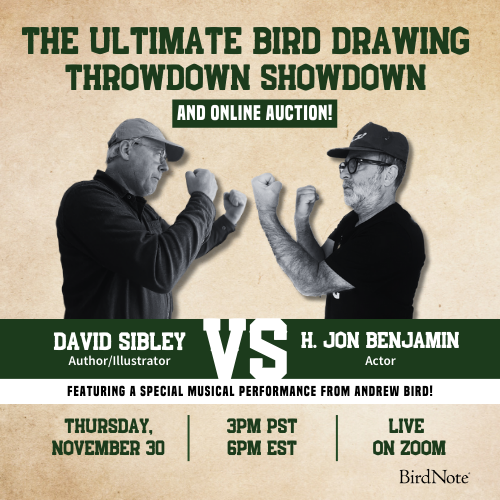
Image: The Ultimate Bird Drawing Throwdown Showdown Graphic featuring images of David Sibley and H. Jon Benjamin

Join BirdNote tomorrow, November 30th!

Illustrator David Sibley and actor H. Jon Benjamin will face off in the bird illustration battle of the century during BirdNote's Year-end Celebration and Auction!

RESERVE YOUR SPOT

Shows With Contributions by Michael Stein

A pigeon in close up looking at the viewer; it has a gray head with orange eyes, and iridescent green and purple feathers on its neck and breast.

A Pigeon-eyed View of the World

Pigeons — and other birds with eyes on the sides of their heads — have a different view of the world from that of creatures with forward-facing eyes. The images from a pigeon’s eyes overlap slightly, so the bird can see in front of itself, even though it has worse depth perception. But…
Wild Turkey

What's with the Wattles?

Birds like male turkeys or barnyard roosters have a wrinkly, bumpy flap of red skin called a wattle. But what are wattles for? Birds can’t sweat, so wattles help release excess heat. Wattles are also key to courtship displays. Many other birds, including some storks and plovers, also have…
Two tiny songbirds sit very close together on a branch. The female (to viewer’s left) is light brown and the male (to viewer’s right)

Fairy-Wrens - To Duel or Duet?

The Red-backed Fairy-Wren, a tiny songbird living in the Australian scrublands, is highly territorial and promiscuous. The male can’t be sure the eggs in his nest are his own. One way to help avoid this problem? The male may rough up a rival who approaches his territory. But research shows…
BirdNote narrator Michael Stein speaks before a microphone in a recording studio.

Behind the Scenes

It takes a lot to bring you the rich sounds of birds yodeling, cooing, and screeching to you each day. It's a meticulous process of researching, writing, fact-checking, editing, recording and sound design. That’s all done by our in-house production team! BirdNote is a non-profit…
A grey bird with black wings and black mask stripe across its eyes sits on a wire fence, and holding a small lizard in its beak

Loggerhead Shrike

Loggerhead Shrikes are found across much of the United States in open country, like pasture and sagebrush. Male shrikes are well known for impaling their prey on thorns, creating a larder that may help impress potential mates. But pesticides and the loss of habitat to residential and…
A tiny Costa's Hummingbird shows his iridescent purple head and throat feathers while perched on a twig

Decibels Per Gram

Some of the tiniest birds in the world have impressively loud voices. The Ruby-crowned Kinglet — that bright-headed sprite of the treetops — would be downright deafening if it were just a little bigger. Hummingbirds were originally named for the mechanical buzzing produced by their…
Cooper's Hawk splashing in a birdbath, its tail feathers raised and its chest feathers wet

Providing Water for Birds

From chickadees to Cooper’s Hawks, most birds love a good bath. Some birds get the fluids they need from their food, but many birds need a drink at least twice a day. Water is essential for birds, and supplying clean water for them to drink and bathe in is a great way to help maintain…
A brown-and-white striped hawk with long tail and wings outstretched in flight against a clear blue sky.

Urban Cooper's Hawks

Next time you’re in the city, look up. When pigeons are wheeling, you might just see a different bird in pursuit. The Cooper’s Hawk, once known as the “chicken hawk,” used to be in steep decline due to hunting and the effects of DDT on breeding. Today, it’s the most abundant of the bird…
Greater Roadrunner

Roadrunner

The Greater Roadrunner is a common species in the desert and brush country of the Southwest, but its full range reaches from California to western Louisiana. Its soft cooing voice hints at its connections to another bird: scientists group roadrunners with the cuckoos. Where to see a…
Surf Scoter

Surfing with Scoters

Surf Scoters are perfectly at home in the element they’re named for. They swim smack in the middle of what surfers call the impact zone: Just where the waves break with greatest violence. Why risk the harshest waves when there’s calmer water close by? Because the churning action of…