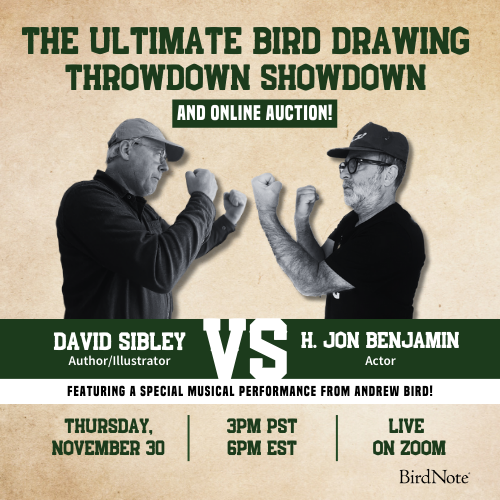
Image: The Ultimate Bird Drawing Throwdown Showdown Graphic featuring images of David Sibley and H. Jon Benjamin

Join BirdNote tomorrow, November 30th!

Illustrator David Sibley and actor H. Jon Benjamin will face off in the bird illustration battle of the century during BirdNote's Year-end Celebration and Auction!

RESERVE YOUR SPOT

Shows With Contributions by Bob Sundstrom

American Robins

A Bird in the Hand

You’ve probably heard the old saying: “A bird in the hand is worth two in the bush.” Well, it’s a very old saying, and it’s gone through some changes over the years. In each era, the pragmatic wisdom is clear: Hold on to the sure thing rather than taking a gamble on something better. The…
Red-ruffed Fruitcrow

February Summer in Argentina

In February, winter still holds sway over much of North America. But in Argentina, it’s summer, and birds are in full voice. Argentina’s national bird, the Rufous Hornero, belts out a rapid trill while the Rufous-bellied Thrush sings its lovely song. In the tropical forests of northeastern…
Pair of Sandhill Cranes in flight

To Breathe Like a Bird

Birds have a highly efficient breathing anatomy that powers the exertion of flight. It is driven by large, thin-walled air sacs located throughout the body cavity that operate like bellows. This parabronchial system for extracting oxygen from the air has a far greater surface area than the…
A Black Rail walking across a grassy area in sunlight, showing its dark plumage and bright red eye.

Conserving Wetlands for Black Rails

Black Rails are marsh-inhabiting birds, more often heard than seen. Many Black Rails nest in marshes along the Atlantic seaboard and in the Midwest. But in winter they concentrate in the coastal marshes of East Texas, Louisiana, and Florida, areas that face many threats. Sadly, according…
Photo comparing a House Finch on the left and a Purple Finch on the right

Voices and Vocabularies: House Finch or Purple Finch

In parts of the United States, House Finches overlap with similar-looking Purple Finches. Their distinct songs help us sort them out. House Finch songs are jumbled and have a sharp, buzzy note — especially during the breeding season. Purple Finches’ songs, on the other hand, are smoother…
A New Zealand Bellbird perched on a flowering branch, the bird's face lightly speckled with pollen and its red eyes shining

New Zealand Bellbird

A forest in New Zealand rings with the sound of bellbirds, also known as Korimako or Makomako. Many bellbirds sing together, especially in the morning. Pairs sing duets. And a pair may counter-sing with its neighbors, perhaps letting them know that this patch of land is taken. It all…
Male Belted Kingfisher facing the camera, his head turned to the left as he preens beneath his raised left wing.

Preening 101

If a bird’s feathers get too dried out, they become brittle. To prevent that from happening, most birds have a gland located above the base of the tail that produces oil. They use their beaks to massage oil from the gland into their feathers to keep them supple. A bird first grips a…
Broad-tailed hummingbird hovering while drinking nectar from a coral-colored blossom

The Heart of a Bird

Birds’ four-chambered hearts run larger than those of mammals, relative to body size, and they are coupled with extremely efficient cardiovascular systems. The energy demands of flight require these adaptations. An exercising human has a heart rate around 150 beats per minute. In contrast…
Magnificent Frigatebird with his red throat sac ballooned out with air

Magnificent Frigatebird Drum Roll

Magnificent Frigatebirds are huge, gangly seabirds found around the warm waters of the Western Hemisphere. When it comes time to mate, males inflate giant red throat sacs, then rattle and drum their bills against them to create jazzy percussive sounds.
American Robin with orange breast and dark brown head pulls a worm from a grassy area

The Early Bird

We've all heard that the early bird gets the worm. But research shows that birds dining early and heavily may lower their life expectancy. Socially dominant birds stay lean (and agile at avoiding predators) during the day, and then stoke up later, before a cold night. Subordinate birds…