

Join BirdNote tomorrow, November 30th!
Illustrator David Sibley and actor H. Jon Benjamin will face off in the bird illustration battle of the century during BirdNote's Year-end Celebration and Auction!
The New Jersey Pine Barrens
Why do they call such a rich habitat the "barrens"?

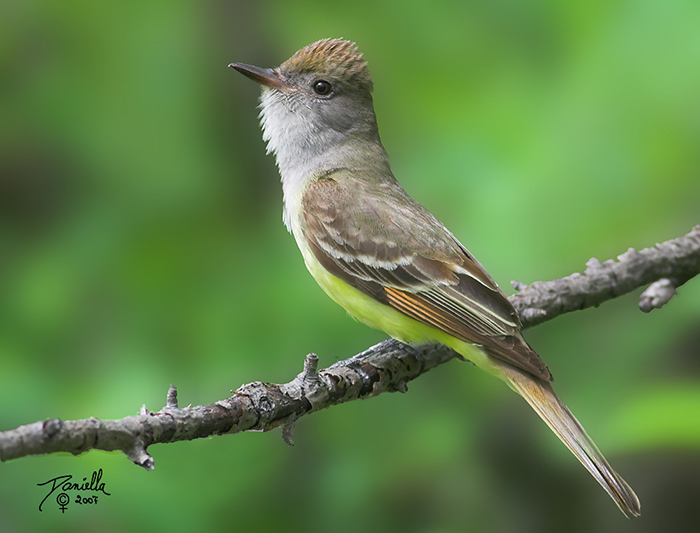
© Daniella Theoret
In southern New Jersey lies a region known as the Pine Barrens, home to many birds, including this Great Crested Flycatcher. With broad tracts of pine forest interspersed with grassland and shrubland, the Pine Barrens remain one of the largest expanses of green in the Northeast, supporting a diversity of plants and animals. Early European settlers tried farming here, but the sandy, acidic soil wasn’t suited to their traditional crops. Upland Sandpipers and Prairie Warblers nest here. Agricultural barrenness has saved the Pine Barrens and its native habitats. If its soils grew traditional crops, it would have – centuries ago – disappeared beneath the plow.
Today’s show brought to you by the Bobolink Foundation.
BirdNote®
The New Jersey Pine Barrens
Written by Bob Sundstrom
This is BirdNote.
[Song of Pine Warbler followed by song of Eastern Wood-Pewee]
Stretching across a good portion of southern New Jersey lies a region known as the Pine Barrens. With broad tracts of pine forest interspersed with grassland and shrubland, the Pine Barrens remain one of the largest expanses of green in the Northeast.
[Song of Eastern Wood-Pewee and song of Pine Warbler]
So why do we call so green a region a “Barrens”? Early European settlers tried farming here, but the sandy, acidic soil wasn’t suited to their traditional crops. Because the land proved unproductive for them, they called it barren. The name stuck.
Despite their gloomy name, the New Jersey Pine Barrens support a diversity of plants and animals. Bright yellow Prairie Warblers trill atop young pines [Prairie Warbler song]. Great Crested Flycatchers call out overhead [Great Crested Flycatcher calls]. Upland Sandpipers, a scarce and threatened species, nest in open grasslands.
For the Pine Barrens and its native habitats, agricultural barrenness has proven a saving grace. If its soils grew traditional crops, it would have – centuries ago – disappeared beneath the plow. [Prairie Warbler song]
Today’s show brought to you by the Bobolink Foundation. For BirdNote, I’m Michael Stein. [song of Pine Warbler]
###
Bird sounds provided by The Macaulay Library of Natural Sounds at the Cornell Lab of Ornithology, Ithaca, New York. Call of Great Crested Flycatcher 94314 recorded by W.L. Hershberger, song of Pine Warbler 107410 recorded by W.L. Hershberger; song of Eastern Wood-Pewee 73930 by G.A. Keller; song of Prairie Warbler [110248] by W.L. Hershberger.
Producer: John Kessler
Executive Producer: Chris Peterson
© 2014 Tune In to Nature.org June 2014/2021 Narrator: Michael Stein
ID# pinebarrens-01-2012-06-04
[Frequent low-intensity fires keep the Pine Barrens ecosystem healthy. Typical trees like pitch pine need these fires to reproduce, and fire helps preserve the open areas of grass and low-growing shrubs.]




Sights & Sounds


