


Join BirdNote tomorrow, November 30th!
Illustrator David Sibley and actor H. Jon Benjamin will face off in the bird illustration battle of the century during BirdNote's Year-end Celebration and Auction!

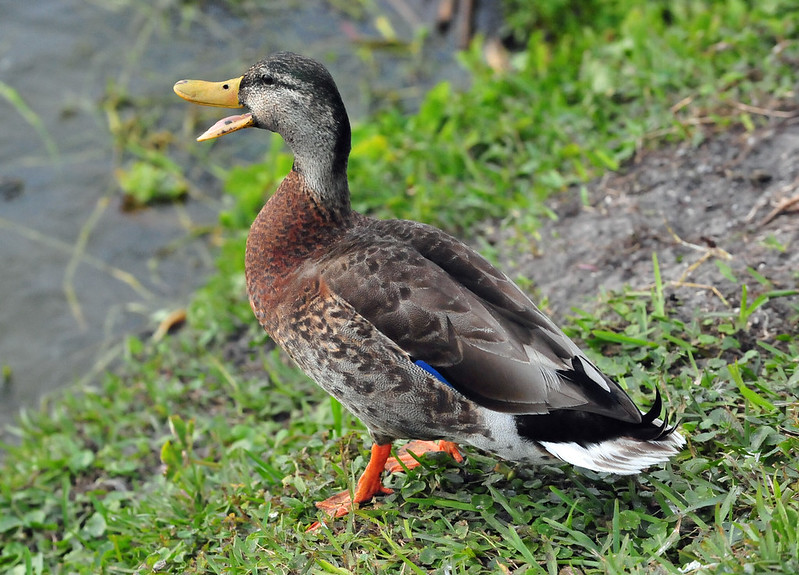

© Heather Paul
By late summer, the male Mallard’s need for fancy feathers to attract the females has passed. These birds have molted, and their bright feathers are replaced with mottled brown ones. Subdued colors help camouflage the male ducks, protecting them from predators. Come fall, the male Mallards will molt again and become the colorful dandies we remember.
Ducks Unlimited protects habitat for Mallards at all stages of their lives. Learn more below in Related Resources.
BirdNote®
Male Mallards Disappear
Revised from script written by Frances Wood
This is BirdNote.
[Mallards chattering at edge of water]
Ah, Mallards at your local pond… They’re our largest dabbling duck and among ducks, the most abundant species. They’re the source of all domestic ducks except the Muscovy. (muss-KO-vee) There’s a female making herself heard… [Female Mallard quacking]
But does it seem that all the brightly colored male Mallards have disappeared? By now, the male duck’s need for fancy feathers to attract the females has passed. The male Mallards have molted, dropping their bright green, reddish, black, and white feathers, and replacing them with mottled brown ones. Changing into more subdued colors for the months of summer, helps camouflage the male ducks, protecting them from predators. Come fall, the Mallards will molt again and return to the colorful dandies we remember.
In the meantime, while all the Mallards look like brownish females, there is one way to distinguish males from females. Look closely at the bill: the male’s bill is dull yellow, while the female’s is orange marked with black.
And watch to see which duck is quacking. [More female quacking]
That’s the female Mallard.
Male Mallards make a more subdued and raspy call, mostly when courting or greeting, or when they feel threatened.
For BirdNote I’m Mary McCann.
###
Calls of the Mallard provided by The Macaulay Library of Natural Sounds at the Cornell Lab of Ornithology, Ithaca, New York. Recorded by A.A. Allen
BirdNote’s theme music was composed and played by Nancy Rumbel and John Kessler.
Producer: John Kessler
Executive Producer: Chris Peterson
© 2015 Tune In to Nature.org August 2018 / 2020 / 2022 Narrator: Mary McCann
ID#080105MALLKPLU MALL-02b
Reference: “Mallard” by Drilling, Nancy, Rodger Titman and Frank McKinney, Birds of North America.

Frances Wood
Writer
Mary McCann
NarratorSights & Sounds


Related Field Notes

Living year round along the Pacific Coast of the US and into the Southwest, Anna's Hummingbirds a