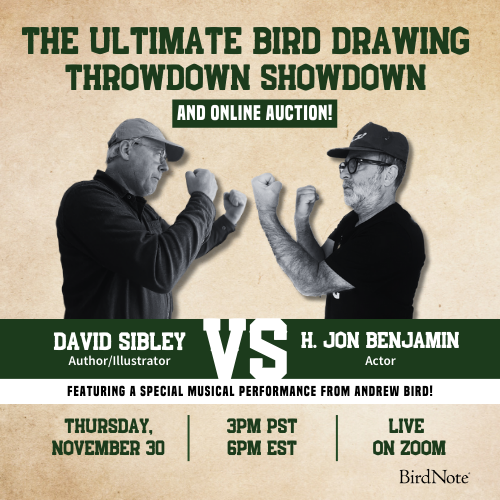
Join BirdNote tomorrow, November 30th!
Illustrator David Sibley and actor H. Jon Benjamin will face off in the bird illustration battle of the century during BirdNote's Year-end Celebration and Auction!
Bobolinks and Grasslands

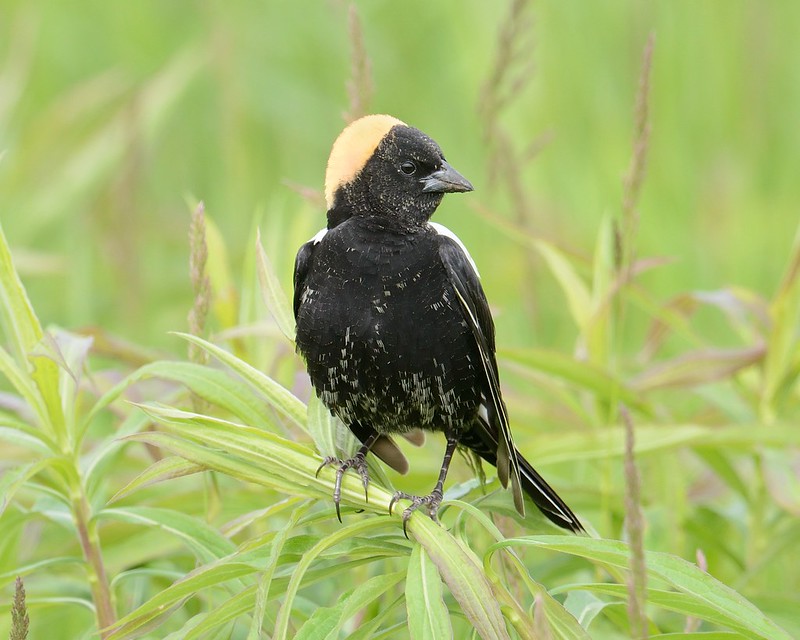
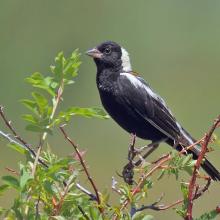
© Phil Hauck
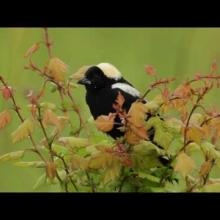
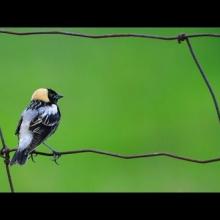
Male Bobolinks are first to arrive on their breeding grounds in the grasslands. Why are there fewer Bobolinks than in decades past? Probably because the landscape of North America has changed so much. Bobolinks originally nested on native prairies of the Midwest and southern Canada. Much of the land where they nested has come under intense cultivation. Grassland conservation can help Bobolinks!
BirdNote®
Bobolinks: Birds of Grasslands
Written by Todd Peterson
This is BirdNote!
[Grassland ambient featuring Bobolinks]
It’s early May and we’re standing in a large hay field in western New York State, where Bobolinks are returning to nest.
[Songs and calls of male Bobolinks – throughout show]
The males are first to arrive. Their black and white plumage makes them look, it's been said, as if “they’re wearing tuxedos backwards.” (1) In about a week, the females too will complete a round-trip journey of more than 12,000 miles from the pampas of Brazil and Argentina.
[Calls of male Bobolinks]
Why are there now so many fewer Bobolinks than in decades past? Probably because the landscape of North America has changed so much. Bobolinks originally nested on native prairies of the Midwest and southern Canada. When much of this grassland came under intense cultivation, they expanded their range eastward to hay fields and meadows.
Bobolinks like large, infrequently plowed fields that offer broad-leaved plants, under which the females build their nests directly on the ground. In the Northeast, there are fewer hay fields, and many have been converted to alfalfa, vegetation Bobolinks don’t normally use. Also, hay fields now are mowed earlier than they used to be (2) and the mowing coincides with the peak of Bobolink nesting.
[Sound of a combine]
Support for federal and local efforts that conserve grassland habitat can help these far-flying birds. Learn more at BirdNote.org. I'm Michael Stein.
[Song of Bobolink]
###
Song of the Bobolink provided by The Macaulay Library of Natural Sounds at the Cornell Lab of Ornithology, Ithaca, New York. Recorded by A. A. Allen. Grassland habitat recorded by W.L. Hershberger
Producer: John Kessler
Executive Producer: Chris Peterson
© 2014 Tune In to Nature.org May 2018/2020 Narrator: Michael Stein
ID #: SotB-BOBO-01
1&2. Martin, Stephen G. and Thomas A. Gavin. 1995. Bobolink. The Birds of North America Online. Ithaca: Cornell Lab of Ornithology. https://www.allaboutbirds.org/guide/Bobolink/?__hstc=161696355.6a9146f1f78e4c3ae8f7a905449fd330.1705614285853.1705725629102.1706306655644.3&__hssc=161696355.3.1706306655644&__hsfp=185005585&_gl=1*oejyyz*_ga*MTQ0OTE1MDk5NC4xNzA1NjE0Mjg1*_ga_QR4NVXZ8BM*MTcwNjMwNjY1NS40LjEuMTcwNjMwNzYwNi40My4wLjA.&_ga=2.23246450.953580970.1706306655-1449150994.1705614285


Sights & Sounds