
Image: The Ultimate Bird Drawing Throwdown Showdown Graphic featuring images of David Sibley and H. Jon Benjamin

Join BirdNote tomorrow, November 30th!

Illustrator David Sibley and actor H. Jon Benjamin will face off in the bird illustration battle of the century during BirdNote's Year-end Celebration and Auction!
RESERVE YOUR SPOT

Shows With Contributions by Michael Stein

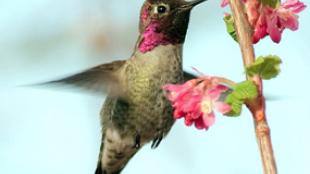
Anna's Hummingbird drinking from flower

A Natural Feast for Hummingbirds

Hoping to attract hummingbirds to your yard or balcony? One way is to grow native plants. Native plants provide cover, and they offer nectar in spring and summer. They also attract insects, the most important part of a hummingbird’s diet. Just add a source of water for drinking and bathing…
A flock of Red-billed Quelea densely bunched on leafy branches

The World's Most Abundant Bird

An estimated 1.5 billion Red-billed Quelea live in Africa today, making them the most abundant of all wild birds. The sparrow-sized Red-billed Quelea flock together in groups so large, from a distance they appear to be clouds of smoke. Red-billed Quelea are in the weaver family and create…
Male Lance-tailed Manakin, with black body and orange crest, perched on curved branch.

To Beta or Not to Beta

Male Lance-tailed Manakins pair up to perform choreographed courtship displays for females. Known as cooperative courtship, it involves one alpha male and one beta male, who are not closely related, working together to attract the female. While it might not seem like a good deal for the…
House Finch in spring

Birds Are Evolving Rapidly - Today

House Finches are evolving rapidly and visibly. In 1941, some captive House Finches from California escaped near NYC. They spread rapidly and are now found across most of the US. We know the finches have evolved, because those that survive differ from their parents. Size is one example…
A small brown bird with a white "eyebrow" streak and its beak open stands on a stump.

Voices and Vocabularies - How Birds Sing So Loudly

When a Carolina Wren like this one sings, something remarkable happens. These birds can sing so loudly that you almost have to shout to be heard over their songs! How can a bird like a Carolina Wren – at just 5½ inches long and weighing only as much as four nickels – produce so much sound…
Great Blue Heron standing alone on a dock

Great Blue Heron, Alone Again

Great Blue Herons nest in colonies, in adjoining trees or with several nests in one tree. But by autumn, the adults and gangly young have left the nests to take up solitary lives, a pattern that is the reverse of many other species. After all the "togetherness" of the nesting colonies, the…
Dried Tilapia on the shore of Salton Sea

Birds Winter at the Salton Sea

California's Salton Sea is hot and smelly - and it's also a Mecca for thousands of wintering birds. This inland sea formed when the Colorado River breached floodgates in 1905, forming a lake 45 miles long. The lake has diminished in size and greatly increased in salt concentration, but a…
Common Poorwill

Common Poorwills Can "Hibernate"

Common Poorwills don’t sing much when the mercury drops. But they can do something else that is remarkable. As the winter cold deepens, these petite members of the nightjar family can enter a hibernation-like state — and stay like that for hours — or even weeks! Scientists call it torpor…
King Penguins gleaming in sunlight as they stand in a group at the water's edge

King Penguins - World's Largest Kazoo Band

While it’s still winter in many parts of North America, it’s summer in Antarctica. And the King Penguins are singing! Some form breeding colonies that number in the tens of thousands. When many pairs of these colorful birds tip their heads back and sing, it sounds like the world’s largest…
Yellow-rumped Warbler

Yellow-rumped Warbler - The Winter Warbler

By winter, most warblers have migrated south. But the Yellow-rumped Warbler, which birders affectionately call “butterbutt” is a lesson in adaptation, notes Bryan Pfeiffer, a writer, naturalist, and educator who lives in Vermont. “In winter, when most of their kin are enjoying insects in…