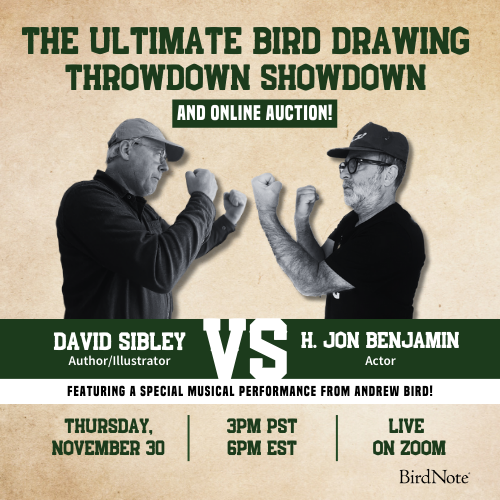
Image: The Ultimate Bird Drawing Throwdown Showdown Graphic featuring images of David Sibley and H. Jon Benjamin

Join BirdNote tomorrow, November 30th!

Illustrator David Sibley and actor H. Jon Benjamin will face off in the bird illustration battle of the century during BirdNote's Year-end Celebration and Auction!

RESERVE YOUR SPOT

Shows With Contributions by Mary McCann

Rose-breasted Grosbeak

Beaks and Grosbeaks

Beaks suited for opening tough, hard seeds — thick, conical beaks — evolved in more than one lineage of birds. Rose-breasted Grosbeaks are related to cardinals, which also have powerful beaks. Evening Grosbeaks belong to the finch family, which includes goldfinches and crossbills — an…
An Anna's Hummingbird sitting on a nest

Stand-still Birding

While full-speed-ahead birding can mean spotting a large number of species, there's quiet joy in stand-still birding. Pick a place-forest, field, or marsh. Find a seat that's dry, and hold your binoculars to your eyes. Be still and blend in. After perhaps 20 minutes, birds accept you as…
Fox Sparrow perched on a thorned branch in partial sunlight

Creating an Inviting Habitat

Bird feeders and birdbaths are great ways to attract birds to your yard, but they aren’t the only ways to entice our feathered friends. Planting an area densely with native shrubs, trees, and other vegetation can create a natural look that some birds are more likely to feel at home in…
Humboldt Penguin swimming below the water's surface

Why Are There Flightless Birds?

The ability to fly seems to define birds. But there are more than 50 species of flightless birds throughout the world — from the Ostrich and Kiwi to flightless rails, ducks, and this Humboldt Penguin. Why did they evolve the inability to fly? Many dwelt on islands. Others evolved until…
Chestnut-backed Chickadee perched on a branch in sunshine

Chickadee Line-up

Chickadees are tiny songbirds named for their characteristic song and there are seven species found in North America. You'll find the Black-capped Chickadee across the northern US into Canada. The Carolina Chickadee holds sway in the Southeast. Hear the husky voice of a Mountain Chickadee…
Red-breasted Sapsucker clinging to side of tree, the bark with small holes pecked in it

Sapsuckers

Sapsuckers drill small holes in the bark of favored trees, then return again and again to eat the sap that flows out. And hummingbirds, kinglets, and warblers come to the sap wells to eat the insects trapped in the sap. Although a sapsucker, like the Red-breasted Sapsucker pictured above…
Thick-billed Euphonia

Thick-billed Euphonia – Deceitful Mimic

Northern Mockingbirds can learn to mimic the sounds of just about any bird. They mimic to show off, not to deceive. But this Thick-billed Euphonia, a tiny songbird in South America, employs what scientists call “deceitful mimicry.” When frightened by a predator near its nest, a Thick…
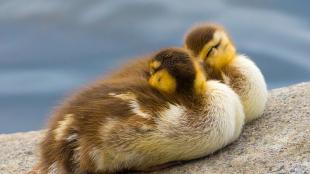
Two Mallard ducklings snoozing on a cement bank by the water, their beaks tucked beneath their wings

Where Birds Sleep

All birds need to sleep — or at least snooze — sometime during each 24-hour period. And most sleep at night. A bird, like a Mallard duckling, may turn its head around and warm its beak under its shoulder-feathers. Songbirds find a protected perch, sheltered from rain and nighttime…
Large Ground Finch

Darwin's Birds

The finches of the Galapagos Islands are famous in the history of evolutionary theory. But Charles Darwin spent four years studying other birds as well, as the Beagle circumnavigated southern South America before reaching the Galapagos in 1835. It was not just the birds, but a lifetime of…
A murmuration of starlings

Starlings and Roman Divination

European Starlings were present in great numbers in ancient Rome. They swarmed in massive flocks or murmurations — thousands of individuals cascading and folding in awe-inspiring geometric patterns in the sky. Roman augurs, or diviners, scrutinized these patterns for signs of how the gods…