
Image: The Ultimate Bird Drawing Throwdown Showdown Graphic featuring images of David Sibley and H. Jon Benjamin

Join BirdNote tomorrow, November 30th!

Illustrator David Sibley and actor H. Jon Benjamin will face off in the bird illustration battle of the century during BirdNote's Year-end Celebration and Auction!

RESERVE YOUR SPOT

Shows With Contributions by Mary McCann

Puffin with fish in its beak

All Those Fish in a Puffin's Beak

Puffins fly under water into schools of slender fish, filling their large beaks. Fish are wedged into the gape, the stretchy skin at the beak hinge, but the bill edges still line up neatly. The dangling fish won’t slide out because the puffin’s tongue and roof of the mouth are heavily…
Canvasbacks 2014-15 Duck Stamp artwork by Adam Grimm

Detroit River International Wildlife Refuge

The United States is home to more than 550 National Wildlife Refuges – havens for wildlife, including the Canvasback. But only one refuge can claim the distinction of being international: the Detroit River International Wildlife Refuge. It hosts millions of migratory ducks annually in the…
Rainbow Lorikeet foraging on flowers

Birds as Pollinators

Birds are part of the complex web of Nature, and each fits into this web in its own way. Some even pollinate flowers! While feeding at a flower, this Rainbow Lorikeet gets pollen on its forehead and throat. When it visits another flower of the same species, it transfers the pollen to that…
American Robin listening for worm under the ground

Does a Robin Hear Its Worm?

How does a robin know a worm is in one exact spot? Does it see the worm or hear it? Smell it? Sense its movements through its feet? To find the answer, researchers buried worms in soil in a tray. They covered the soil with a thin but opaque sheet of cardboard, followed by more soil, so the…
Pair of Wood Ducks

Wood Ducks Succeed

Your eye may be drawn to the gorgeous male Wood Duck, but it is the call of the modestly plumaged female you’ll hear. This call tells the male where his mate is, important as the pair stays together through much of the winter and spring. Wood Ducks are among a small number of North…
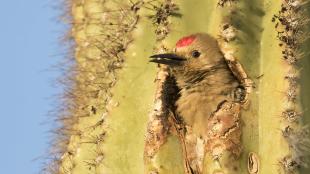
Gila Woodpecker nesting in Saguaro cactus

Making a Home Among the Saguaros

In the arid Arizona desert, where cacti thrive but trees are scarce, the Gila Woodpecker and Gilded Flicker carve out nest cavities in living saguaros. Tall, old saguaros may be pocked with twenty or more nest holes, bearing witness to decades of woodpecker families. The woodpeckers…
Bar-tailed Godwit flock

Precision Flight in Flocks: How Does It Work?

A flock of shorebirds flying wingtip to wingtip seems to act like a single organism, rolling and twisting in exquisite patterns. Flocks like these use a combination of two organizational patterns. One is a “cluster”: lots of birds flying together in a loose, three-dimensional cloud. The…
Blue-gray Gnatcatcher

Blue-gray Gnatcatcher: Little Bird with a Big Story

The slim, 4½-inch Blue-gray Gnatcatcher is found over much of the East and Midwest and in parts of the West, too. It actively searches trees and bushes for small bugs to eat, often hovering briefly and flaring a long black-and-white tail. ¡Escuche este episodio en español!
Black-necked Stilt foraging

Black-necked Stilt - The Bird with Outrageous Legs

Visit a shallow wetland in summer, and you might see this slender, black-and-white shorebird with outrageous red legs. The Black-necked Stilt uses its long legs for wading as it feeds on tiny insects and crustaceans on the surface of the water. Stilts are sensitive to drought, which has…
Long-billed Curlew standing in a grassy field

Shorebirds Aren't Always on the Shore

Shorebirds' lives take them to many places other than the shore. Most of the shorebirds we see along our coasts migrate to the Arctic in summer. Here, many nest on the tundra, some along rushing streams, and others on rocky mountainsides. Long-billed Curlews winter on the Florida, Gulf…