
endangered species

Northern Spotted Owl II

The plight of the gravely endangered Spotted Owl illustrates the imperiled status of old-growth forest in the Pacific Northwest. More than 90% of that forest is gone, a percentage that dwarfs even the worldwide loss of tropical forests and wetlands. Spotted Owls rely on those ancient trees -... read more »

RELATED

White-throated Swifts

A pair of White-throated Swifts twists and turns, sailing through the air. Dashing headlong across the canyon toward an unyielding wall, the birds disappear at the last second into a slender crevice. This swift is aptly named - and doubly so. The White-throated Swift is among the fastest of all... read more »

RELATED
Topics & Themes:  flight

Henry David Thoreau and the Wood Thrush

In June 1853, Thoreau wrote of an enchanting encounter with the Wood Thrush: "This is the only bird whose note affects me like music. It lifts and exhilarates me. It is inspiring. It changes all hours to an eternal morning." Wood Thrushes thrive in large expanses of forest. And their numbers have... read more »

RELATED
Topics & Themes:  migration, vocalization

Southwestern Willow Flycatcher

Willow Flycatchers nest across the northern two-thirds of the U.S. and southernmost Canada. A subspecies, known as the Southwestern Willow Flycatcher, nests in the Southwest, as far east as Texas. The Southwestern Willow Flycatcher was listed as endangered in 1995. It's just one of 300 bird... read more »

RELATED
Topics & Themes:  migration

Wilson's Phalarope

If any bird is an anomaly, it's the Wilson's Phalarope. In a birdbook, Wilson's Phalaropes are found among the sandpipers. But they forage while swimming. Spinning like tops, they create an upwelling, pulling food to the surface. The breeding of Wilson's Phalaropes is anomalous, too. Females are... read more »

RELATED
Topics & Themes:  breeding display, migration

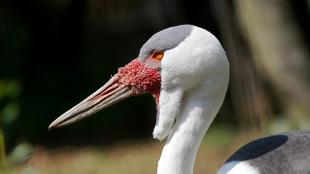
The Lobstick Family of Whooping Cranes

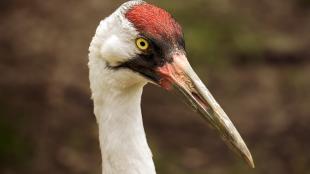
The celebrities of the Whooping Crane world have to be the Lobstick family, named for the Lobstick marshes where they nest in Canada. The Lobstick male, at 33, is the oldest Whooping Crane in the wild whose age we know for certain. And Tom Stehn of the US Fish and Wildlife Service tells us the... read more »

RELATED
Topics & Themes:  migration

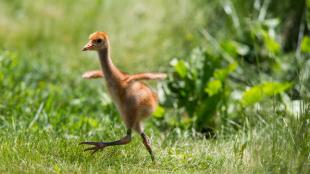
Operation Migration Update

Unlike many other birds that have an inherent sense of direction and destination, young Whooping Cranes have to learn their migration route from the adults. Enter Operation Migration and ultralight aircraft to lead them on their journey! Fortunately, the young cranes need to be shown the way only... read more »

RELATED
Topics & Themes:  migration

Aggressive Warblers and Climate Change

The territories of Townsend's Warblers and Hermit Warblers overlap in Washington State. Ornithologists call the overlap where the two species interbreed a "hybrid zone." The hybrids - like the one seen here - reveal characteristics of both. And they may also lend clues about our changing climate.... read more »

RELATED
Topics & Themes:  science

Osprey Return to Pennsylvania - Interview with Larry Rymon

Ospreys, common along the rivers of Pennsylvania, stopped nesting there in the 1950s, due to the effects of DDT. But in 1980, Larry Rymon, a professor of biology, began to restore Ospreys to Pennsylvania. Larry says: "Osprey have been a part of this planet's wildlife for 17 million years. They... read more »

RELATED
Topics & Themes:  nesting, science

Olive-Sided Flycatcher - Preserving a Unique Voice

These days we're hearing the song of the Olive-sided Flycatcher less often. Clear-cutting and fire suppression in forests, along with acid rain, has reduced its available habitat. Pesticides affect the supply of food. American Bird Conservancy has named it a priority species for conservation.... read more »

RELATED
Topics & Themes:  migration, vocalization

Pages