


Join BirdNote tomorrow, November 30th!
Illustrator David Sibley and actor H. Jon Benjamin will face off in the bird illustration battle of the century during BirdNote's Year-end Celebration and Auction!

It’s nesting season again, and that coincides with Mother’s Day. Pretty soon we’ll be seeing birds feeding young. Are they all mother birds? What are the males doing all this time? You might be surprised!
One of the most common misconceptions among people watching birds is that parental care is furnished only by females. “Look at that robin feeding her young” is frequently heard at this time of year, or “Let’s not scare the Killdeer off her nest.” Well, it’s time to squelch another stereotype. Both of those statements are likely to be wrong about half the time!
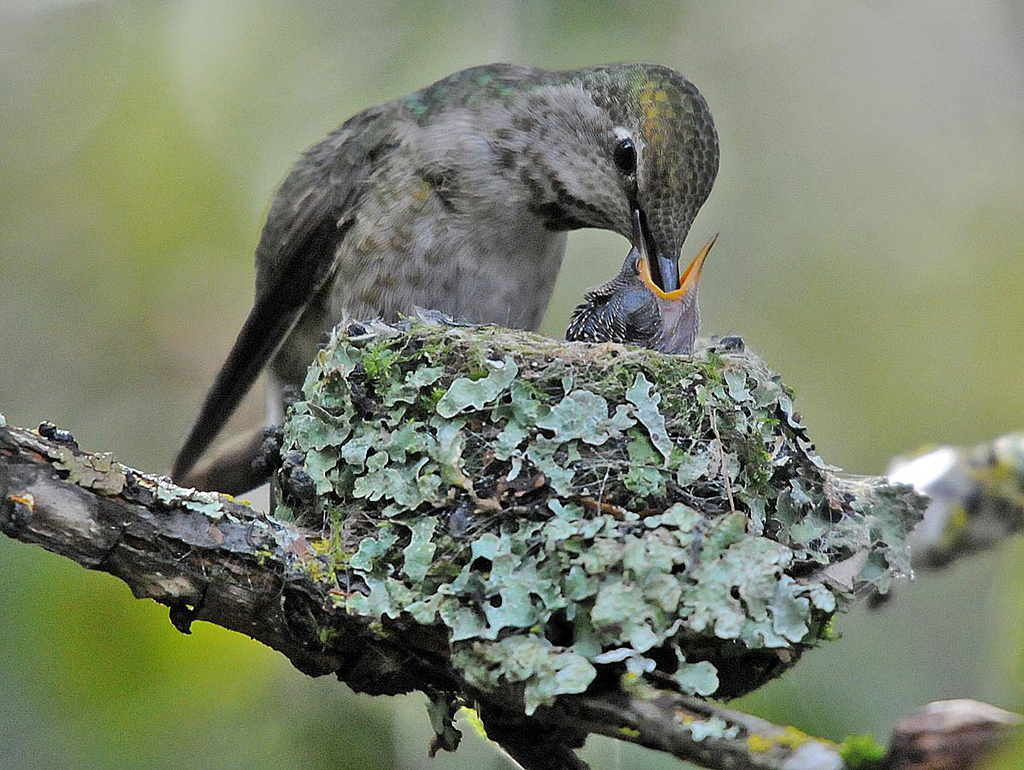
Only female birds can lay eggs; they’ve got that aspect of parental care patented. But from that point on, anything is possible. Male birds make nests, incubate eggs, and brood and feed young. In other words, they furnish all types of parental care. But male and female parental care are differentially distributed in the avian world.
Let’s start off with our familiar songbirds, or passerines – members of the bird order Passeriformes. Typically, the female builds the nest (with male help in a wide variety of species) and incubates the eggs. But once the eggs hatch, the male and female together feed the young until (and often after) they leave the nest.
By working together, birds can raise more young than if only one sex provided parental care.
The fact that both sexes, by working together, can raise more young than if only one sex provided parental care is what has led to a monogamous mating system in the majority of birds. In some birds, males may mate with more than one female, and in some of these polygynous species, for example Red-winged and Yellow-headed Blackbirds, the male may contribute little or no parental care.
How about other birds? In hawks and owls, both sexes construct the nest, and the female incubates, but the male feeds her throughout that period. Shortly after the eggs hatch, both sexes participate fully in feeding the young. In ducks, chicken-like birds, and hummingbirds, the female provides all parental care – making the nest, incubating the eggs, and taking care of the young. Recall that the young feed themselves in the first two groups, thus making male parental care less important.
But in just about all other North American birds, both sexes build the nest, take turns incubating the eggs, and cooperate in feeding the young. In some groups, including shorebirds, gulls, and terns, the male may actually provide more parental care than the female, who has exhausted some of her resources while laying the eggs.
It’s time to recall that there is also a Father’s Day!