
You are here

Bobolink (Dolichonyx oryzivorus)

Related shows:

Bobolinks

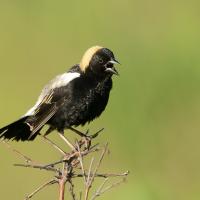
Washington Irving called the Bobolink "the happiest bird of our spring...he rises and sinks with the breeze, pours forth a succession of rich tinkling notes ..." Bobolinks nest in hayfields and grasslands, returning north each spring, all the way from southern South America. Listen to more songs... read more »

RELATED
Topics & Themes:  breeding display, vocalization

Bobolink Migration

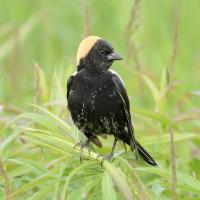
When Bobolinks return to North America from the tropics each spring, they have completed one of the longest migrations of any songbird in the Americas: roughly 6,000 miles-all the way from northern Argentina to the northern states and Canada. You can learn more about the Bobolink's migration in... read more »

RELATED
Topics & Themes:  migration

Bobolinks and Grasslands

Male Bobolinks are first to arrive on their breeding grounds in the grasslands. Why are there fewer Bobolinks than in decades past? Probably because the landscape of North America has changed so much. Bobolinks originally nested on native prairies of the Midwest and southern Canada. Much of the... read more »

RELATED

The Bubbly Bobolink

Washington Irving called the Bobolink "the happiest bird of our spring." Emily Dickinson called the Bobolink "the rowdy of the meadow" for its bubbly, jangling song. Bobolinks have declined, due to the loss of grasslands. Farmers who delay mowing their hayfields until mid-summer or later - after... read more »

RELATED
Topics & Themes:  migration

Navigating by Earth's Magnetic Field

How do birds navigate? They steer by landmarks and by the sun and stars. A keen sense of smell helps some birds chart their course. And, it turns out, migrating birds also find their way by responding to the magnetic field of the earth. Iron-rich magnetic crystals inside the upper beak of this... read more »

RELATED
Topics & Themes:  migration, science