
You are here

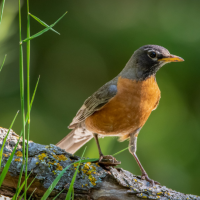
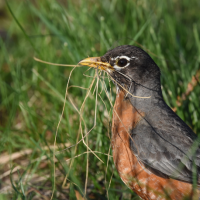
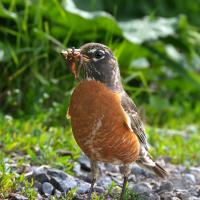
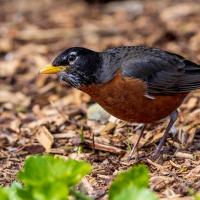
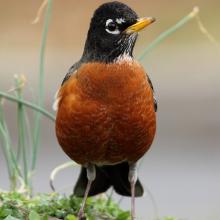
American Robin (Turdus migratorius)

Related shows:

Cheery American Robin

What was the first bird you noticed as a child? Perhaps you heard the cheery song of the American Robin coming from the top of a nearby tree. Or maybe you saw a robin running and pausing on the lawn, cocking its head before extracting a fat, juicy worm from the ground. The robin is often the... read more »

RELATED

American Robin, Valiant Challenger

The male American Robin - fiercely territorial - belts out its distinctive cheery song to defend its breeding territory from invasion by other robins. Sometimes, the robin sees its own reflection as an interloper and challenges the “invader” over and over, even to the point of exhaustion or... read more »

RELATED

American Robin Babies Afoot

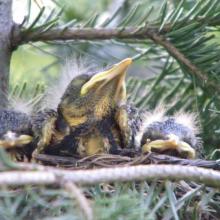
After hatching, baby robins spend up to 15 days in the nest. By July, many young American Robins have left the nest, or fledged. But they aren't ready to make it entirely on their own yet, and follow their parents around, learning to fend for themselves. Outside of the breeding season, robins... read more »

RELATED
Topics & Themes:  nesting

Is It the Same Robin?

Autumn brings robins to feed on tree fruit and berries. Are the robins you see now the same robins that you saw in your garden last summer? Some robins do remain year 'round. Others spend only the winter, having nested farther north. John James Audubon may have been the first to band birds, in... read more »

RELATED
Topics & Themes:  migration, nesting

How the Robin Got Its Name

When English settlers in the New World encountered the American Robin, they saw in it a reflection of the bird they knew as the Robin in the old country. So they called this one a robin, too. Today the American and British Ornithological Unions together determine how a bird is named. For a... read more »

RELATED
Topics & Themes:  ornithology

Why Robin Has a Red Breast

According to the Suquamish story, many years ago, South Wind blew hot and long. The animals banded together and found the source of the wind - a fortress atop a rocky mountain. At night, the animals crept into the fortress and vanquished the men who protected the South Wind. Afterward, the... read more »

RELATED
Topics & Themes:  myth

Evening's Last Singer

After sunset, the American Robin sings faster and more elaborate versions of his daytime songs. Some birds have more than 100 songs! They time their singing to the intensity of light as well as to the time of sunset. When dark clouds roll in, they get rolling earlier. Males sing mainly to attract... read more »

RELATED
Topics & Themes:  vocalization

First Songster of the Day

Why do birds start their songs so early in the morning? Many are announcing that they've made it through the night. Some males grab the first opportunity to remind others of their territories and to fend off other males. Certain migratory males signal their location and availability to females... read more »

RELATED
Topics & Themes:  vocalization

Robins and Berries in Winter

It's mid-winter, and a passing flock of robins suddenly drops out of the sky. A moment ago, the yard was empty of birds, but now it's full. They settle in a bush laden with fruits. When the robins pass over a fruiting shrub, those red berries signal like a neon sign on a restaurant. Time to stop... read more »

RELATED

How Long Does a Robin Live

Mortality rate is high in our familiar songbirds. For robins, it's around 50% each year once young birds have fledged. If a robin survives to midwinter, it lives an average of 1.7 years after that. The oldest robins in your yard might be about six years old, although one banded bird lived almost... read more »

RELATED

Angry Birds

Every day, nearly 3.5 million hours are spent playing Rovio's award-winning game, "Angry Birds." We don't know of too many birds whose eggs are stolen by pigs, but no bird is happy when its eggs are stolen. You might hear an American Robin, sounding its alarm. An angry Peregrine Falcon protects... read more »

RELATED
Topics & Themes:  humor

Anting: Avian Spa Treatment?

On a warm, sunny day, an American Robin flops on the ground, wings outstretched and tail splayed behind. The robin sits astride an anthill, and the ants are swarming over its body! This is called "anting," and probably has to do with transferring the ants' formic acid to the bird's body. This... read more »

RELATED

Baby Birds Move Out of the Nest

After they leave the nest but before they take flight, many baby birds - especially robins and flickers - spend time on or near the ground. If you see such a baby bird, and your first thought is to "rescue" it, the better thing to do is let it be. Protect it from cats. Then watch from a distance,... read more »

RELATED
Topics & Themes:  nesting, rehabilitation

Birding without Sight

It can be difficult to identify a bird by its appearance, and just as challenging to do so by its song. But birding by ear is a great way to get to know birds. A blind birder in Kitsap County, Washington, was puzzled by a haunting bird song. She thought it might be a special song of the American... read more »

RELATED
Topics & Themes:  birdwatching by ear

John Burroughs II

John Burroughs, one of the masters of American nature writing, wrote "The birds do indeed begin with the day. The farmer who is in the field at work while he can yet see stars catches their first matin hymns. In the longest June days the robin strikes up about half past three o'clock..."... read more »

RELATED
Topics & Themes:  vocalization

The Early Bird

We've all heard that the early bird gets the worm. But research shows that birds dining early and heavily may lower their life expectancy. Socially dominant birds stay lean (and agile at avoiding predators) during the day, and then stoke up later, before a cold night. Subordinate birds have to... read more »

RELATED
Topics & Themes:  science

Birds and Berries

Henry David Thoreau wrote, "Our little mountain-ash is all alive with [birds.] A dozen robins on it at once ... plucking the berries... A robin will swallow half a dozen berries, at least, in rapid succession..." If you, too, enjoy watching birds eat berries, then consider planting trees and... read more »

RELATED
Topics & Themes:  gardening

Nesting Niches

American Robins (like this male seen here with its young), House Finches, and Song Sparrows may all nest within one small garden. By selecting different nesting strata, the species avoid competing for the same nesting sites. If you plant your garden in multiple layers – trees both short and tall,... read more »

RELATED
Topics & Themes:  gardening, nesting

Nest Building

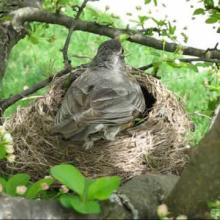
Want to try building a nest? Consider this... An average American Robin weighs less than three ounces. An average person weighs 170 pounds, or 1,000 times as much as a robin. A robin's nest, made of grass and mud, weighs about seven ounces, so yours will weigh 450 pounds. You'll need to collect... read more »

RELATED
Topics & Themes:  nesting

Another BirdNote Quiz

This quiz features - an American Robin ...- an Olive-sided Flycatcher, like this one ... - a Red-tailed Hawk ...- a Steller's Jay, which you're most likely to hear west of the Rockies ... - and a Blue Jay, usually seen east of the Rockies. read more »

RELATED
Topics & Themes:  birdwatching

Shakespeare's Birthday

April 23 is the birthday of William Shakespeare. Mr. Shakespeare was pretty well acquainted with-among one or two other things-birds. More than forty strut, twitter, shriek, sing, and soar through his works. But the bird he knew as a Robin Redbreast is not the bird we call a "robin" in the United... read more »

RELATED
Topics & Themes:  history

Early Spring Songs (Washington State)

In March, we welcome the lengthening days and the renewal of bird song. Among the earliest spring singers in the Northwest is this House Finch, whose sweet, jumbled song carries along city blocks and rocky canyons. And spring songs are breaking out all over the country. Listen to the song of the... read more »

RELATED
Topics & Themes:  migration, vocalization

Early Spring Songs (SE Alaska)

In March, we welcome the lengthening days and the renewal of bird song. Among the earliest spring singers in the SE Alaska are American Dipper (left), American Robin, and American Tree Sparrow. Listen to the songs of these early spring songsters and thousands of others at Cornell University's... read more »

RELATED
Topics & Themes:  migration, vocalization

Early Spring Songs (Bay-area, California version)

In March, we welcome the lengthening days and the renewal of bird song. Among the earliest spring singers in California are American Robin (left), Fox Sparrow, and Wrentit. Listen to the songs of these birds, plus thousands of others at Cornell University's Macaulay Library website. Learn more... read more »

RELATED
Topics & Themes:  migration, vocalization

Helping Birds Survive Window Strikes

A hawk dives into your yard, and a frightened robin slams against a window, mistaking the transparent rectangle for an escape route. But you can help. Fold its wings gently over its body in their natural position, grasp the bird lightly, and wrap it loosely several times in the towel. Keep the... read more »

RELATED
Topics & Themes:  rehabilitation

American Robins Are Exceptional Singers

As singers go, American Robins are exceptional. They’re often the first birds to sing in the morning, and the last you’ll hear in the evening. While their average song strings fewer than a dozen short phrases together and lasts only a few seconds, robins sometimes sing for minutes without a pause... read more »

RELATED
Topics & Themes:  sound

Voices and Vocabularies - Robin's Evening Song

During the day, an American Robin, a member of the thrush family, sings a lovely, familiar song of rich phrases. But as the sun begins to set, robin song takes on a different character. From sunset until dark, a robin adds ethereal whispered notes to its carol, creating a song of remarkable grace... read more »

RELATED
Topics & Themes:  sound, vocalization